
Immediate Futures: The Framework for Acting on What’s Already Arriving
Most futures thinking tells you what might happen. Immediate Futures tells you what is already happening, and what you can do about it now, before the window closes.
Most futures thinking tells you what might happen. Immediate Futures tells you what is already happening, and what you can do about it now, before the window closes.
Most organisations respond well to the first wave of any change. It is the third wave, the one they did not see coming, that reshapes everything.
Most organisations are approaching AI adoption backwards, automating first and asking the strategic question later. The HUMAND framework is the tool for asking it right.
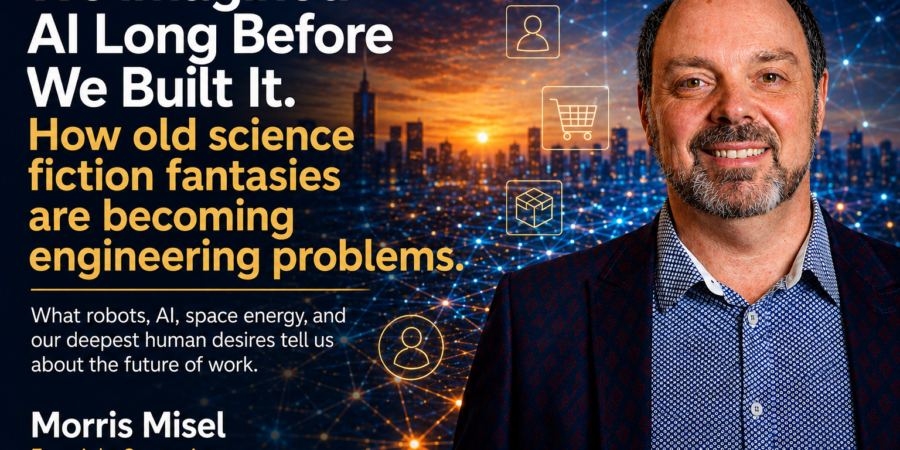
Old sci-fi got the details wrong, but the cravings right. In this new article, Morris Misel unpacks how AI is helping turn fantasy into engineering, why humanoid robots like Optimus matter, and what these signals tell us about the future of work, energy, and human-machine collaboration.
If you want to see where the next 12 to 24 months are heading, don’t start with AI. Start with where serious money is being placed inside the machinery of business. Morris Misel interprets the Forbes Fintech 50 as a signal map showing how enterprise financial systems, embedded finance, identity verification and fraud prevention are quietly reshaping the foundations of business.
Technology isn’t arriving as spectacle anymore. It’s arriving closer to our bodies, our thinking, and our decisions. In this reflective piece, Morris Misel explores what’s really changing in 2026, why it feels heavier for leaders, and how to prepare without relying on prediction.
