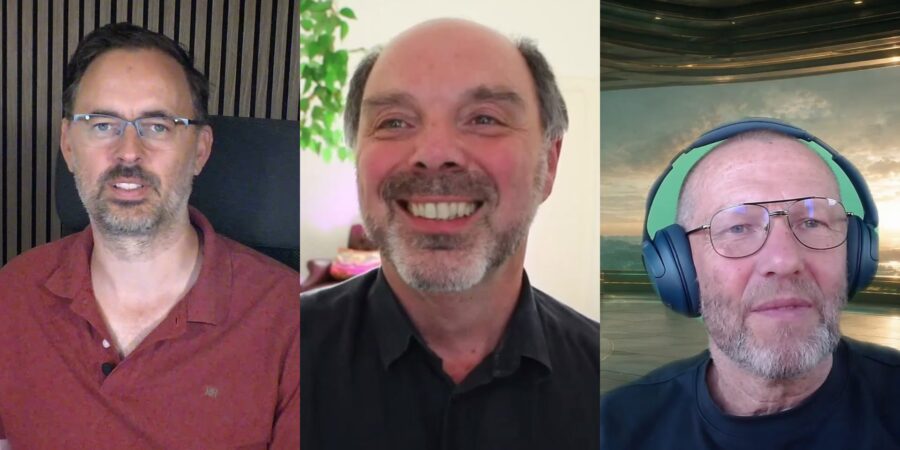
Will AI Become as Ordinary as Electricity? My Chat on AI Business Flywheel
In October I joined Duncan Isaksen-Loxton and Joe Bonington from SixFive for their AI Business Flywheel podcast, and Episode 16 went live on 5 November. It’s a show for small business owners trying to work out what AI means for them, so I’ve put all the links here, with the bits I think are worth your time.
You can watch it on YouTube, listen on Spotify or listen on Apple Podcasts.
Key points
- The background of AI will become as ordinary as electricity and gas.
- Break work into tasks and ask who each one is best done by: a person, a machine or AI, or a mix.
- Run your life like a solopreneur, with income likely from more than one place.
- The AI bubble, in Morris's view (never financial advice), comes in waves: deep, sharp and quick to recover.
- What we pay people for now is wisdom: the accountant who tells you how the world reads your figures.
The background of AI will become boring
Joe opened by asking whether there’ll be a day when AI becomes boring, and I think the background of it will. “Joe, how many of us really think about electricity before we put the light switch on?”
When electricity and gas first came into our homes, the newspapers rallied against them and plenty of grandparents thought the world was going downhill, and these days none of us think twice about either of them.
Anything new is extraordinary for a while. When I take my grandchildren into a lolly shop they don’t know where to start, and after a few lollies they’re kind of over it.
Joe asked why so many Australians are fearful of AI. The fear makes sense to me, because we’re wired to be wary of anything we don’t know enough about yet, and AI, to me, “is no more than a hammer or a screwdriver. It’s a useful tool in useful hands.”
Will AI ever become boring? From 10:17 in.
How I found my way into this work
Duncan asked how I’d ended up doing what I do. If I tell my story looking back it sounds like a straight line, but living it forwards it was a mess, and I loved every minute of it.
Straight after school I started delivering leaflets into letterboxes, and within about three hours I’d had enough, so I got my mates to do it and took a cut, and eventually that became a business.
When I sold it my clients kept coming back to me. They didn’t want the leaflets. They wanted to know where to put them, what their customers would be buying, and what’s different about a Thursday from a Tuesday, because it might be pension week.
What they were really after was strategy, and I didn’t even know what the word meant. Over the years that interest in what the world will look like turned into my practice. “I don’t do predictions… but I do a hell of a lot of preparation.”
How I got into this work, from 14:18 in.
Knowledge, intellect and wisdom
Duncan asked whether AI will make our kids dumber, and I think it’s the opposite. “I think kids are going to be wickedly successful in a way that we’ve never been able to before,” and for the first time in my career I’d like to start over.
For 250 years we’ve had to carry the whole library in our heads to make a living, and AI lets us put some of that down, the same way I no longer remember my wife’s phone number, which 15 years ago she’d have had a few words to say about.
I’m not a fan of the word intelligence for what AI does. The internet gave us data and then knowledge, and AI turns it into something that sounds like what I’d know, which I call intellect, and it’s wildly intellectual, but I want a line between people and machines, and the line for me is wisdom.
Data, knowledge, intellect and wisdom, from 17:30 in.
Run your life like a solopreneur
Joe has two daughters at university, one finishing a degree and one just starting, so he asked what I’d tell people their age. My first bit of advice is to forget the word career, because it talks about a straight path, and you won’t have one.
The second is to become a solopreneur. I’d want you to look at yourself as the CEO of your own life, because most likely you’ll earn from more than one place, often at the same time.
I’d also want you looking for the place where what you love and what you’re good at overlap, because having that direction, a North Star, is vital, and being happy to go with the flow, because life’s going to change on you whatever you plan.
Why the next generation should think like solopreneurs, from 22:10 in.
Will the AI bubble burst?
Joe asked what happens after a bubble like this one bursts, since with the railways the real take-up came afterwards. I don’t give financial advice, but I do have an opinion.
The selling that makes a crash used to be done by people, and now AI can do it at speed, so I think we’ll see it in waves. An industry here, a company there, and then it rises just as quickly.
It’ll be deep and sharp, I think, and we’ll come out of it just as quickly, partly because so many of us already know it’s a bubble. The industries that grow up around it interest me more than AI itself.
The AI bubble, from 25:52 in.
Make hay, and keep an eye on the horizon
Duncan asked about the people who’ve set themselves up as AI experts. If that’s your business right now, I’d say make hay while you can, there’s nothing wrong with it, and people need the advice, the same way they needed a hand getting their first website up.
I’d also keep 10 or 20 per cent of my eye on the horizon beyond it, because what was impossible with AI a month ago is ordinary today. And when he asked whether all this means the death of the expert, I think it’s the rebirth of the expert, with titles we haven’t even heard of yet.
Make hay, and the rebirth of the expert, from 27:20 in.
Manage a task force
Work as we’ve known it, everyone in one place with a job description, came out of the Industrial Revolution, and I tell businesses to forget about workforces, because what you’ve got to manage now is a task force.
A task is just one piece of activity, so when you hire a receptionist you’re really hiring somebody to answer the phone and somebody to do the invoices and so on.
Once you see the tasks you can ask who each one is best done by, whether that’s a person or a machine that repeats itself or AI, and more likely it’s a mix of the three, which is what I call HUMAND.
And a business of one or two people can now get done what looked out of reach, so the small operator is playing on much the same field as the big ones.
The task force, from 32:20 in.
What I’d pay my accountant for
Duncan wondered how much value an accountant gives now that AI can fill in the form. Anything that’s a step-by-step transaction is going to be done by software and AI, and the tax department already gathers most of what it needs before you tell it.
What I pay my accountant for is when she looks at my figures and says, you’re reading it the way you want to read it, but the rest of the world is reading it this way. “That’s the wisdom I want from her.”
The accountant and the wisdom, from 36:00 in.
Where does a business learn now?
Then Joe asked about the juniors, and I haven’t got the answer to that one yet. Entry-level jobs are thinning out, and so is middle management, and the juniors always learned from the middle managers.
If those two rungs aren’t there the way they were, where does a business get its ongoing wisdom from, and where does it practise, make mistakes and get things right? I wrote it up after we recorded, in Where does a business learn now?
Juniors, middle managers and where a business learns, from 38:30 in.
For a room of founders
To finish, Joe asked what I’d say to a room of founders with up to five people. The first thing is a mindset shift.
I think AI lets you get closer to what you always wanted to do, because I’ve never met anyone who started out wanting the repetitive, routine stuff.
Then I’d ask what your North Star looks like when you’re doing it, what you’d be doing with your day. Kids tell me they want to be an influencer, and I want to know influence what, whom, where and why.
Next you look at the ripples, the things we talked about on the show, so you’ve pre-thought them, and then you land on three immediate futures, which are three things you can do right now to get through them.
It’s the same as dinner at Mum’s. You know you’ll be at the table, you hit traffic, so you ring her and sort out the shop and get there a bit late, and you still get the hug and the roast, which I told in full in You Won’t Make It by Six. Ring Mum.
North Star, ripples and three immediate futures, from 43:40 in.
Right at the start I told Duncan and Joe about Choose Forward, where you can think a decision through with Mo, the digital me, and the team behind him. I offered every listener a free month, and the offer stands: your month starts here.
And if you’d like to work through some of this live, on Thursday 19 November at 11 am AEDT I’m running a free online session for 45 minutes on which of this year’s changes will actually land on you in 2027. You’d be very welcome, and you can save a seat here.
Thanks, Duncan and Joe, I really enjoyed it.
Choose forward.
If you’d like a short read every Tuesday on what’s coming and what it means for your work: welcome.morrismisel.com/join
My year-end guide, Before the Year Turns, is at morrismisel.com/guide.
Morris Misel is a foresight strategist, keynote speaker, and trusted adviser. He works with organisations to interpret what’s changing and make better decisions about what comes next. Heard by more than a million people a year on stage and in the media.
Questions people ask
Will AI become boring?
Morris thinks the background of it will, the same way none of us think about electricity or gas any more.
What is a task force?
Work broken into single tasks, each given to whoever does it best: a person, a machine that repeats itself, AI, or a mix of the three, which Morris calls HUMAND.
Will the AI bubble burst?
Morris never gives financial advice. His opinion is that it comes in waves, deep and sharp, and that we come out of it quickly.
Where can I watch or listen to the episode?
On YouTube, Spotify and Apple Podcasts; the links are at the top of this piece.
Sources
AI Business Flywheel, Episode 16, with Duncan Isaksen-Loxton and Joe Bonington of SixFive, recorded 8 October 2026, released 5 November 2026: YouTube, Spotify, Apple Podcasts.