Retail spending changes as we increasingly value the social experience / The New Daily
 on the eve of my heading off overseas to deliver a Future of Retail keynote to one of the world’s largest FMCG brands, David Ross of the New Daily and I caught up to have a look at Australia’s retail scene past, present and future…
It’s not news to anyone that Australians love to shop but there are some dramatic cultural changes under way that show where we spend our bucks is changing dramatically.
While previous decades were about the stuff we bought, the networked digital world seems to be making us crave social consumer experiences.
The latest Australian Bureau of Statistics figures show this changing face of Australian consumers.
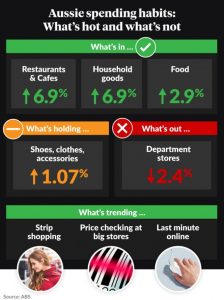
Despite talk of flat wages and rising living costs, we’re lashing out big time on eating out with spending in cafés and restaurants up almost 7 per cent in just one year.
Sean Sands from Monash University said the strong growth in dining spending reflects consumer connection ambitions.
“It’s driven by people’s desires to socialise,” he said.
Between June 2016 and June 2017 spending on household goods rose 6.9 per cent. But we’re getting choosy on where we buy, with spending in department stores actually falling 2.4 per cent despite spending on clothing, footwear and personal accessories up 1.07 per cent.
Dr Sands said the drop of spending in department stores reflected a return to the high street experience.
“A lot of people want to shop locally,” he said.
Retail and business futurist Morris Miselowski told The New Daily things have changed significantly in Australia’s shopping landscape since the global financial crisis in 2008.
“We’ve seen retail change dramatically over the last decade,” he said.
The arrival of international brands opening flagship stores in the heart of our capital cities has been a significant part of that.
But big-name brands aren’t finding it smooth sailing, British brand Topshop has entered administration. This is in contrast to several other imports, like Zara, H&M and Aldi which so far have been able to deliver what Australians are looking for.
Mr Miselowski said Topshop failed to understand what Australians want and so we didn’t go for their offer.
He told The New Daily that Topshop didn’t grasp that “Australians are more laid back” in their shopping and their style “didn’t make sense to our local vernacular”, he said.
Mr Miselowski said as online spending has grown, many people have started treating some big stores like showrooms, going there to check prices.
But some household names are doing well. Harvey Norman is one reporting net profits up 29 per cent to $448.9 million on the back of people buying household goods as we build and renovate at record levels.
In the post global financial crisis world many households have cut back spending on credit with the return of lay-by and other new retail functions through online platforms.
Dr Sands said one key area the recent sales figures showed was the continued growth in online shopping.
“Australians are spending more online and are purchasing from small and medium enterprises at a larger rate,” he said.
Will On, co-founder of online shipping platform Shippit, which ships products for many Australian retailers, said they were seeing a huge growth in online retailing as Australians look for flexibility.
“Australian consumers are looking for the basics,” he said. For many products “it’s a lot easier to buy online instead of picking up”.
Shippit’s most shipped items are clothing, followed by pet food, however the things Australians are looking for varies significantly during the week.
New technology companies like Shippit are able to see how spending changes across a single day.
Mr On told The New Daily that three-hour express clothing deliveries are more popular on Friday afternoon than any other time during the week as people planning to go out left shopping to the last minute.
Frequently Asked Questions
Q: Is physical retail dying?
Commodity retail is under enormous pressure, particularly anything that can be purchased more conveniently online. But experiential retail, social retail, and retail as entertainment are growing. The stores that are struggling are those that have not asked what distinctively physical experience they offer that cannot be replicated on a screen.
Q: What does the future of physical retail look like?
Less shelf space, more experience. The Immediate Future™ for successful physical retail is stores that are destinations rather than distribution points, places worth visiting because of what happens there, not just what can be purchased.
Q: How should retailers approach the digital-physical integration?
By treating the digital channel as preparation and continuation, and the physical channel as the irreplaceable centre. The customer journey that converts and retains is the one where digital makes the physical visit easier and more relevant, and the physical visit creates the emotional connection that the digital channel cannot.
Q: Can Morris Misel speak about the future of retail and consumer experience?
Yes. For keynotes on retail, consumer behaviour, and the future of shopping, visit morrismisel.com/event-organisers.
on the eve of my heading off overseas to deliver a Future of Retail keynote to one of the world’s largest FMCG brands, David Ross of the New Daily and I caught up to have a look at Australia’s retail scene past, present and future… It’s not news to anyone that Australians love.
The window between a signal arriving and it demanding a response is shortening. Retail spending changes as we increasingly value the is already shaping strategy conversations in forward-looking organisations. Treating it as a future concern rather than a present one builds a preparedness gap that will have to be closed under pressure.
The most important question is not whether Retail spending changes as we increasingly value the will matter, but how quickly it will matter in your specific context. Leaders benefit most from mapping the ripple effects early — not just the direct impact but the second and third-order consequences that arrive later and hit harder. That is the practical work of foresight.
