The World’s Fastest-Growing Megacities Are Now in Africa, and the Ripple Effects Are Already Here
The World’s Fastest-Growing Megacities Are Now in Africa, and the Ripple Effects Are Already Here
I got an email last week that I had to read twice.
It was from Our World in Data, their Data Insight newsletter. I’ve subscribed for years because it has a habit of delivering a single chart that quietly rewrites a story I thought I understood. This one was about cities. About which ones are still growing, which have peaked, and what the next seventy years of global urban geography might actually look like.
The data is from the European Commission’s Joint Research Centre. The analysis is by Esteban Ortiz-Ospina. The numbers are not projections built on optimistic assumptions. They’re built on demographic momentum, the kind of shift that takes generations to reverse.
Here’s what stopped me.
Since 1950, São Paulo’s population has grown sixfold. Shanghai’s has grown nearly tenfold. For decades, the story of global urbanisation has been told through those skylines: the towers, the infrastructure investment, the economic muscle of megacities that expanded faster than almost anyone predicted. East Asia and Latin America became the shorthand for “where cities grow.”
That story is ending.
São Paulo is near its population peak. Shanghai is projected to peak around 2050. The cities that defined the era of explosive megacity growth are slowing down. Not collapsing. Slowing. Consolidating. Moving from expansion into management mode.
And something is starting somewhere else entirely.
The city most people have never thought about
Luanda is the capital of Angola. Population roughly nine million. Growing fast.
Fast doesn’t quite capture it.
According to the Joint Research Centre dataset, Luanda is on track to overtake São Paulo’s population in approximately twenty years. And Shanghai’s in approximately sixty.
I want to give you a moment with that.
A city that most people in Melbourne or Sydney or Brisbane couldn’t place on a map (a city that rarely appears in strategic planning cycles, trade mission discussions, or market entry conversations in Australian boardrooms) is projected to be one of the world’s great population centres within the decision-making window that begins right now.
Luanda isn’t alone in this trajectory.
Dar es Salaam in Tanzania. Addis Ababa in Ethiopia. And outside Africa: Karachi in Pakistan. These are among the cities growing fastest. The urban centres that will define the next phase of global urbanisation aren’t in East Asia or Latin America. They’re in sub-Saharan Africa and South Asia.
The dataset covers today’s one hundred largest cities. Of those one hundred, only twenty-four are projected to still be growing by 2100. Of those twenty-four cities with sustained demographic expansion ahead: twelve are in Africa. Five are in South Asia.
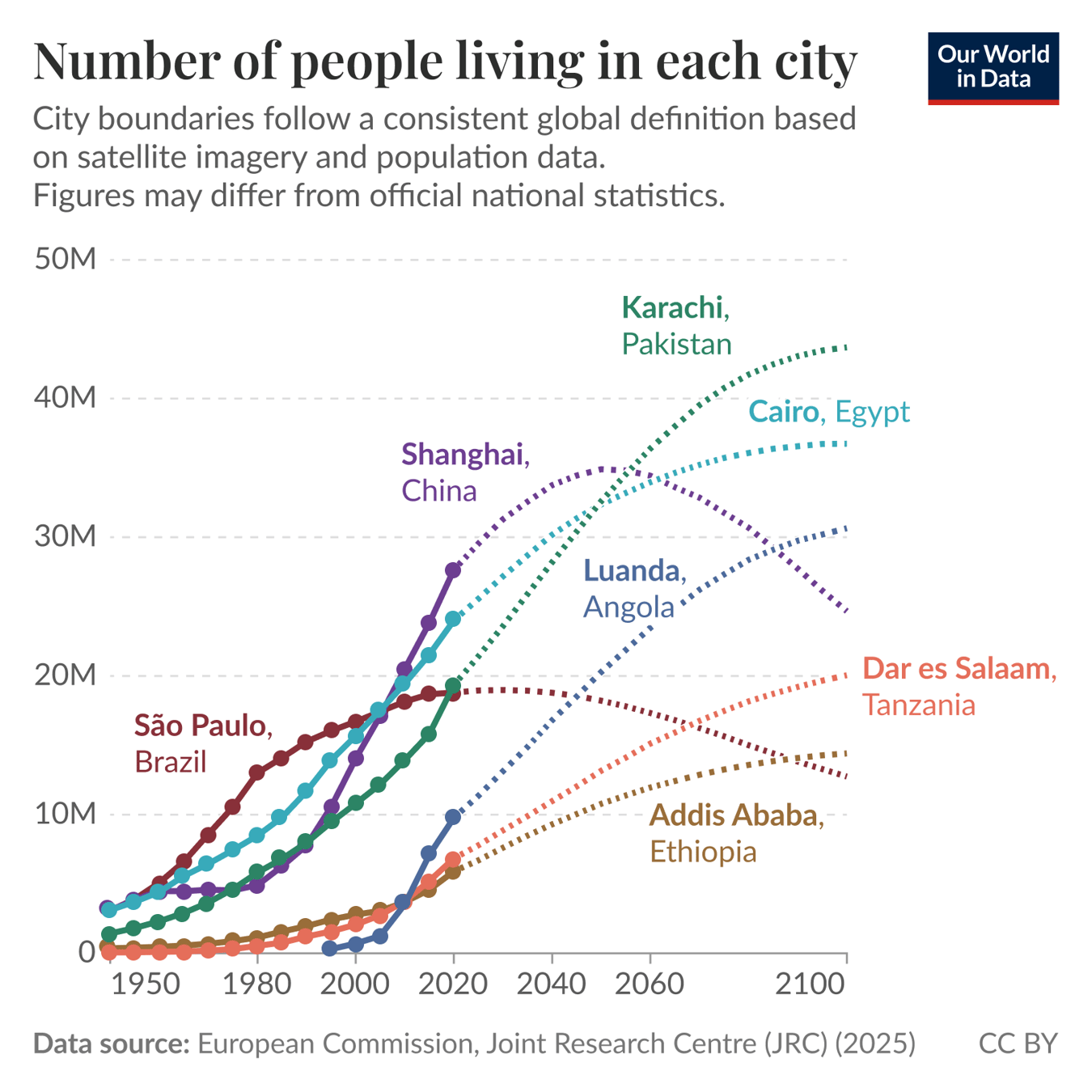
Source: European Commission, Joint Research Centre (JRC) (2025), via Our World in Data. CC BY. Explore the full interactive chart, select Luanda, São Paulo, and Shanghai together to see the crossover clearly.
Read that ratio again.
The cities that will still be expanding at century’s end, the engines of future labour force, future consumer markets, future political weight, are overwhelmingly concentrated in two regions the world has historically looked past rather than at.
This is not advocacy. It’s not development theory. It’s the European Commission’s numbers, and they carry consequences for strategy that don’t wait for permission.
This isn’t news to me. But it needs to land differently now.
I’ve been watching Africa’s trajectory for years.
In 2024, I wrote about what I called the African Era: the convergence of demographic weight, a youthful workforce, a rapidly growing middle class, and leapfrog technology adoption that is reshaping the continent’s economic position. The data I was working with then projected Africa reaching 2.8 billion people by 2050 and holding approximately 20% of global GDP. I argued that three to four of the world’s top ten economies by mid-century could be African nations.
At the time, that framing served as a strategic signal worth surfacing, something worth adding to the planning horizon for organisations thinking seriously about the next twenty-five years.
The megacity data changes the frame in an important way. It moves the conversation from “Africa is rising” (a narrative, and narratives can be held at arm’s length) to “the physical centres of human activity are shifting to Africa” (a structural fact with consequences that play out regardless of whether any particular boardroom is paying attention).
It also extends the useful time horizon. We’re not just talking about 2050. The projections run to 2100. Cities don’t shrink without crisis. The demographic momentum embedded in these numbers means the strategic logic compounds over time. A twenty-year window to understand Luanda’s trajectory is not a comfortable buffer: it’s the exact window in which foundational relationships, market knowledge, and positioning are built or missed.
In 2025, I also wrote about global income distribution: the quieter data story that the share of low-income countries globally had dropped from 30.7% in 2000 to just 11.9% today. That middle-income nations (often dismissed, rarely strategically prioritised) now represent 48.6% of countries globally. That the stereotypes most organisations carry about “developing” economies are now actively harmful to strategy, not just philosophically wrong.
The megacity data connects to that income story directly. The same regions being overlooked in economic classification terms are the same regions where urban growth is concentrating. The populations most organisations treat as tomorrow’s market are already building tomorrow’s cities. These aren’t separate storylines.
Why the peak matters as much as the growth
It would be easy to read the Luanda trajectory and think: that’s a long way away. Twenty years, sixty years. Time enough to monitor and respond.
That reading misses how systems actually work, and it’s exactly the kind of thinking I’ve spent thirty years unpicking with organisations.
When a city peaks, its economic posture changes. Infrastructure stops being an investment vehicle and becomes a maintenance liability. Consumer growth plateaus. Labour force expansion slows. Political energy shifts from expansion to distribution and consolidation. The questions asked by government, by investors, by multinationals: all of them change character.
São Paulo’s economy, still Brazil’s largest, is already navigating this. Shanghai’s planners are now building for a population peak, not a growth surge. The capital allocation decisions, the real estate positions, the supply chain anchor points, the trade relationships built around these cities’ continued expansion: all of them are now building on a slowdown model.
This doesn’t mean São Paulo or Shanghai are done. Cities don’t work that way. But the investment thesis that drove decades of capital into those centres is shifting. And capital (patient or otherwise) moves toward expansion, not toward managed decline.
Meanwhile, the cities still growing are in the build phase. Luanda, Dar es Salaam, Addis Ababa, still in the infrastructure investment stage. Roads, ports, digital networks, consumer class formation, institutional development. The phase where early presence compounds. The phase where the relationships formed in the next ten years define positioning for the following fifty.
This is the core of what I mean by Ripple Effects.
Not just the headline number: Luanda overtaking São Paulo. The second-order consequence is where the capital that was following East Asian and Latin American growth goes next, and who’s positioned to receive it. The third-order: what happens to the institutions, universities, law firms, logistics companies, professional associations, that built themselves around those urbanisation waves? What choices do they now face if they haven’t started building Africa-facing capacity?
The fourth-order is geopolitical. Cities don’t just produce GDP. They produce political voice, cultural export, and institutional influence at scale. A Luanda of thirty million people makes Angola a different kind of actor in African Union debates, in global trade negotiations, in the corridors of the IMF and World Bank and WTO that currently barely register its name. A Dar es Salaam of forty million changes the political weight of Tanzania and with it the entire East African economic community.
The organisations and governments that understand these ripple effects early will have built relationships with institutions and leaders that most of their peers are still discovering.
The Australian question
I want to be direct about this, because it matters specifically for an Australian audience.
Australia’s strategic gaze has historically been oriented north and east. Japan, Korea, China, the United States. ASEAN, increasingly. These are the relationships embedded in our trade agreements, our diplomatic investment, our business school curricula, our aviation corridors, and our business development assumptions.
There is almost nothing in Australian strategic planning, government or corporate, that seriously accounts for Africa as a near-term economic partner.
Australia is currently ranked approximately thirteenth in global GDP. By 2050, Africa’s economies are projected to hold substantial positions in the top global rankings. The configuration of who Australia is strategically adjacent to, and more pointedly who Australia is currently invisible to, will look very different by mid-century.
The African continent will be home to the world’s largest labour force within the decade. It already has six of the world’s twenty fastest-growing economies. The middle class is projected to reach 1.1 billion by 2030. These are not projections dependent on everything going right. They are projections grounded in demographic trends that are already locked in.
Australia has genuine strategic advantages here that are currently largely unused. Historical relationships with several African nations. A diaspora community with professional networks across the continent. A resources and agricultural knowledge base directly applicable to African development challenges. A research and higher education sector that could be building deep partnerships with African universities that will be enormously influential within twenty years.
Most of those advantages sit dormant while we focus north and east.
The organisations that will navigate the coming transition well are not the ones that pivot reactively when the data forces them to. They’re the ones that build knowledge, relationships, and genuine understanding now, when the signals are clear but the urgency hasn’t yet arrived in most board papers.
What PTFA tells us about why we’re not acting
There’s a pattern I’ve observed consistently across thirty years of working with organisations on uncertainty. When data points toward a future that requires genuine structural change in how they operate or where they focus, there’s a predictable response.
It’s not denial exactly. It’s more like a careful not-noticing. The presentation is received. The data is acknowledged. Someone says “we should keep an eye on this.” And then the meeting moves to the quarterly numbers.
I’ve come to call this PTFA (Past Trauma, Future Anxiety). The combined pull of a familiar operating environment and the discomfort of a future that requires preparation rather than just incremental adjustment. Organisations that have built their identity, their relationships, and their strategy around one worldview find it genuinely difficult to act on evidence that suggests that worldview needs fundamental updating.
Africa has been carrying the weight of that not-noticing for a long time. The mental model inherited from the colonial era (of the continent as resource-exporting, aid-receiving, structurally dependent on external support) persists in boardroom language long after the economic evidence has moved decisively on.
The megacity data is useful precisely because it cuts through inherited language. Cities are concrete. They have names and trajectories and they don’t lie. Luanda will be larger than São Paulo. That’s not a development theory or an advocacy claim. It’s a demographic projection from the European Commission’s Joint Research Centre, published by Our World in Data, available to any leader who chooses to look.
The question is whether they will, and what it costs them if they don’t.
What to start in the next twelve months
I’m not suggesting every Australian organisation immediately restructures around Africa. That’s neither realistic nor what the signal requires.
What the Immediate Futures frame asks is more specific: what can you begin in the next twelve months that you’ll be genuinely grateful for by 2030?
Build the knowledge base deliberately. Most organisations don’t have anyone who understands African markets in any depth. That doesn’t require hiring twenty specialists. It requires deliberately adding African economic and urban data to the regular intelligence diet your leadership team consumes. The African Development Bank publishes rigorous quarterly economic analysis. Afrobarometer tracks public opinion across 39 African countries. Our World in Data makes the urbanisation and demographic data accessible. Building this baseline costs almost nothing. Arriving without it costs a great deal.
Review your supply chain and manufacturing assumptions. Sub-Saharan Africa is in the early stages of becoming a significant manufacturing hub. The same labour cost dynamics and demographic profiles that drove East Asian industrial growth are now present across Ethiopia, Rwanda, Ghana, and Kenya. Vietnam surprised many organisations. Ethiopia’s industrial park development has surprised more. The window for early positioning in these markets is narrower than it looks from the current distance.
Map the relationship capital you don’t have. Who in your leadership team has professional relationships with African counterparts? Who in your professional services network has meaningful expertise in African regulatory environments, in African legal frameworks, in African procurement systems? These relationships take years to build credibly. The organisations that have them before they urgently need them will be in a fundamentally different position to those scrambling to find them under pressure.
Update the language your organisation uses. “Developing markets,” “emerging economies,” “frontier markets”: this language, whatever its original purpose, carries assumptions about trajectory and maturity that are now actively wrong in many contexts. Luanda is becoming a megacity. Dar es Salaam is becoming a megacity. These cities will define global consumption patterns, labour pools, and political weight for the rest of this century. The language your leadership team uses internally to describe them shapes the quality of the thinking that follows.
Find the Australian advantage. Australia has specific capabilities that are directly relevant to African development challenges: resources and mining expertise, agricultural technology, clean energy transition knowledge, higher education partnerships. These aren’t charity offerings. They’re genuine exchange propositions with growing African institutions that will be major global actors within twenty years. The organisations and universities that start building those exchanges now will be in a very different position to those that wait.
The thing I keep coming back to
Twenty years from now, someone will write a piece about how obvious this was. How the data was clear. How the signals were available to anyone paying attention in the mid-2020s. How the European Commission’s Joint Research Centre had already documented that twelve of the twenty-four cities still expanding by 2100 were African.
The organisations positioned well in that future will be the ones paying attention now.
I’ve watched this pattern play out across technological change, demographic transition, and climate adaptation over three decades. The organisations that act when the signal is legible, not when the urgency is undeniable, are the ones with the most options. The ones that wait for the urgency manage a catch-up strategy. Catch-up is expensive in every dimension: financially, relationally, strategically.
The conversation about Africa has been too often framed as a moral one: about development, about poverty, about historical obligation. That framing, whatever its merit, lets organisations hold the issue at a distance. It’s someone else’s priority. It belongs in the CSR budget, not the strategy session.
The megacity data closes that distance. This isn’t a development question. It’s a strategic geography question. The physical centres of human activity (where people live, where they work, where they consume, where they vote, where they build institutions) are moving. Twelve of the cities that will still be expanding at century’s end are in Africa. Five more are in South Asia. Two regions that most Australian organisations treat as peripheral to their planning horizon hold the majority of the world’s future urban growth.
That is the strategic environment your organisation is operating in. The question is whether your strategy reflects it.
Luanda will be larger than São Paulo.
The data is clear. The window is open. The decision is yours.
Choose Forward.
I’ve been tracking Africa’s economic trajectory for years. The pieces connect: read Unlocking Africa’s Potential: The Coming Era of Opportunity for the broader economic frame, and Breaking Stereotypes: What We Think vs. What We Know About Global Wealth Distribution for the income classification shifts that sit underneath this urban story.
Source: European Commission’s Joint Research Centre dataset, published by Our World in Data (Esteban Ortiz-Ospina, July 2026).
Frequently Asked Questions
What are the fastest-growing megacities in Africa?
According to the European Commission’s Joint Research Centre dataset (published by Our World in Data in 2026), the fastest-growing megacities in Africa include Luanda in Angola, Dar es Salaam in Tanzania, and Addis Ababa in Ethiopia. These cities are among the twenty-four globally projected to sustain population growth through 2100, and they represent twelve of those twenty-four.
Will Luanda really overtake São Paulo in population?
The data says yes. Luanda is on track to overtake São Paulo’s population in approximately twenty years, and Shanghai’s in approximately sixty. These projections are built on demographic momentum already embedded in Africa’s age structure and fertility patterns, not optimistic assumptions. They’re among the more reliable types of long-range projection available.
Of today’s 100 largest cities, how many will still be growing by 2100?
Only 24 of today’s 100 largest cities are projected to still be growing by 2100. Twelve of those 24 are in Africa and five are in South Asia. The vast majority of East Asian and Latin American megacities are approaching or past their population peaks. São Paulo is near its peak now; Shanghai is projected to peak around 2050.
Why are African cities growing faster than cities in Asia or Latin America?
The core driver is demographic structure. African countries have younger populations, higher fertility rates, and earlier-stage urbanisation compared to East Asian and Latin American nations. The same demographic forces that drove rapid city growth in China, Brazil, and South Korea during the 20th century are now operating at scale across sub-Saharan Africa. These are long-cycle, slow-reversing patterns.
What does Africa’s megacity growth mean for Australian organisations?
Australian strategy is almost entirely oriented north and east. The African megacity shift means a significant portion of the world’s future labour force, consumer markets, and political influence will concentrate in cities that rarely appear in Australian corporate planning. The organisations best positioned won’t be those that pivot when the scale forces their hand. They’ll be those that started building knowledge and relationships now, while the signal is legible and the urgency hasn’t arrived.
What is the Ripple Effects framework?
Ripple Effects is a foresight framework for tracing not just the immediate consequence of a change, but its second, third, and fourth-order effects. For African megacity growth: the direct effect is population shift; the second-order is where capital moves as East Asian and Latin American cities slow; the third-order is what happens to institutions built around those urbanisation waves; the fourth-order is the geopolitical influence African cities gain as they grow to thirty or forty million people.
Where does the megacity data in this piece come from?
The data is from the European Commission’s Joint Research Centre dataset, analysed by Esteban Ortiz-Ospina and published by Our World in Data in July 2026. It covers population projections for today’s 100 largest cities through 2100. Explore the interactive chart here.
What should leaders actually do about Africa’s emerging megacities?
Four concrete steps: build your knowledge base deliberately by adding African Development Bank reports and Our World in Data urbanisation data to your regular intelligence diet; review supply chain and manufacturing assumptions for sub-Saharan Africa, particularly Ethiopia, Rwanda, Ghana, and Kenya; map the relationship capital your organisation currently doesn’t have; and update the language your leadership team uses internally about African economies. The Immediate Futures window is open now.