She Is Not the Person She Is Before She Walks In
I’ve got a friend, one of my closest, and she’s about the most composed person you’ll ever meet. Not a professor, but she’s got that way about her. Considered. Precise. Finishes her sentences.
She’s also a mad Carlton supporter. And I mean mad.
Walk into a stadium with her and she isn’t the person who got out of the car. You wouldn’t put the two together if you met them separately. What gets me is that she knows exactly what she’s doing. She knows she’ll spill out a part of herself in those three hours that wouldn’t, in any other way, shape or form, be possible in her week.
That’s not a fan. That’s someone using a crowd to do something for her that nothing else on offer can do.
Jamie Mercanti asked me about this on Curtin Radio in Perth on Monday, two days after the Grand Final. His question was the obvious one and the right one. Why do people still go? Every match is broadcast. Every match streams. The couch is warmer, it’s closer, and you’ve already paid for it.
We go anyway, in numbers nobody saw coming.
Curtin Radio 100.1FM | The Afternoon Show with Jamie Mercanti
Monday 28 September 2026 · 12 min 14 sec
Prefer to read it? The full transcript is at the foot of this piece.
The numbers, quickly, because they’re not the interesting part
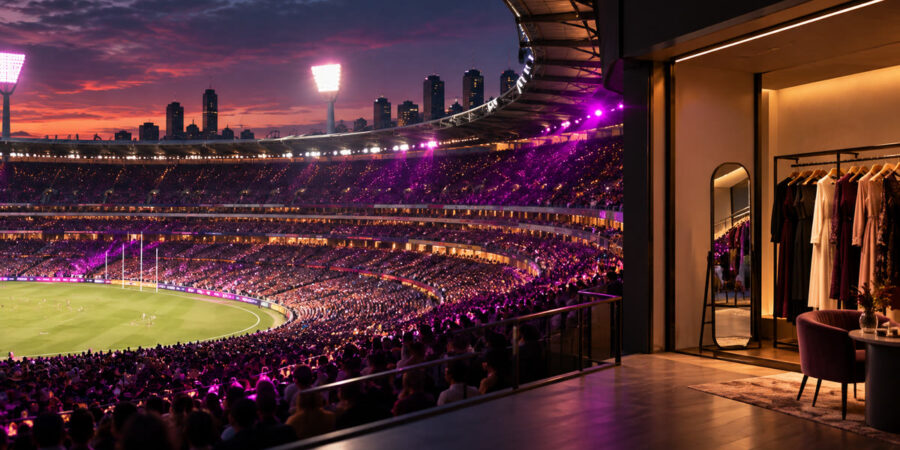
A hundred thousand and twenty-three people filled the MCG on Saturday for Fremantle and Brisbane. Two clubs, neither of them Victorian, playing in a third city. Best attended Grand Final ever between two non-Victorian sides.
Across the home-and-away season, 7.77 million went through the gates, the most the game’s ever had, with forty matches drawing more than fifty thousand each.
But here’s the one that sticks with me. A fortnight before that, the same ground held a hundred thousand and twenty-one people for American football. A code most of them have never played, will never play, and plenty couldn’t talk you through the rules of. On a Friday morning. At ten o’clock.
One of Jamie’s own colleagues at Curtin flew across the country for it. He doesn’t follow either team. He’s American born and he’d never seen grid iron played in Australia in his life, so he got on a plane.
None of that’s convenience, it’s the exact opposite of convenience, and a hundred thousand people did it anyway.
What we were told would happen
We were told the screen would empty the stands.
It wasn’t a silly prediction either. It followed. Better broadcast, better cameras, better commentary, replays from nine angles, none of the parking, none of the queue for a pie, none of the weather. On paper the stadium loses that argument every time you run it.
The stadium’s fuller than it’s ever been.
I’ve been watching this particular prediction fail for a long time now, and it fails the same way every time, which is the bit worth understanding rather than just noticing. It fails because it’s measuring the wrong thing. It treats going to the footy as a way of consuming a football match, and if that’s all it was, the screen would’ve won this years ago.
The Colosseum effect
I call it the Colosseum effect.
Everything we know about those crowds, from the histories and the films both, says the thing happening on the sand wasn’t the whole of it. People shouted and screamed and threw things. It was a place to be, a place to be seen, and the place you talked about before, during and after. The spectacle was the excuse. The gathering was the point.
Two thousand years and that hasn’t shifted. We’re herd animals, we’ve always travelled in packs, and where there’s no football we go and find something else. The market. The square. The shuk. Somewhere to be among people, to complain about them, to wish them well, to catch up on who’s done what to whom.
Back in 2015 ABC Overnights asked me whether shopping malls were finished, and I said no. The reason had nothing to do with retail. The local village square, shuk and market have for millenniums offered this little oasis, a place to shop, meet, greet and catch up on the gossip.
Eleven years on it’s the same instinct, no weaker for the wait, and all that’s changed is which buildings it fills.
The bit that’s easy to miss
The broadcast and the crowd aren’t fighting each other, they feed each other, and that’s the part most of the predictions got backwards.
Some weeks I’d be in that stadium and some weeks you couldn’t get me there if you tried. That’s not me being inconsistent, that’s how it actually works for most of us. Being able to watch it easily doesn’t replace the going. It turns the going into a choice rather than the only option, and a choice you’ve made deliberately is worth more to you than one you had no say in.
Nobody says I’m paying for it on telly anyway, so I’m not going.
They just go.
Now the part that ought to worry a lot of people
If that instinct’s strong enough to fill the MCG twice in a fortnight, it doesn’t politely stay in the stadium. It turns up everywhere people gather, and it’s been quietly rearranging retail for years while everyone argued about whether online shopping would kill the shops.
Online didn’t kill the shops. It killed the errand.
Buying printer paper is a transaction, and transactions go wherever’s cheapest and fastest, which is the phone in your pocket. They’re not coming back, and honestly, why would they. But going somewhere is emotional, and emotional beats transactional nearly every time.
Have a look at what’s happening to foot traffic instead of what the headlines say about it. Strip shopping centres are filling up, and look at what’s moved into them: cafes, local produce, accountants, doctors, massage, the service trades. Things you can’t post. Things that need one person in a room with another person.
And the mall, which gets declared dead about twice a year, is busier than the obituaries suggest. It’s just not being used to buy any more.
It’s being used to showcase.
People go in to touch and feel, to be around other people, to have a coffee, to do the social part of it. Then they buy later, from home, from the phone, from wherever.
I should be straight with you about that one. What I’ve just said about foot traffic rising in both strip centres and malls is what I’m seeing, and it’s not a figure I can hand you with a citation attached. Take it as an observation from a lot of time spent looking, not a statistic.
Who actually pays for this
Here’s where it stops being an interesting trend and turns into somebody’s mortgage.
If you’re a chain with a national footprint and a decent online setup, becoming a showroom is fine. Better than fine. Someone walks in, tries the thing on, decides they want it, buys it on their phone in the car park. The cash register still rings. Rings somewhere else, sure, but it rings, and the business doesn’t much care which door the money came through.
If you’re one boutique, with one owner, and clothes you chose yourself, that exact same behaviour is something else entirely.
Someone comes in. You give them your time. You give them your judgement, which is the thing you’re really selling and the thing that took you twenty years to build. They try four things on in your fitting room, in your shop, under your lights, on your rent.
Then they go home and find something close enough somewhere else, online, cheaper.
You’ve done the work and someone else has taken the money. And you can’t do much about it, because the second you make the experience less generous you’ve thrown away the only advantage you had.
That’s the same human instinct, the one filling the MCG, walking into two businesses and landing completely differently depending on what’s sitting underneath them. Identical behaviour. Opposite outcome.
That’s what ripple effects look like when they’re actually happening to someone. Not a trend arriving, but a trend arriving and then travelling, doing something different to each thing it touches on the way through. I wrote a while back that the future of retail isn’t shopping, it’s authorisation, and this is the same argument standing in a fitting room.
So what’s the question worth asking
Not how do we get people back through the door, because they’re already coming through the door and foot traffic isn’t where your problem lives.
The question is what happens once they’re in the room, and whether that belongs to you.
Back in 2017 ABC Far North asked me what a retailer has to do to survive, and the answer hasn’t aged badly. It was never about competing on price or range, because you’ll lose both. It was about being the reason someone chose to come.
For the solo boutique that means the unglamorous work of making sure the reason they came is attached to something they can only get from you. Not the garment, which is everywhere. The eye. The alterations. Ringing them when something walks in the door that you know they’ll want. The part that doesn’t survive being copied into a search result. There’s a real argument that AI is pushing retail back towards something more personal rather than less, and the shops that already work that way are sitting in a better spot than they think.
For anyone running a place people physically turn up to, same test. Why would anyone choose you when the faster, cheaper version of what you do is one click away? What is there in dealing with you that a transaction can’t hand them? And can you say it out loud, in one sentence, that isn’t “our people”?
If that sentence comes easily, protect it. That’s the whole asset.
If it doesn’t, you’ve become the showroom. You’ll be busy, and you’ll feel good about how busy you are, right up until you look at the till.
Back to my friend
She doesn’t go to the footy for the football. She could watch it in better quality, in a warmer room, with a shorter queue for the toilets, for nothing.
She goes because for three hours she gets to be a version of herself the rest of her week hasn’t got room for. Nothing on a screen has worked out how to give her that, and I’m not convinced anything will. We’ve spent a few years now watching people quietly back away from social media and turn up somewhere in person instead, and I don’t think that’s nostalgia. I think they’ve worked out what the screen can’t do. Men who built their whole social life at work found the same thing out the hard way when the work stopped.
Worth sitting with if you’re building anything people are meant to turn up to. The crowd isn’t an inefficiency waiting to be optimised away. For a lot of people it’s the only place all week they get to put something down.
And if your business is currently the room where they do that while the money goes somewhere else, that’s not a marketing problem. That’s the first thing to fix.
Choose Forward.
Related reading. A fortnight ago Apple launched new phones and nobody slept on a footpath: We Stopped Queuing. That one’s about the queue disappearing and an occasion turning into a transaction. This one picks up what the crowd is for, and who carries the cost.
▾ Read the full transcript of the segmentCurtin Radio 100.1FM · 28 September 2026 · 12 min 14 sec · click to open
Machine transcription, lightly cleaned, speaker labels added. It carries recognition errors and is not a verbatim record. Unrecoverable words are marked [unclear].
JAMIE MERCANTI: Last Saturday the AFL Grand Final had an estimated audience of 6.5 million viewers, including 100,023 football fans at the MCG, plus 40,000-odd in Fremantle. My next guest is foresight strategist Morris Misel, who believes people are still going to the footy regardless of AFL games being available free to air, or streaming on your tablet or your phone. So why are people still filling football stadiums across Australia? Welcome to the Afternoon Show, Morris.
MORRIS MISEL: Happy Monday, Jamie. Wonderful to be here.
JAMIE MERCANTI: Before we start, what football team do you barrack for?
MORRIS MISEL: Not one that I would admit to on air.
JAMIE MERCANTI: That’s fair enough. I’ll take that as a good opening, as a place of all the Dockers fans here in Western Australia lamenting the result from the weekend. Good luck to Brisbane, they deserved the flag, they played out of their skins. So Morris, why do humans come together in their thousands for live events?
MORRIS MISEL: We are human. It comes down to that. We love being with other humans, we love the atmosphere. You said at the beginning, 100,023 people crammed the MCG. Two empty seats. I don’t know where they were. But if we want to talk about empty seats, the week before, the NFL came from America to Melbourne and played at the MCG. And in that stadium, for a code hardly anybody in Australia follows or knows anything about, there were 100,021 people, on a Friday morning, at ten o’clock.
JAMIE MERCANTI: One of our staff members here at Curtin actually flew over for the weekend for that. He’s not a fan of either team that played, but he’s American born and he went and saw the game because he hadn’t seen grid iron in Australia in his entire life.
MORRIS MISEL: That’s it absolutely. It comes down to human nature. It comes down to what I call the Colosseum effect. Everything I’ve seen in the movies and everything I’ve read, where everybody shouted and screamed and threw things and couldn’t wait to see what was happening in the stadium below them. It was a place to be, a place to be seen, and the place you talked about before, during and after. Humans need that interaction. The phone meant we were going to watch it on the phone. We were going to watch it on TV. All of these things were going to empty the stadium. Nothing could be further from the truth.
JAMIE MERCANTI: This is one of the most successful seasons for AFL attendance in history, and the NRL is also increasing its market share strongly, and probably sealed the best broadcast deal in sports history here in Australia. So there’s obviously an audience watching. But there’s also still an audience going to every single game.
MORRIS MISEL: And they both feed each other so beautifully. That’s what it comes down to. There’s such ready access to seeing it online. Some weeks I’d be in the stadium and some weeks you couldn’t get me there if you tried. That’s really what it comes down to. Some weeks, some times, some opportunities, it’s wonderful to be there with a crowd. And we never say, I’m paying for it on TV anyway, so I’m not going. We just go.
JAMIE MERCANTI: Is experiencing a live event with thousands of people a form of tribalism?
MORRIS MISEL: It is. We are herd animals. We have always travelled in packs. If it’s not sport, then we love to go down to the local market. It happens today, it happened a thousand years ago, it happened a million years ago. Called a shuk, called a market. We like to go down, we like to be with people. We like to complain about them, we like to wish them all the best, we like to gossip. That’s a great part of being human. We like to know what’s happening. Those things really only ever happen in a live environment. The footy does it, the cricket does it, and every other form of people getting together and enjoying sport brings us into a stadium to do all of those things.
JAMIE MERCANTI: I come from a music background, so I’ve been to plenty of concerts with tens of thousands of people. And I’ve worked in theatre. The last show I did at Crown was We Will Rock You, and there were 56,000 people over three and a half weeks. Incredible numbers. People coming together and leaving, hopefully, with the same level of emotion. Obviously with sport someone’s always going to walk away disappointed. Either way you celebrate, or throw things, or let off flares.
MORRIS MISEL: That’s exactly right.
JAMIE MERCANTI: It gives people almost a cathartic effect. They can expel all the negativity towards the opposition team and towards the umpires, and they probably walk out better for it.
MORRIS MISEL: There’s a lot to be said for it. You may know someone like this. One of my best friends, female, is on every level somebody you would say is professorial, that kind of persona. She is a mad, mad, mad Carlton supporter. I cannot tell you how mad this woman is for Carlton. When she is in that stadium she is not the person she is before she walks in. You would not put the two personas together. And it’s her place to become another version of herself that she loves, enjoys and looks forward to. She knows she will spill out a part of herself in those three hours that would not, in any other way, shape or form, be possible in the week.
JAMIE MERCANTI: Our space manager here is a Carlton supporter himself, and has an effigy of Patrick Cripps in his office. [unclear]
MORRIS MISEL: Yes, I’ve heard that many times over the weeks and months.
JAMIE MERCANTI: I believe the atmosphere at the MCG for the Grand Final was incredible, some of the loudest cheering and support they’ve heard, especially with two visiting interstate teams at the MCG.
MORRIS MISEL: Apparently. The crowds literally went wild, as they say, and with a lot of background to it. It is very, very much a spectacle now. Kylie in the middle before the show, all of those things add to the carnival of it. And it’s the atmosphere. People who watch online or on TV, like me, enjoy it. A lot of people who were there fed off it in a way that makes live shows.
MORRIS MISEL: I heard that online was going to decimate that industry. And it did cause a lot of difficulties, so there’s still all sorts of pain in there. But anecdotally and statistically, people, to your point, are going back to live shows in great numbers.
JAMIE MERCANTI: I think the only thing being affected at the moment, when it comes to access to any form of shopping, is retail. They seem to be suffering the most with the rise of Amazon and many other online suppliers. Retail outlets in shopping centres, that’s probably the worst trade they’ve seen in decades.
MORRIS MISEL: This is really difficult, because I think retail is the one going through the most change. When you look at dollars spent, that’s not really changing. Just where the transaction is being done. But what I’m finding is that strip shopping centres and malls, when you look at foot traffic, are both really increasing in numbers. Because people are going there, but they’re going there for very different reasons than putting their hand in their pocket. That sounds strange. But strip shopping centres have a lot of cafes. They’ve gone back to local produce, local people talking to local people. They’ve gone to service industries. You’ll see accountants and doctors and massage, all kinds of things moving into those spots. And when you go to the mall, the mall is not being used to buy. That sounds strange, but the mall is actually being used to showcase, more than it ever has been before. People want to go and touch and feel and be together and have a cup of coffee and do those social things. Maybe go back online at home or somewhere else and actually buy.
JAMIE MERCANTI: I have a lot of women’s boutiques sort of having people come in to try things on, then they go home and buy it online.
MORRIS MISEL: For some places that makes perfect sense. If you’re a larger chain with an online presence, it really allows the possibility for you to become a showroom. Exactly as you said. It makes no difference to that retailer, because as long as the cash register rings, it’s fine. It’s where you’re a solo boutique, where you have specialist clothes, and somebody comes in and takes your time and your effort and tries your clothes on, and then goes away and tries to find something similar somewhere else online. Then it’s an issue for you, quite rightly.
JAMIE MERCANTI: What’s your next big event? A music event or a sporting event? Where are you based, Morris?
MORRIS MISEL: I’m based in Melbourne. I’m going to the Melbourne Show tomorrow with my granddaughter and looking forward to that very much. And then on Thursday night I’m going to the Melbourne Symphony Orchestra to hear Elton John played. Looking forward to that very much. He shan’t be there, I’m told, unfortunately.
JAMIE MERCANTI: That’s a shame. But the music’s going to keep you well into the night. Morris, thank you very much for your time. Especially with the performing arts, young people do come out en masse. It keeps us alive and keeps us occupied. There’s nothing like the atmosphere of going live, and to me it’s the fundamental reason why people perform. I’m sure it inspires the sportsmen at places like the MCG and other major stadiums around Australia.
MORRIS MISEL: It actually does. Look from the other side. I spend a lot of time on stage keynoting, and there’s an energy there that just can’t be gotten anywhere else. If it’s a place that causes you pleasure, which it does for me, there’s nothing else like it on earth.
JAMIE MERCANTI: Thanks again, Morris. Have a great long weekend. You had yours last Friday, didn’t you?
MORRIS MISEL: We had Friday off. Don’t know why. AFL Grand Final, but I don’t know. Anyway, thank you.
JAMIE MERCANTI: That was Morris Misel, foresight strategist and keynote speaker. The subject was people are still going to the footy, and why human interaction still beats the convenience of technology.