Men Built Their Social Life at Work. Nobody Told Them What Would Happen When It Ended.
Phil Whelan asked me in our weekly on-air chat on RTHK Radio 3 in Hong Kong why we’re suddenly talking about male loneliness. It feels like it’s everywhere at once. Was this always the problem it is now?
I said: it’s not that men are suddenly lonelier. It’s that for the first time, they’re allowed to say so.
That’s a small sentence with large consequences. And it’s why the data coming out right now matters more than it looks.
Segment Transcript, RTHK Radio 3 Morning Brew, 14 July 2026
Auto-transcribed via Whisper. Verify accuracy against the audio before direct quotation.
Phil Whelan: Morris, good morning. I wanted to talk about something today that I think a lot of people will find surprising, there’s new data showing that older men are now lonelier than older women. Is that right?
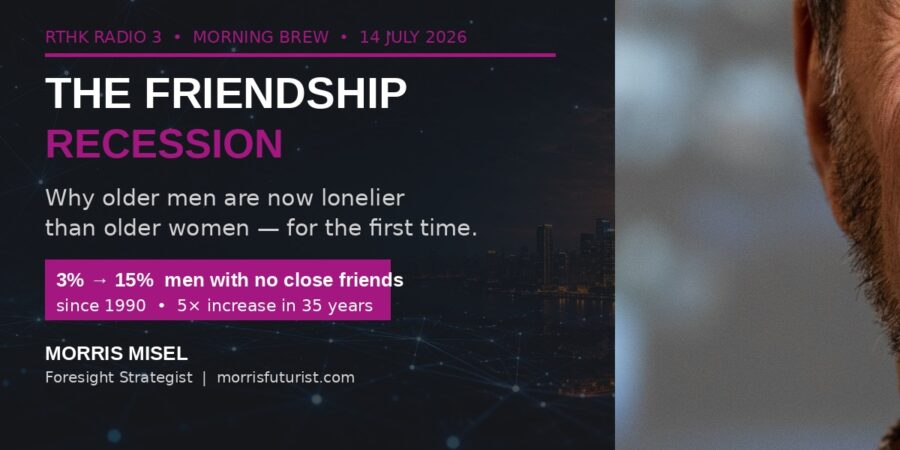
Morris Misel: That’s right Phil, and it’s the first time in the data that this reversal has happened. For a long time the assumption was that women were lonelier than men, and that was broadly true in the research. But the most recent AARP survey shows for adults over forty-five, men are now reporting higher levels of loneliness than women. And the number that stopped me was this: in 1990, three percent of American men had no close friends at all. Today that’s fifteen percent. Five times higher in thirty-five years.
Phil Whelan: That’s remarkable. Why is that happening?
Morris Misel: The structural reason is that male friendship has always been context-dependent. Men bond shoulder to shoulder, doing things together rather than talking about things together. The friendship lives inside the activity. Work, sport, a project, a regular pub on the same night of the week. When you remove those contexts (through retirement, redundancy, a move) the friendship often doesn’t survive. Nobody meant for that to happen. The relationship just didn’t exist outside the shared activity.
Morris Misel: And the retirement cliff is particularly striking. The first year often feels like freedom. But AARP research on men’s social health in retirement documents a sharp spike in loneliness and social isolation, typically appearing around eighteen months in, when the structure of work has gone and no alternative has formed to replace it. That’s when they discover what the workplace actually was, not just a job, but their social infrastructure. The people they saw every day, the rhythms, the casual conversations that weren’t about anything in particular. All of that disappears together.
Phil Whelan: Is this something you’re seeing in Hong Kong specifically? Because this is a city where a lot of men are very work-focused.
Morris Misel: Hong Kong has a partial buffer that Western data doesn’t fully capture. Multigenerational households, stronger family obligation, social structures that keep people connected without deliberate maintenance. But the buffer isn’t immunity. The HK professional in his fifties who relocated for a role, whose friends from home are in different cities, whose social life is built around professional networks. He can feel the same structural gap.
Phil Whelan: What about COVID? Did that make this worse?
Morris Misel: Significantly. COVID disrupted the shared contexts that were holding a lot of male friendships together, the regular sports team, the office routine, the after-work pattern. For many men, those contexts didn’t fully reconstitute after lockdowns ended. The social fabric thinned and for some it didn’t recover.
Phil Whelan: The health data, is this actually dangerous?
Morris Misel: The health data is where this gets really serious, Phil. Julianne Holt-Lunstad’s research shows that chronic loneliness carries mortality risk equivalent to smoking fifteen cigarettes a day. In men specifically, social isolation is a stronger predictor of early death than obesity. And in Australia, men aged forty-five to fifty-four are the highest suicide-risk demographic. Those two data sets, the friendship recession and the male suicide data, map onto the same demographic. That’s not a coincidence.
Phil Whelan: Is there anything being done about it?
Morris Misel: Australia actually stumbled on the structural solution before the research caught up. The Men’s Shed movement started here in the 1990s and has grown to over a thousand Sheds nationally with more than a hundred and twenty thousand members. The insight is simple: give men a project and the friendship builds itself. You don’t ask them to talk about feelings. You give them something to do in the same room. The relationship emerges shoulder to shoulder, exactly as it always has.
Phil Whelan: So what’s the takeaway for people listening?
Morris Misel: The friendship recession is real and it’s accumulated over decades, not through any single event but through the slow bleeding out of the shared contexts that male friendships depend on. Take honest stock of your actual social architecture now, not after the scaffolding comes down. Invest in context before you need it. And if you’re a leader or an organisation, recognise that for many of the men inside your walls, you are the social infrastructure. That matters for what you build and how you think about transition.
Phil Whelan: Morris Misel, as always a lot to think about. Thanks for coming on.
Morris Misel: Thank you Phil, good morning to everyone.
The data reversal nobody expected
The AARP Public Policy Institute’s 2025 loneliness survey of 3,276 US adults aged 45 and over found that 40% of that group feel lonely, up from 35% in 2018. But the figure that stopped me was this one: for the first time in the data, men report higher rates of loneliness than women. 42% of men versus 37% of women. The gap has reversed.
For decades, the assumption was that women were the more isolated gender. The AARP 2025 findings turn that narrative around. Older men are now lonelier than their female peers.
The underlying trend had been building for a long time. A 1990 survey found that 3% of American men had no close friends at all. The most recent comparable figures put that number at 15%. Five times higher, in 35 years.
In Australia, the picture lands differently but the consequences reach the same place. According to the Australian Bureau of Statistics, males aged 45 to 59 carry the highest rates of suicide of any demographic. In 2023, men in the 55-59 age bracket died by suicide at a rate of 30.9 per 100,000, the highest of any group measured. That’s not an abstract number. It’s men who’ve reached what should be the most resourced decades of their lives, without enough social infrastructure to hold them.
Why male friendship works the way it does
There’s a structural reason this is happening to men in particular. Male friendship is almost entirely context-dependent. It’s not built on the phone call, the deliberate conversation, the intentional act of staying in touch. It’s built shoulder to shoulder: around a shared activity, a recurring location, a regular routine.
Work provides all of that at once. It supplies the routine, the shared purpose, the daily proximity, the collective language. Men don’t need to maintain their workplace friendships consciously. The structure does it for them. The job is doing the social work.
I wrote a while back about the quiet retreat from social media, and how much of our social infrastructure had quietly migrated online without anyone making a deliberate choice about it. The same thing has happened with work. Men have quietly outsourced their entire social life to the workplace without noticing that’s what they were doing.
When the context disappears, the friendship usually goes with it. Not because the relationships weren’t real. Because they were never designed to survive without the scaffold.
The depth matters too. Men, at best, have five people they’d call mates, someone to go to the pub with. But the number who actually know what’s going on with you, who know your situation, your fears, what you’re carrying: for most men that’s one or two. Often one. For women it’s three to five. That gap matters. One close friend isn’t resilience. One close friend is a single point of failure.
The retirement cliff, and why retirement itself has changed
The most acute version of this is what I call the retirement cliff. The pattern shows up reliably: the first year feels like freedom. The second year starts to feel different. By 18 months out, many men discover that the workplace wasn’t just where they worked. It was where they belonged.
When I talk to leaders about this, I sometimes ask: if your ten most senior people retired tomorrow, how many of them have a social life that doesn’t depend on their role here? The answers are usually uncomfortable.
COVID added a layer that didn’t exist before. It didn’t just disrupt the shared contexts. It pushed men home with themselves in ways they weren’t really prepared for. A lot of men, for the first time, slowed down enough to notice what they didn’t have. Previous generations didn’t have that kind of time or occasion. The reckoning it triggered didn’t go away when restrictions lifted.
But here’s the thing. Retirement itself has changed. The hard stop at 65, gold watch, done: that model barely exists anymore. What we actually have is a series of involuntary transitions: restructures, redundancies, WFH isolation, career pivots, early exits. Men go through versions of the retirement cliff multiple times across their working lives, often without recognising what it is.
There’s a direct parallel with financial planning. We built an entire superannuation system around the idea that people need to prepare financially for the years after work. Nobody built the equivalent for social capital. The assumption, which nobody ever examined, was that social connection would take care of itself. It doesn’t. And for men who’ve been outsourcing that social work to the job for decades, it takes care of itself least of all.
The word “retirement” itself does damage. It frames departure from work as a single clean moment. It isn’t. It’s a series of losses: of identity, of routine, of the people you saw every day. The men navigating this best are the ones who plan the social transition as deliberately as they plan the financial one. Most don’t.
When Phil asked me about the partner burden, I described something that turns up in the research repeatedly. When men are asked who they would call in a genuine personal crisis, many name only one person: their partner. She is the entire social infrastructure. That’s fragile architecture for two people to carry between them. And it means that any disruption to that relationship (illness, death, separation) leaves men with nothing.
The health cost isn’t abstract
Julianne Holt-Lunstad’s 2015 research is the benchmark study here. Chronic loneliness is associated with a 26% increased risk of early mortality. Social isolation with 29%. Living alone with 32%. These are larger effect sizes than many of the physical risk factors we routinely monitor in corporate health programmes.
The Ripple Effects are worth sitting with. Loneliness doesn’t just damage the individual. It increases healthcare costs. It increases the burden on partners and families. It drives political radicalisation. Isolated men are more susceptible to movements that offer belonging and identity. And the widower effect is documented: men who lose a partner die at significantly elevated rates in the period that follows, particularly if they have no other social infrastructure.
This is an organisational problem as much as a personal one. When the structures providing social infrastructure are dismantled (through restructure, automation, or remote-work mandates) the consequences land somewhere. They don’t disappear.
Why men don’t ask
Something I come back to in my Past Trauma, Future Anxiety framework is how conditioning shapes what people feel they’re allowed to do. Men have been told for most of their lives that vulnerability is weakness. That asking for help signals inadequacy. That admitting loneliness is admitting failure.
So men don’t ask. They endure. And from the outside, endurance looks like self-sufficiency.
But something is shifting. The cultural permission to name loneliness, to say “I don’t have close friends and that matters”, is genuinely new. More men are using mental health tools than five years ago. Men are talking about burnout in ways they weren’t a decade ago. The language is opening.
That matters, because a window is only useful if you’re prepared to use it. And this window won’t stay open indefinitely.
What Australia accidentally got right
Australia invented the structural solution to male loneliness before the research had confirmed the problem. The Men’s Shed movement began in the late 1990s. There are now more than 1,200 Sheds across the country, with tens of thousands of members. The movement has spread to the UK, Ireland, Canada, and New Zealand.
The insight at the centre of it is elegant: don’t ask men to talk about their feelings. Give them a project. Woodworking, restoration, community repair, gardens. The friendship builds itself around the doing.
That’s the shoulder-to-shoulder model in practice. The Shed provides what work used to provide: routine, shared purpose, a reason to show up, people who notice when you don’t. It’s not accidental that the movement started in Australia and grew to global scale. We stumbled on a structural truth before we had the language for it.
Phil raised the Hong Kong context: the strong professional identity culture, the role of family networks, the way male status attaches to role even more acutely in East Asian settings. The loneliness problem exists there too. The way it surfaces and the way it can be addressed will look different from the Australian model. But the underlying principle is the same.
What this means if you lead people
This is where I think the conversation changes from observation to implication. And it’s the reason I’m raising this with leadership audiences, not just health and wellness ones.
If men have built their social life at work, and you lead men, then you’re currently part of their social infrastructure. The team rituals you sustain or abandon, the incidental contact your working arrangements enable or prevent, the way your culture does or doesn’t acknowledge connection: all of it is doing social work that most of your people aren’t conscious of.
When you restructure, you’re not just changing reporting lines. When you make someone redundant, you’re not just ending an employment contract. When you moved your team to remote-first and closed the office, you didn’t just reduce overhead. You dismantled social infrastructure. For some of the people in your team, particularly the men who’ve been there longest, you may have dismantled the only social infrastructure they have.
That’s a design decision. It deserves to be made deliberately.
The organisations I see navigating this well have a few things in common. They don’t treat wellbeing as an EAP hotline and a gym subsidy. They design for community alongside productivity. They create shared projects outside the formal structure. Their leaders ask questions that treat connection as an operational concern, not a soft one. They give offboarding the same care they give onboarding.
I think this is where Inhabitable Futures becomes a practical concept rather than a philosophical one. What does it mean to build a workplace that’s actually inhabitable for people across the full arc of their working life, including the transition out of it? That’s a design question, and most organisations haven’t asked it.
The AI transition makes this more urgent. Automation is going to accelerate career disruptions for the demographic most vulnerable to the loneliness cliff: men in their 40s and 50s who’ve built long specialised careers in roles AI can now partially or fully replicate. If you think the retirement cliff is a retirement problem, look again. It’s arriving earlier, in the middle of careers, for people who didn’t see it coming and weren’t prepared for it.
Three things worth doing now
I’m not a fan of generic lists, but given what the data shows, three things are worth being deliberate about.
First, ask the question. If you have senior people approaching major transitions, ask them directly: what does your life outside work actually look like? What are you building that doesn’t depend on this role? Not as a policy question. As a genuine leadership conversation. Most of them have never been asked.
Second, design for community, not just productivity. The incidental connections that matter most often don’t appear on any org chart. Team rituals, shared projects, the regular rhythm of time together. If you moved to remote-first working, you’ve probably lost most of this without noticing. That’s worth examining with intention.
Third, transition with intention. Offboarding is at least as important as onboarding, and most organisations treat it as an HR administrative task. A man who leaves without a transition plan, without a community, without the shoulder-to-shoulder contexts that might replace what he’s losing, is at genuine risk. The organisation that shaped his working life carries some responsibility for his exit from it.
I wrote earlier this week about those kindergarteners who are now 19. In 2016 I predicted on radio that close to half of that cohort would be unemployable by 2030 if we didn’t rethink what we were teaching them. 2030 is four years away. What I didn’t see coming was how the male loneliness data sits right alongside that. It’s not just that AI is disrupting the entry-level roles those young men were training for. It’s that those roles were also where male friendship gets built. Shoulder to shoulder, on shared projects, in the same room. The junior years of working life were doing double duty: professional development and social scaffolding at the same time. If those years shrink or disappear, both things go. This generation inherits the friendship recession and the employment disruption together, with fewer of the incidental structures their fathers at least had for a while.
I wrote earlier this year about why 2026 might be a “good enough” year, about finding the inhabitable space in an uncertain decade. The male loneliness question is a direct test of that. Whether we build social infrastructure deliberately, or leave it to chance and habit.
The cultural permission shift is real. Men can now say they’re lonely in ways they couldn’t ten years ago. If you create the right conditions (the genuine community, the question that lands with care, the recognition that social infrastructure matters as much as any other infrastructure), men might actually use that permission.
That’s not soft leadership. That’s risk management for the decade ahead.
I discussed this with Phil Whelan on RTHK Radio 3 Morning Brew on Tuesday 14 July 2026. Listen to the segment at the top of this post.
Choose Forward.
Morris Misel is a foresight strategist who works with leaders, organisations, associations, and media to prepare for uncertainty and make better strategic choices. He appears regularly on RTHK Radio 3’s Morning Brew with Phil Whelan. morrisfuturist.com
Frequently Asked Questions
Why are older men now lonelier than older women?
Men’s friendships tend to be context-dependent: built around shared activities, routines, and workplaces rather than deliberate relationship maintenance. When those contexts disappear through retirement, redundancy, or life change, the friendships often go with them. Women, on average, maintain more varied and intentionally sustained social networks. The 2025 AARP survey found 42% of men aged 45+ reported loneliness, compared with 37% of women, the first documented reversal in the data.
What is the friendship recession?
The long-run decline in close friendships, particularly among men. In 1990, 3% of American men had no close friends. That figure now sits at 15%, five times higher in 35 years. The friendship recession reflects structural changes in how people socialise: the decline of community institutions, longer working hours, and the shift to remote work.
What does male loneliness mean for organisations?
If men have built their social life at work, organisations are currently part of the social infrastructure for a significant portion of their workforce. Decisions about restructuring, remote work, and offboarding have social consequences beyond their operational purpose. Organisations that design deliberately for community see different wellbeing, retention, and transition outcomes. The risk of not doing so is measurable: through health costs, productivity loss, and downstream effects on men who exit work without adequate social support.
What is Men’s Shed and how does it address male loneliness?
Men’s Sheds are community spaces where men gather around shared projects: woodworking, repair, restoration, gardens. The insight is that male connection is most natural shoulder-to-shoulder, focused on doing rather than talking. Australia’s movement started in the 1990s and now has more than 1,200 Sheds nationally. The model has spread to the UK, Ireland, Canada, and New Zealand.
Is loneliness a serious health risk?
Yes. Research by Holt-Lunstad and colleagues found chronic loneliness associated with a 26% increased risk of early mortality, larger than many physical health risk factors routinely monitored in workplace programmes. Social isolation carries a 29% increased risk, and living alone 32%. In Australia, the ABS reports that males aged 55-59 die by suicide at a rate of 30.9 per 100,000, the highest of any age group measured.