
The World Is in a Funk. It’s Not Permanent, and It’s Not Random.
You’re making worse decisions than you think you are, and it’s not your fault.
Not because you’ve lost your edge. Something bigger than any single deal, any board paper, any strategy session, has been sitting underneath every call you’ve made this year. You’ve felt it. You just haven’t had a name for it.
So let’s name it. It’s a funk, a global one, and it’s been building for a while. Not yours. Not your organisation’s. Everyone’s.
Here’s the part worth staying for: it’s not permanent, and it’s not random. Let’s look at the numbers, because they tell a more useful story than “everything feels heavy right now.”
What’s actually different this time
We’ve had low periods before. What’s new is the wiring.
Right now, more people than at any point in history are watching the same things happen, everywhere, at once. A currency wobbles here. A government falls there. A storm flattens something somewhere else. A conflict grinds on in a fourth place. That news used to take weeks to reach you, softened by distance. Now it lands in the same hour, on the same feed, stacked on top of yesterday’s, before you’ve even processed it.
It’s less a single wound than a scar that keeps reopening somewhere new before the last one’s closed. Not one crisis. A steady diet of them.
I map this kind of thing with a framework I call Ripple Effects: how one decision moves through second and third order consequences most people never see coming. What’s happening globally right now is the same mechanism, just running at a scale I never built the framework to describe. The ripples used to arrive one at a time. Now they arrive from everywhere, all at once, in front of everyone. Nobody built a psychology for that yet. We’re building one on the fly, badly, under load.
The bit I actually want to argue
Here’s the claim, stated plainly, because it’s the whole point of this piece and I’m not going to bury it in hedging.
Economics and politics get treated as the things that shape how people feel. I think it mostly runs the other way. Politics and economics are just humans, organised. When the humans running them are carrying a shared weight, that weight shows up downstream, in votes, in spending, in what a board is willing to risk, before it shows up in any official number.
I’m not the only one who thinks so. Robert Shiller won a Nobel prize partly for making this exact case: economies move on contagious stories as much as they move on data, and the stories usually get there first. A downturn isn’t just a set of numbers. It’s a story people start telling each other, and then start acting on, which is what makes it real.
That’s the mechanism I think is running right now. Psychology first. Not the only cause, I won’t pretend it’s that simple, but the first mover more often than the spreadsheet gets credit for.
What the numbers actually say
Good news: you don’t have to take my word for it.
Ipsos asked 25,709 people across 30 countries in 2026 the plainest question there is. Is your country headed the right way, or the wrong one. Worldwide: 41% said right way.
Australia: 44%. Just above the line.
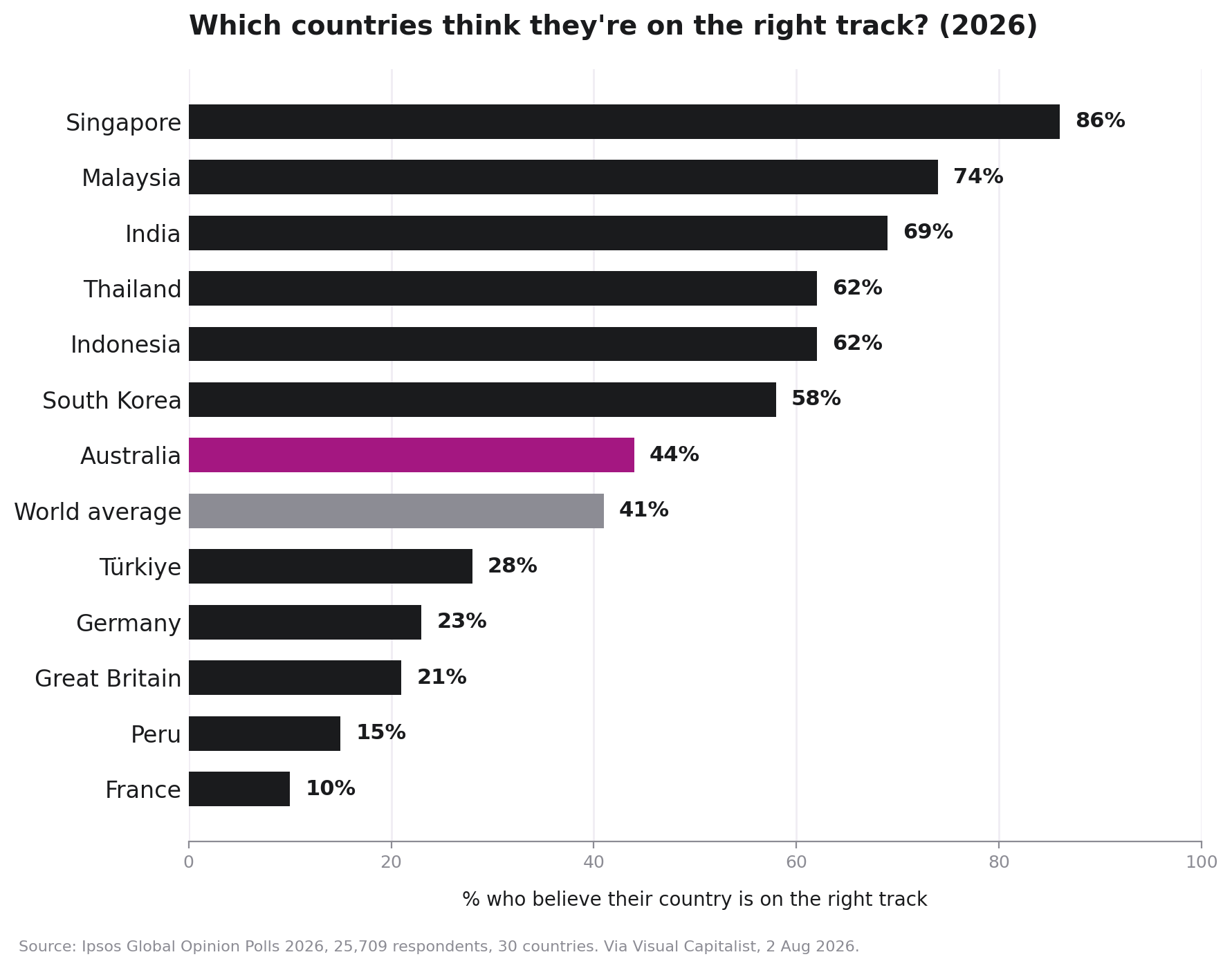
Singapore’s at 86%. Malaysia 74%. India 69%. Thailand and Indonesia both 62%. South Korea 58%. Six of the seven most optimistic countries in the whole survey are in Asia.
Down the other end: France, 10%, the lowest score anywhere in the data. Peru 15%. Great Britain 21%. South Africa, Hungary and Germany all sitting on 23%.
That’s not a world in a funk. That’s one specific group of countries carrying the weight, sitting next to another group that isn’t, dragging the average down while hiding what’s actually happening underneath it.
What’s underneath the low numbers
Some of this is straightforwardly economic. The AI boom is lifting Samsung and SK Hynix in a way Koreans can feel in their own pay packet, not just read about. India and Indonesia are two of the biggest emerging economies on the planet, still climbing. Confidence tends to follow growth you can actually feel.
But growth alone doesn’t explain it. Japan blows the theory up: decades of stagnation, and still 41% say right track, bang on the global average, not the depressed number you’d expect. Something else is doing the work.
I think that something is what I call PTFA: Past Trauma, Future Anxiety. A country that’s been through a recent, specific institutional wound doesn’t respond to uncertainty the same way a country that hasn’t. Britain’s had a run of prime ministers since the 2016 Brexit vote. Peru’s had nine presidents in a decade. France just posted the lowest score in the entire survey. That’s not fragility. That’s a population that’s learned, the hard way, not to expect much from the next announcement.
Trust cliffs, not trust declines
There’s a difference between trust wearing away and trust falling off a cliff, and the bottom of this table reads like cliff cases, not slow declines.
I’ve written before about Trust Cliffs: trust doesn’t erode the way most models assume. It sits quietly, sometimes for years, then drops the moment a gap opens up between what an institution claims and what it actually does. Germany, 23%. Britain, 21%. France, 10%. These don’t read like a decade of slow disappointment. They read like populations that crossed a line at a specific moment and haven’t climbed back since.
That distinction matters if you’re trying to do something about it, not just feel bad about it. A slow decline responds to slow reassurance. A cliff doesn’t. You don’t win back trust that fell off a cliff with the messaging that would’ve slowed an erosion. You have to name what actually broke before anyone believes the direction’s changed.
The “we’ve been here before” bit, checked properly
This is the claim I most wanted to test rather than just say from the stage, because it’s doing the heavy lifting every time I say it: that this kind of collective low has happened before, more than once, and it’s passed.
It has. Pew tracked exactly this after 2008. A decade later, economic mood had come back hard in the countries hit hardest. Germany went from the bottom of the crisis to 78% saying their economy was good, up 50 points from 2009. The US climbed to 65%. Poland up 40 points. Britain up 35. Japan up 34. Kenya up 24.
That’s not a mood lifting on its own. That’s specific institutions, over specific years, doing specific, visible things that gave people a reason to expect something different. Confidence collapsed after 2008. It came back. It collapsed again through COVID, unevenly, and it’s coming back now, unevenly too, which is roughly where the bottom of this year’s table sits.
So no, I don’t think I’m wrong about the cycle. What changes is the timeline. It’s not a mood that lifts by itself. It’s evidence, built over years, that changes what people expect next. Whoever’s building that evidence now, while everyone else waits for the mood to improve, is the one already moving when it does.
A quick word on Hong Kong
I made a version of this argument with Phil Whelan on RTHK Radio 3 back in March, the same week I covered similar ground with Todd Johnson on 6PR, written up here at the time. Hong Kong isn’t in this year’s Ipsos survey, but two numbers are worth knowing: the AmCham Hong Kong 2026 Business Sentiment Survey found over half its respondents optimistic about the year ahead, up from a third the year before, and PwC’s Global CEO Survey put Hong Kong CEO optimism at 70%, against 61% worldwide. Different measure to the Ipsos data, business sentiment rather than general population, but a useful reminder that confidence splits by vantage point as much as by geography.
What this actually means inside your organisation
This doesn’t stay at the national level. It walks straight into your next meeting.
A workforce sitting inside a country reading 21% or 23% brings that baseline into every room you put them in, whether the meeting’s about politics or not. It shows up as caution that looks like risk management but is actually PTFA. It shows up as scepticism toward any change that arrives without a clear, specific reason to trust the people proposing it. It shows up as people who’ve learned, correctly, to wait and see before they commit to anything.
None of that’s a character flaw. It’s a rational response to an environment that’s under-delivered on its promises more than once. The organisations getting this right aren’t running the most upbeat internal comms. They’re being specific: here’s exactly what changed, here’s exactly what we’re doing about it, here’s how you’ll know it’s working. Vague optimism reads as more of the same pattern that caused the scepticism in the first place.
Singapore’s 86% isn’t a mood. It’s the accumulated effect of institutions that have, over a long run, mostly done what they said they’d do. That’s rebuildable anywhere. It’s just slower, and more specific, than most leadership teams want it to be.
Where that leaves us
Australia’s 44% sits just above the world, alongside Canada, just ahead of Poland and Ireland. Not a funk country. Not a confident one either. Somewhere in the middle, which is its own kind of instruction: we’re not in crisis, but we’re not immune, and the gap between us and Singapore closes on the same terms Singapore closed it. Specific institutions, doing specific things, for long enough that people update what they expect.
The mood in the room this year is real. I’m not talking anyone out of it. But it’s not everywhere, and the evidence says it’s not permanent either. It’s sitting in specific places, for specific, nameable reasons, and every one of those reasons has been through this before and come out the other side. The people building the evidence now, instead of waiting for the mood to lift, will be the ones already moving when it does.
Choose Forward.
Frequently Asked Questions
Is the whole world actually pessimistic right now?
No, and that’s the point. Global averages hide the real pattern. Ipsos 2026 data shows only 41% of people worldwide believe their country is on the right track, but that average masks a sharp split: Asian countries like Singapore (86%) and Malaysia (74%) are broadly optimistic, while much of Europe, led by France (10%) and Great Britain (21%), is deeply pessimistic. Australia sits at 44%, just above the global line.
What is PTFA and how does it explain national mood?
PTFA stands for Past Trauma, Future Anxiety, a framework describing how a recent, specific institutional shock leaves populations and organisations wary of trusting the next announcement, even when current conditions are stable. It explains why confidence tracks institutional history as closely as it tracks current economic performance.
Does history show that periods of national pessimism actually recover?
Yes. Pew Research tracked economic mood a decade after the 2008 financial crisis and found sharp rebounds in the hardest-hit countries: German economic confidence rose 50 percentage points between 2009 and 2018, with strong recoveries in the US, UK, Poland, Japan and Kenya. The recovery wasn’t automatic. It followed years of specific institutional action that gave people reason to update their expectations.
What is the Trust Cliffs framework?
Trust Cliffs describes how trust in institutions and organisations doesn’t erode gradually the way most models assume. It accumulates quietly, sometimes for years, then collapses suddenly at a specific moment that reveals a gap between what an institution claims and what it actually delivers. Countries like France, Great Britain and Germany, sitting near the bottom of the 2026 right-track data, show the signature of a cliff rather than a slow decline.
Why does psychology matter more than economics in explaining the current mood?
Economist Robert Shiller’s research on narrative economics shows that contagious popular stories about the economy can shape spending, investment and confidence ahead of, and independently of, the underlying data. Political, economic and cultural systems are run by humans, and when the humans inside those systems are carrying a shared psychological weight, that weight shows up in decisions before it shows up in the official numbers.
What should leaders do with this data rather than just feel worried by it?
Read it as an instruction to build evidence, not wait for the mood to lift. The countries and organisations with the highest confidence didn’t get there through better messaging. They got there through institutions doing specific, visible, consistent things over a long run. Leaders in lower-confidence environments should focus on making decisions visibly, explaining what changed and why, rather than defaulting to vague reassurance, which reads as more of the pattern that produced the scepticism in the first place.