{Radio} Synbio the new $40 trillion industry
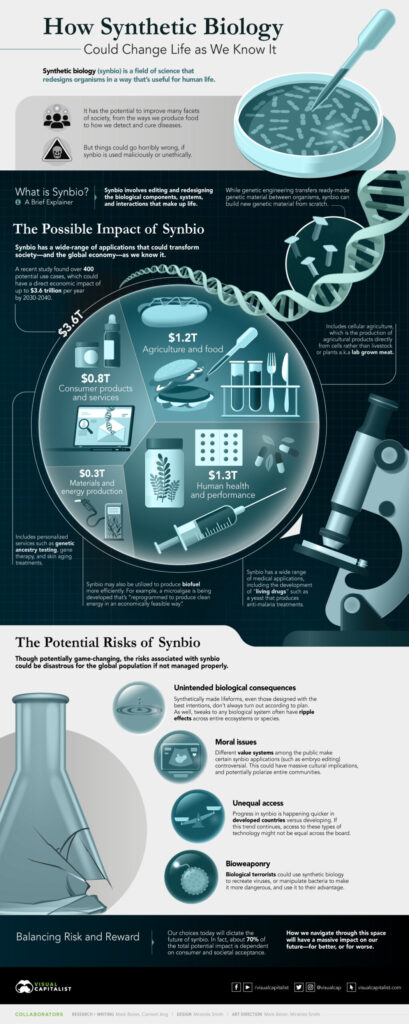
Which industry barely exists now, helped tame COVID, will allow planes to fly on sugar cane fuel, could solve 45% of all medical problems and will be worth $40 trillion globally, $27 billion in Australia alone, by 2040 meet Synbio.
Synbio, or Synthetic biology, uses engineering principles to design and modify living things.
It’s a multidisciplinary area of research that seeks to create new biological parts, devices, and systems, or to redesign systems that are already found in nature.
Synthetic biology is the convergence of advances in chemistry, biology, computer science, and engineering that enables us to go from idea to product faster, cheaper, and with greater precision than ever before.
It can be thought of as a biology-based “toolkit” that uses abstraction, standardisation, and automated construction to change how we build biological systems and expand the range of possible products.
The term was first coined in 1910, but had limited applications or possibilities. It was again picked up in the 1960’s, but in the last decade has come into its own and is set for the brightest of futures.
In this week’s segment Hong Kong Radio 3’s Phil Whelan and I chat about the possibilities of Synbio, what it is, why it is, and what possibilities it may bring.
Listen now (16 minutes 31 seconds)
Frequently Asked Questions
Q: What is synthetic biology and why does it matter?
Synthetic biology applies engineering principles to biological systems, designing and building new biological parts, devices, and organisms, or redesigning existing ones. It enables the manufacture of materials, fuels, medicines, and food using biological processes rather than chemical or petroleum-based ones. The economic potential is enormous because biology is essentially universal manufacturing infrastructure.
Q: Where is synthetic biology already creating real-world impact?
In pharmaceuticals (mRNA vaccine platforms are synthetic biology), in agriculture (bio-engineered crops and pest-resistance), in materials (spider silk proteins, mycelium-based packaging), in energy (bio-engineered organisms that produce fuel), and in food (precision fermentation producing dairy proteins without cows). These are not experiments. They are commercial products.
Q: What are the risks and ethical concerns of synthetic biology?
Biosecurity is the primary concern: engineered organisms or pathogens released deliberately or accidentally. The regulatory frameworks were built for pharmaceutical safety, not for a world where biological systems are programmable. Governance is running significantly behind the science. The dual-use problem, the same capabilities that create medicines can create weapons, is the central ethical challenge.
Q: Can Morris Misel speak on biotechnology futures and synthetic biology for our event?
Yes. Biotech, synthetic biology, and the ethics of emerging science are regular keynote topics for science, healthcare, and corporate audiences. Book at morrismisel.com.
Synbio the new $40 trillion industry.
When signals like Synbio the new $40 trillion industry emerge, organisations that engage early have the advantage of choosing their response rather than reacting to events. That gap between those who prepared and those who did not is where competitive positioning is actually made or lost.
The most important question is not whether Synbio the new $40 trillion industry will matter, but how quickly it will matter in your specific context. Leaders benefit most from mapping the ripple effects early — not just the direct impact but the second and third-order consequences that arrive later and hit harder. That is the practical work of foresight.