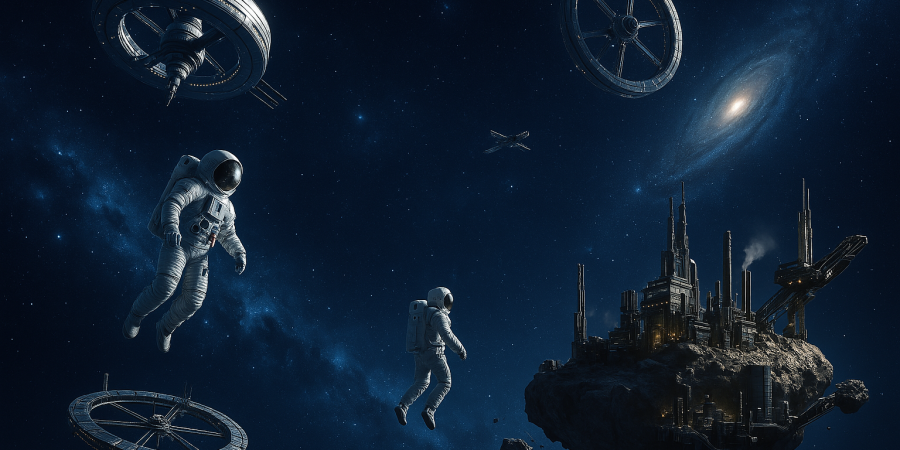
{+Podcast} Space: The Final Business Frontier or Humanity’s Next Gold Rush?
Pop quiz
What do railroads in the 1800s, highways in the 1900s, and launch pads in the 2000s have in common?
They’re not just modes of transport.
They’re signals. Markers of a civilisation shifting gears.
And right now, space has slipped out of the hands of astronauts and governments and landed squarely in the palms of billionaires and boardrooms.
We’re not predicting. We’re already there
The space economy is no longer theoretical.
It’s a $600 billion global sector tracking toward $2 trillion by 2040.
Forget moonshots.
This is bottom-line strategy.
Space isn’t just exploration now.
It’s logistics, hospitality, real estate, mining, manufacturing, tourism, law, and comms.
And that’s just orbit.
Boys with toys, rockets for joy
The original space race was Cold War theatre.
Government versus government.
The new race is ego versus ego.
Private. Personal. Profitable.
Bezos, Branson, Musk.
Sci-fi kids turned CEOs.
Building rockets instead of buying islands.
Treating space like a sandbox for legacy.
You want in? Half a million gets you a seat.
A quick bounce to the Kármán line and a certificate to prove you “went to space.”
It’s tourism, not transcendence.
But it’s the thin edge of a fat wedge.
Space hotels, 3D printing in orbit, and the rise of cosmic construction
The Hiltons and Marriotts are already playing with zero-gravity hotel concepts.
Swanky lounges.
Panoramic pods.
Gravity-on-demand.
Don’t ship the suite.
Print it.
Companies like Redwire Space are pushing orbital 3D printing, letting you build what you need, where you need it, on-demand construction in microgravity.
This is logistics beyond Earth.
And it’s moving fast.
Mining the skies, not the soil
We’re not just sending satellites up.
We’re eyeing asteroids.
Flying treasure chests loaded with platinum, gold, rare earths, and who-knows-what-yet.
But it’s not about bringing it back to Earth.
It’s about using it up there.
Building, powering, connecting.
Turning space into a functioning, liveable, workable environment.
New jobs, new rules, new frontiers
In April 2014, I wrote about something that sounded made-up:space traffic control.
Today, it’s real.
With over 9,300 active satellites and 36,000 pieces of space junk orbiting Earth, we now need literal air traffic controllers for the sky beyond sky.
I first flagged this profession in “Space Age Work”, reprinted from MX Magazine. Back then, it sounded like sci-fi.
Today, it’s essential infrastructure.
This is just one of the hundreds of new professions space will demand.
We’re moving from STEM to STEAMS: Science, Tech, Engineering, Arts, Maths, and Space.
Space nations, sovereignty, and the legal wild west
In The First Space Nation, I asked: Who owns the sky?
Turns out, not many know.
Sure, treaties exist.
But like any unpoliced frontier, they’re only as good as the rocket that enforces them.
We’ve seen this before.
Colonial flags on someone else’s land.
This time, it’s just in orbit.
And the stakes are interplanetary.
Space babies and generational ambition
In Where Do Space Babies Come From?, I explored the real question:
What happens when humans live and die in space?
What laws? What health? What rights?
We’re not just sending bodies up there.
We’re sending cultures. Expectations. Ethics.
The future of space isn’t mechanical.
It’s profoundly human.
Why it matters now
Space is no longer optional. If you’re in business, education, policy, or innovation, you need a space lens.
The workforce is already evolving. Not in decades. Now.
Private enterprise is leading. And where they go, opportunity follows.
Regulation is reactive. The first-movers set the tone.
Ignore this shift, and your strategy’s already old.
Final thought
We’ve swapped wide-eyed wonder for high-altitude headlines.
But space hasn’t lost its magic.
It’s just changing shape.
We don’t need to predict the future.
We need to prepare for it.
So I’ll ask again: Are you building for Earth’s next decade, or humanity’s next horizon?
Want more glimpses like this?
Visit the blog for future-facing insights
Book a keynote that makes space, and time, make sense
Or start a conversation. Because the best futures are always built in dialogue.
For more on the Future of Space listen to my on-air chat with Hong Kong Radio 3’s Phil Whelan (16 minutes 29 seconds)
#spaceeconomy #futureofwork #strategicforesight #businessfuturist #morrismiselowski #futuretrends #spaceindustry #keynotespeaker #futurethinking #leadershipforesight #emergingindustries #spacejobs #orbitaleconomy #spaceinnovation #ceostrategy #futurebusiness #mininginspace #privatespaceindustry #nextfrontier
Frequently Asked Questions
Q: What is the foresight significance of the commercial space sector for organisations that are not in space?
The commercial space sector is producing capabilities that will change terrestrial infrastructure and competitive dynamics in ways that matter for every sector. Low-orbit satellite constellations are already changing global connectivity, bringing high-speed internet to geographies that were previously unserved, which has implications for global supply chains, talent distribution, and market access. Earth observation from space is changing the cost and resolution of environmental monitoring, agricultural intelligence, and geopolitical assessment. These are not space-sector stories. They are infrastructure stories with broad applicability.
Q: What are the second-order consequences of global satellite internet coverage?
The most significant is the potential end of the digital divide as a geography-determined constraint. If high-quality internet access is available anywhere on earth via satellite, the location advantages of urban concentration (access to talent, information, and markets) become less decisive. This has implications for property markets, regional development, and the global distribution of economic activity that are only beginning to work through the system. It also changes the communications resilience landscape, submarine cable vulnerabilities become less strategically critical when satellite provides a genuine alternative.
Q: What are the geopolitical foresight signals in the commercial space sector?
The democratisation of orbital access, via lower launch costs and smaller satellite platforms, has reduced the barrier to space-based surveillance and communications capabilities to a level where many more state and non-state actors can participate. This is changing the military and intelligence landscape in ways that major powers are responding to with competing regulatory and governance frameworks. The space governance vacuum (the absence of agreed rules for orbital debris, satellite interference, and lunar resource extraction) is a significant strategic risk that is not yet adequately addressed.
Q: Can Morris Misel speak on space economy futures, emerging infrastructure, and geopolitical change for our technology, defence, or policy audience?
Yes. Space economy and geopolitical futures are regular keynote topics for technology, defence, and policy audiences. Book at morrismisel.com.