
{Podcast} Innovating our way through the pandemic
“You should never let a good crisis go to waste,” is a saying that’s being quoted often in the pandemic.
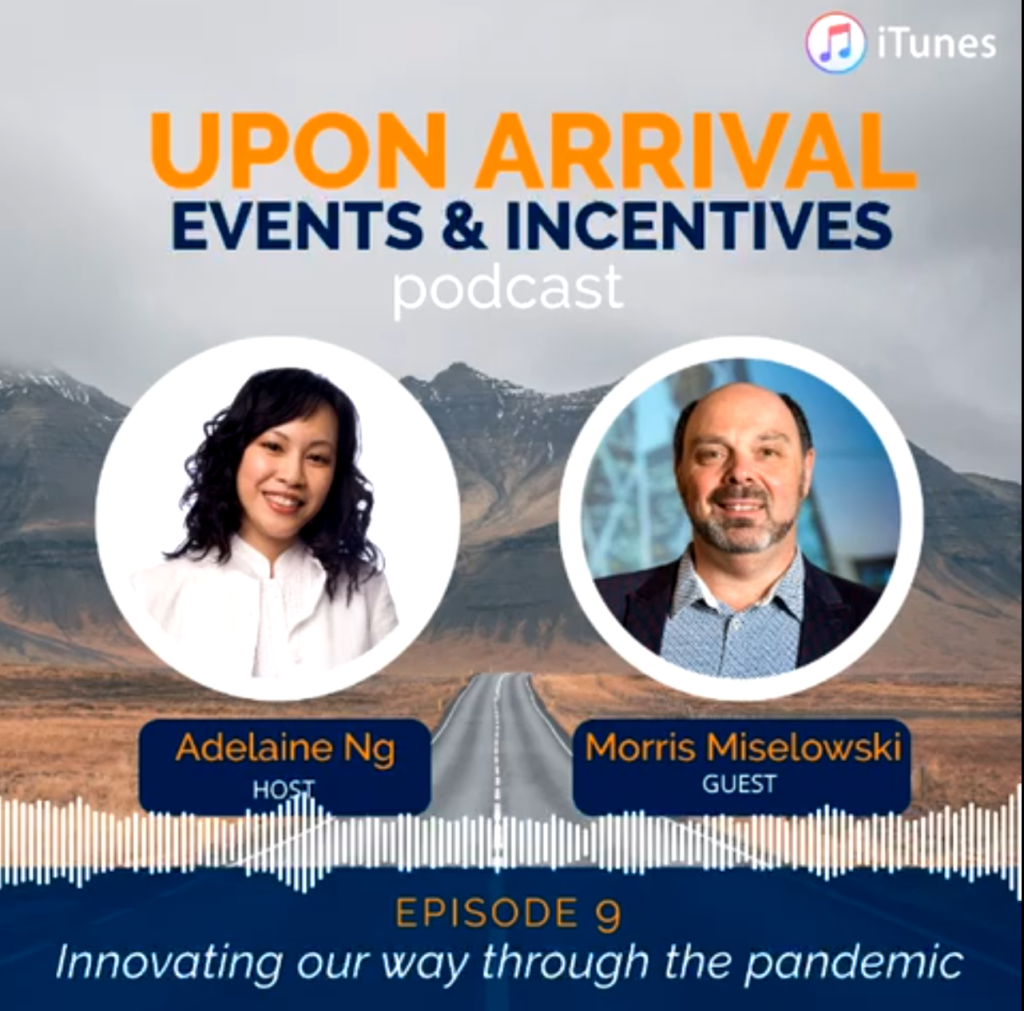
t’s always a pleasure to catch up with Adelaine Ng, and following on from our short chat the other week on her new Podcast series Upon Arrival – Events and Incentives (available on iTunes and Spotify) about the impact and future of the Hospitality, Tourism and and Events industry, in this episode we spend a little longer deep diving into the what happened, the maybe’s of what will happen and what we can do now to take control of an otherwise uncertain future.
Covid 19 has forced us to embrace innovation and technology at speeds we weren’t prepared to do before, making us more nimble for the changes to come.
Morris Miselowski, business futurist, founder and lead strategist at Eye on the Future, talks about how inventions that were previously discarded have now been retrieved from the bin and used to create experiences.
Quotes From Episode
“I remember really uncomfortable experiences in America and other places where the culture is, if you don’t like the speaker you just literally get up and walk out. I’m saying that because online has the same issues as offline, or on stage, or in physical spaces.
We are part of the attention economy. What we’re doing is competing for people’s attention.”
“This year, we have honestly gone into a black hole and we will come out five to 10 years ahead.
We don’t need to convince an audience anymore that there is a physical and digital reality to this world.”
“There’s been billions of dollars spent in… events, hospitality and tourism to get the digital virtual conference working better than it has before. And then the next 12 to 18 months, we will see some huge evolutions in the technology that allows this thing to be different from today, but it’s still human to human.”
Don’t miss:
2:16 – Morris’s learnings as a teen entrepreneur
9:54 – Improving revenue from virtual events
13:46 – Lessons from Blockbuster, Netflix and Spotify
16:01 – Is Zoom fatigue a problem?
21:48 – Future tech in events like holograms, augmented reality and virtual reality tools
23:20 – Reimagining events and experiences
32:48 – What is revenge staying?
37:51 – Different dynamics in Asia vs Australasia
39:28 – Will handshakes die?
Resources or Links Mentioned: Morris’s Innovation Hack Program: http://www.morrisfuturist.com/project/7-step-toolkit/
Listen now (45 minutes 41 seconds):
Frequently Asked Questions
Q: Does genuine innovation happen in a crisis?
Yes, and the evidence from COVID is striking. mRNA vaccine development, remote work infrastructure, rapid regulatory adaptation, and decentralised supply chain experiments all emerged or accelerated under crisis conditions. Crisis removes the social permission structures that slow innovation in stable periods.
Q: What patterns characterise innovation that survives the crisis?
It solves a real problem rather than a novel one. It builds on existing capabilities rather than requiring entirely new ones. And it creates value that persists when the pressure is removed. The innovations that seemed transformative in 2020 but faded by 2022 mostly failed on one of these three criteria.
Q: What does COVID-era innovation tell us about future crisis response?
That investment in adaptive capacity before a crisis is more valuable than investment in specific solutions during one. The organisations that innovated well during COVID had already built cultures of experimentation, decision-making speed, and tolerance for uncertainty. The crisis did not create those capabilities. It revealed and amplified them.
Q: Can Morris Misel speak on crisis innovation and organisational resilience?
Yes. These themes run through Morris’s keynote and advisory work across sectors. Book at morrismisel.com.
"You should never let a good crisis go to waste," is a saying that’s being quoted often in the pandemic. t’s always a pleasure to catch up with Adelaine Ng, and following on from our short chat the other week on her new Podcast series Upon Arrival – Events and Incentives (availab.
When signals like Innovating our way through the pandemic emerge, organisations that engage early have the advantage of choosing their response rather than reacting to events. That gap between those who prepared and those who did not is where competitive positioning is actually made or lost.
The most important question is not whether Innovating our way through the pandemic will matter, but how quickly it will matter in your specific context. Leaders benefit most from mapping the ripple effects early — not just the direct impact but the second and third-order consequences that arrive later and hit harder. That is the practical work of foresight.