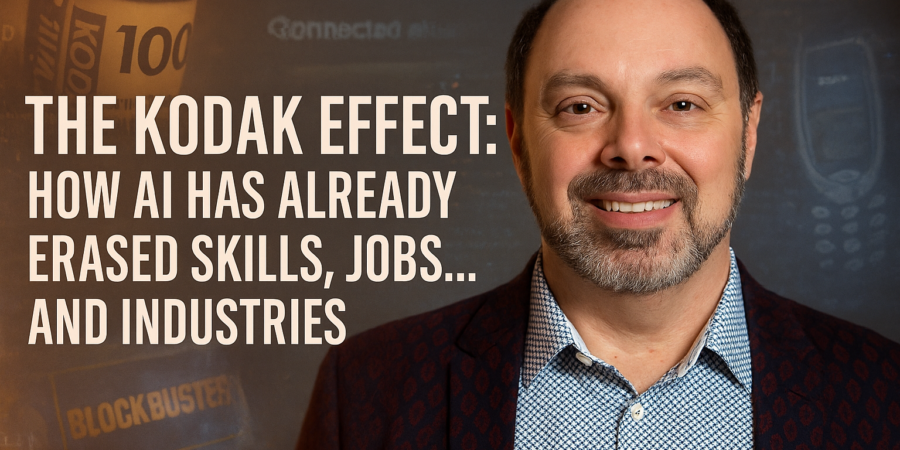
The Kodak Effect, 2025: The Vanishing Act AI Has Already Performed
You don’t hear the exact moment a sound disappears.
The click of a Kodak shutter. The screech of dial-up internet. The clunk of a Blockbuster VHS case.
One day it’s part of the rhythm of life.
The next, it’s gone and we barely notice the silence.
That was the thread of my latest live segment on RTHK3 with Phil Whelan, where we pulled at a meme that said: “Learning to code was once the golden ticket to a six-figure salary. Perhaps no longer, thanks to AI.”
Listen to the full segment here (17 minutes 47 seconds)
Exhibit A: The quiet death of dial-up
On air, Phil and I laughed about AOL’s announcement. After thirty years, the world’s most familiar screech, the dial-up handshake, is finally being switched off.
I called it a perfect example of the Kodak Effect: a technology once so essential that life felt impossible without it, quietly disappearing.
As I said live: “Who would have thought it? AOL dial-up was the lifeblood of the internet. Now it’s gone, and most of us won’t even notice.”
Exhibit B: Coding isn’t the goat anymore
Phil read that meme aloud: “Learning to code was the golden ticket.” Then he asked me: is it still true?
My answer was blunt: “Not anymore.”
Tools like GitHub Copilot and ChatGPT now do the keystrokes. The real skill is knowing what should be built and knowing when to stop.
That’s the human role in the AI era.
This is what I call HUMAND™ the balance between Human, Machine, and AI:
-
Humans set intent, judgment, and accountability.
-
Machines provide repeatable precision.
-
AI translates intention into outcomes at speed.
Exhibit C: Music without musicians
Phil and I also explored the strange new world of AI music.
We talked about imOliver, who openly admits he can’t sing or play yet racks up millions of downloads on platforms like Suno and Udio, even landing a record deal.
And about Velvet Sundown, a “band” with over a million monthly Spotify listeners before revealing they didn’t exist.
As I told Phil: “If it makes your heart sing, if it stretches your soul, it shouldn’t really matter how it originated. If it’s pretending to do that and doesn’t, then it won’t last.”
What disappears next?
From dial-up to coding to music, here’s what I see fading fastest:
-
Trust in content Humans are now hired to clean up AI “slop.”
-
Scarcity as strategy With infinite AI output, curation and credibility are the moat.
-
Origin as value Being “human-made” isn’t enough. Distinctiveness and explainability matter more.
The leader’s lens: replacing what’s lost
Kodak didn’t fail because photography ended. It failed because it didn’t move to where the value migrated. AOL, Blockbuster, Nokia, all fell through the same Kodak window.
Here’s how to avoid the same fate:
-
From keystrokes to outcomes. Stop measuring tasks. Measure capability shipped.
-
From scarcity to signal. Trust and authority are defensible moats.
-
From blind automation to Decision Trust Zones™. My framework for drawing the line: when AI decides, when it only advises, and when humans must own the call.
-
From origin to meaning. Don’t argue for authenticity. Prove you move people, solve problems, and create explainable value.
A 30-day challenge for leaders
-
List your Kodak-risks. Which defaults could vanish tomorrow? Write them down.
-
Draw your Decision Trust Zones™. Make AI governance visible. Teach it internally.
-
Rewrite two job descriptions to HUMAND standards. Replace task lists with outcomes.
-
Run one experiment replacing a legacy default with an AI-powered workflow. Track the Ripple Effects™ across cost, trust, and speed.
Why this matters now
As I said on RTHK3:
“The danger isn’t that AI makes us obsolete. The danger is that we don’t replace what it takes away with something stronger, human-led, and future-facing.”
The Kodak Effect is happening all around us.
The question isn’t whether your current model will disappear, it’s whether you’ll choose what replaces it.
If you don’t, someone else will.
Choose Forward.
#MorrisMisel #Futurist #Foresight #KodakEffect #AI #FutureOfWork #Leadership #Strategy #HUMAND #DecisionTrustZones #RippleEffects #Innovation #FutureProofing #KeynoteSpeaker #Csuite #CEO #StrategicLeadership #BusinessStrategy #EventOrganisers #FutureThinking
Frequently Asked Questions
Q: What is the Kodak Effect and why does it keep repeating?
Kodak’s engineers invented the digital camera in 1975. The company held patents, had the resources, and understood the technology. What they could not do was act against the economic logic of their existing business, film, which was highly profitable and funded everything they did. The digital signal was present and understood; the inability to act on it was structural, not informational. The pattern repeats because it is not caused by ignorance of change signals. It is caused by the deep difficulty of cannibalising a profitable present to protect a threatened future, particularly when the threat is not yet affecting current period results.
Q: Which sectors are showing Kodak Effect patterns in 2025?
Several. Media organisations that understand AI’s implications for content production but cannot act against existing editorial and employment structures. Legal firms that see AI’s implications for billable-hour models but cannot reduce the economics of current practice. Education institutions that understand credential disruption but cannot redesign offerings that undermine existing enrolment models. Financial services organisations that see fintech and AI implications but cannot move against the economics of current product margins. The pattern in each case is the same: the signal is present, the understanding is there, the structural and economic barriers to action are the real constraint.
Q: What differentiates organisations that escape the Kodak Effect from those that don’t?
Willingness to act against current period economics before the competitive pressure makes inaction costlier than action. The structural capacity to run parallel business models, protecting current revenue while investing in the successor model, which requires resources, leadership tolerance for ambiguity, and governance that can hold two economic logics simultaneously. And leadership that frames the choice honestly: not as ‘whether to change’ but ‘whether to change on our own terms or have it done to us.’ The organisations that escape the pattern are those that make the harder choice earlier, when they still have the resources and time to make it well.
Q: Can Morris Misel speak on strategic disruption, the Kodak Effect, and leading through business model change for our board, executive, or industry association audience?
Yes. Strategic disruption and business model change are core keynote topics for boards, executives, and industry associations. Book at morrismisel.com.