Choose Forward: Inside My Future of Leadership Workshop
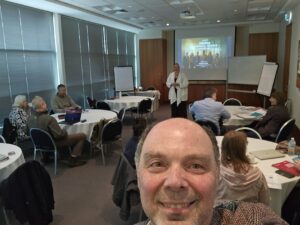
You’ve just sat down. The room feels safe, predictable. I’m introduced and instead of standing still, I stride. From the very back, I move at pace down the aisle. As I pass, I sweep my arm forward and say, “Let’s go.”
And you follow.
Some slowly. Some sheepishly. Some glancing sideways to see if others will move first. But you all follow.
I stop and turn.
“Why did you follow me?”
The answers come, hesitant at first:
-
“I thought I had to.”
-
“Someone stood, so I did.”
-
“I didn’t want to be the one left behind.”
-
“I didn’t want to, but everyone else was.”
Exactly.
“This is leadership. You have the plan in your head, but you’re the only one who does. All they have is the angst, the unease, the uncertainty. And still they follow. That’s your impact. In a single moment, you pulled them out of the safe and into the unknown.”
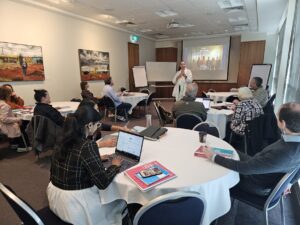
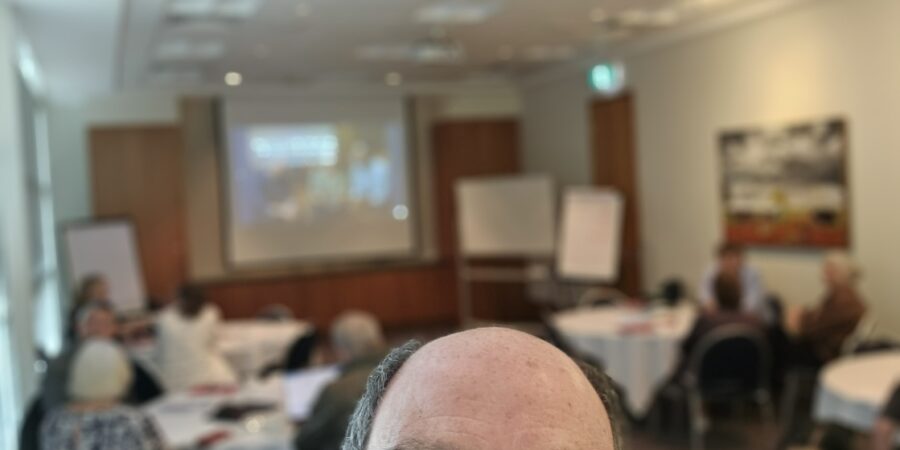
That’s how the workshop began, a room of emerging leaders stepping into the Future of Leadership with me to test real leadership in real time.
Not through slides or lectures, but by feeling it first-hand.
From that moment on, every exercise and story was about exploring what it means to lead into tomorrow.
Workshop Snapshot
-
Who it’s for: emerging and established leaders ready to stretch how they lead into tomorrow.
-
Style: live, interactive, no lectures. We test leadership in real time.
-
What we explore: Felt, Constructed, and Designed Futures. Inhabitable Futures. Ripple Effects. HUMAND™ (humans, machines, AI). Immediate Futures.
-
How it feels: fast, human, practical. You will talk, write, stand, decide.
-
Outcome: clarity, language, and first steps you can act on this week.
What Is Leadership, Really?
With the room still alive from that opening, I asked for one-sentence definitions of leadership.
The answers came quickly:
-
“Guidance, not control.”
-
“Inspiring others to take action.”
-
“Take people along on the journey.”
-
“Help people be better.”
-
“Trust and respect of the team.”
-
“Mentor people to grow.”
These were good, human answers. But I pressed them: “You’ve all defined leadership as leading others. What about leading yourself?”
The room shifted. Quieter now. Heads tilting. People reflecting.
Voices added: “Openness.” “Not being the expert.” “Sometimes just making the tough call when no one else will.”
I framed it this way:
“A manager walks into certainty. A leader takes you beyond it.”
Leadership is a continuum. Ninety-five percent of the time it’s about collaboration, empathy, and bringing people along. But sometimes it’s about flex. Stepping into the space no one else will. Carrying unease. Moving anyway.
Projecting to 2035
I asked them to project forward: “It’s 2035. You’ve become the leader you want to be. What makes you proud?”
The answers were bold and simple:
-
“That I can look back on the last 10 years without regret.”
-
“That I created a workplace people want to be in.”
-
“That I built a team that wants to be there.”
Someone joked they’d be “jaded and cynical.” I laughed but challenged: “Why take the joy out of it? Leadership should be about finding the pride, not losing it.”
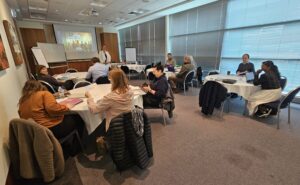
That was the shift, from today’s tasks to tomorrow’s pride. From managing to imagining.
Those answers were their first sketches of an Inhabitable Future: a future they’d be proud to live in.
The Three Futures Leaders Hold
Every leader holds three futures at once:
-
Felt Future: people’s human needs.
-
Constructed Future: the systems, culture, and legacy you inherit.
-
Designed Future: the choices you make within those constraints.
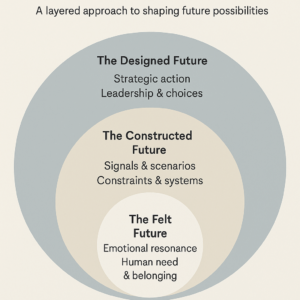
Strategy doesn’t begin with organisations or brands. It begins with people. Meet their needs, then build the scaffolding, and only then design the future.
From there, we moved to Inhabitable Futures: the futures we’d be proud to live in.
“Inhabitable Futures aren’t just visions. They’re futures you’d be proud to inhabit.”
To make it real, I told a story from India: the roads where there are no stoplights, just chaos. You weave, adjust, and move forward.
I reminded them:
“I don’t believe in mistakes. Only missteps. Missteps are human and recoverable. Mistakes feel final. Language matters.”
And then I named the force that keeps us moving: Choose Forward Energy, the determination to act even in uncertainty.
“Choose Forward is the decision to keep moving, to weave, not freeze.”
Ripple Effects Leaders Can’t Ignore
Every leader faces ripple effects, external forces shaping their path. We surfaced the ones pressing hardest right now:
-
Shifting value of credentials
-
Demographic cliff
-
Non-traditional competitors
-
PTFA (Past Trauma, Future Anxiety)
-
Burnout and compliance overload
The room had stories:
-
A 57-year-old carpenter with four decades of skill but locked out because his 1990 qualification isn’t in the system.
-
Apprentices saying they just want “tick-and-flick.”
-
Staff waiting six weeks for swipe card access.
I told them:
“We’re devolving back to craftsmanship and guilds. Credentials are in flux. Leaders must navigate that tension and decide what craftsmanship means in the age of AI.”
HUMAND™: Leading Humans, Machines, and AI
Most conversations about leadership assume it’s only about people. That’s no longer true.
It’s HUMAND™: Humans, Machines, and AI.
[Insert Slide: HUMAND diagram]
-
Humans: empathy, creativity, complex judgment.
-
Machines: tools, systems, processes.
-
AI: automation, pattern recognition, augmentation.
If leadership is designing futures, HUMAND™ is your task map.
“Leaders don’t just lead people anymore. They lead humans, machines, and AI. That’s HUMAND™.”
The leader’s job is orchestration deciding what’s best done by each, or by their dance together. Job descriptions written for yesterday are fences around tomorrow’s possibilities.
What Followers Need Most
We zoomed back in on the human core.
Research shows followers want four things from leaders:
-
Hope
-
Trust
-
Compassion
-
Stability
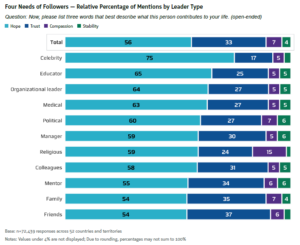
One participant put it best: “If you’ve got hope and trust, you’ve already got stability.”
That’s it. People assume you’ll manage resources. What they really need is hope and trust.
“Protect hope, calm anxiety, keep your people thriving.”
Immediate Futures: Bold and Doable
We ended with immediacy. I asked: “What’s one bold move and one doable tweak you can make today?”
The answers were practical and courageous:
-
Bold: “Get trades staff to use AI to elevate lesson plans.”
-
Doable: “Hold weekly peer-led drop-in sessions.”
-
Bold: “Launch the orchard project.”
-
Doable: “Share power across campuses, even if it means giving some control away.”
I told them:
“Ideas are easy. Leaders move. Full stop.”
Future Me
To close, I asked them to complete one sentence: “Future me…”
The answers were raw and personal:
-
“…leads with more empathy.”
-
“…lets go of overthinking.”
-
“…leads with more clarity.”
-
“…lets go of power.”
-
“…leads with more courage.”
It wasn’t about my permission. It was about theirs. A leader doesn’t wait for approval to move forward. They give themselves permission, to step, to act, to choose.
I anchored it with this:
“You can’t predict the future, but you can prepare for it. Don’t let the future choose you. Choose it. Choose Forward.”
More Than a Workshop
This wasn’t just a session about HUMAND™, or ripple effects, or foresight tools. It was a framework to explore widely, not a prescription to fix one ailment.
We tested what it feels like to follow into the unknown. We surfaced their PTFA (Past Trauma, Future Anxiety) roadblocks. We stretched into Inhabitable Futures. We mapped where humans, machines, and AI belong in the work of tomorrow. And we left with Immediate Futures, bold and doable next steps that can start within seven days.
And remember: this was all in a two-hour workshop. Imagine what unfolds in half a day, a full day, two days, or ongoing. That’s the beauty of this work: it scales and reshapes to fit the context.
What You’ll Experience / Take With You
What you’ll experience
-
The unease of following, then the clarity of naming it.
-
Real voices in the room, not theory.
-
Foresight frameworks you can actually use.
-
HUMAND™ task mapping: who should do what, human, machine, or AI.
-
Turning vision into two next steps: one bold, one doable.
What you’ll take with you
-
A shared language for the future of leadership.
-
A sharper sense of what your people need most: hope and trust first.
-
A shortlist of Ripple Effects already shaping your world.
-
Your Immediate Futures: actions you can start within seven days.
-
Permission to move. Not when it’s perfect. Now.
Call to Action
Bring this to your leaders.
If your leadership team is ready to stretch beyond today’s definitions, to see themselves in a future world of possibilities, to discover what their people need most, to recognise their PTFA roadblocks, and to take their first Immediate Futures steps, let’s design a workshop together.
This is not a formula. It’s a space. A framework to think far and wide from.
Because you can’t predict the future. But you can prepare for it.
And the leaders who will matter most are the ones who choose forward.
FAQ
Can this be virtual?
Yes. It works in-room or online. The exercises shift, but the energy doesn’t.
Do we need AI expertise?
No. HUMAND™ starts with tasks, not tools. We decide what’s best done by humans, machines, and AI, then we act.
What size group works best?
Small enough to hear one another. Large enough for diversity of thought. The format adapts to your context.
What changes in the first 30 days?
Shared language. Clear first moves. More hope and trust in the room. Leaders start moving again.
Pull-Quotes for Reuse
-
“Leadership begins the moment someone says, ‘Let’s go.’”
-
“A manager walks into certainty. A leader takes you beyond it.”
-
“There are no mistakes, only missteps.”
-
“Followers want four things: hope, trust, compassion, stability.”
-
“Leaders don’t just lead people anymore. They lead humans, machines, and AI.”
-
“Ideas are easy. Leaders move. Full stop.”
-
“Don’t let the future choose you. Choose Forward.”
Morris Misel is a futurist, foresight strategist, and human-centric thought leader heard by millions each year in the media and onstage.
For more than 30 years, he has helped organisations across 160 industries prepare for tomorrow with clarity, courage, and imagination.
His proprietary frameworks including HUMAND™, Ripple Effects, Immediate Futures, PTFA, and Choose Forward challenge leaders to move beyond certainty, stretch into inhabitable futures, and take bold and doable steps today.
Misel believes the future isn’t about prediction, it’s about preparation, and his work gives leaders the confidence to navigate disruption while protecting what makes us most human.
#ChooseForward #FutureOfLeadership #LeadershipDevelopment #Foresight #InhabitableFutures #RippleEffects #HUMAND #ImmediateFutures #PTFA #FutureLeaders #WorkforceFutures #LeadershipStrategy #AIandLeadership #EducationLeadership #VocationalEducation #HigherEducation #AdultLearning #LifelongLearning #FutureOfWork #LeadershipMindset #OrganisationalChange
Frequently Asked Questions
Q: What does ‘Choose Forward’ mean as a leadership principle?
It means making decisions that are oriented toward the futures you want to build rather than constrained entirely by the risks you are trying to avoid. Most leadership decisions under uncertainty default to risk minimisation, the question is ‘what could go wrong?’ rather than ‘what do we need to be true about this choice for it to be the right one?’ Choose Forward is not recklessness, it does not mean ignoring risk. It means refusing to let risk aversion become the primary frame for decisions about the future. It means asking, alongside ‘what could go wrong?’, ‘what becomes possible if we get this right?’
Q: What does workshop facilitation reveal about why leaders struggle to choose forward?
That the barriers are almost never informational, leaders generally understand the direction of change and the case for action. The barriers are psychological and organisational. Psychologically, the asymmetry between the pain of a bad outcome and the satisfaction of a good one makes risk avoidance feel rational even when it is not. Organisationally, the accountability structures in most organisations punish visible failures more than they reward invisible ones, the decision not made, the change not attempted, the future not pursued. These structures produce caution even in leaders who are personally willing to act boldly.
Q: What does genuine leadership courage look like in practice?
Making the decision whose downside is visible and attributable to you, rather than the decision whose downside is diffuse and deniable. Naming the uncertainty in the room rather than performing confidence you do not have. Acting on a strategic direction before the evidence is conclusive, because by the time it is conclusive the opportunity has passed. And holding the frame for your team when the path is uncomfortable, not pretending the discomfort is not real, but insisting that the destination is worth it. These are not dramatic gestures; they are the quiet, daily choices that differentiate leaders who build genuinely useful futures from those who manage the present.
Q: Can Morris Misel facilitate a Choose Forward leadership workshop or keynote for our executive team, board, or leadership conference?
Yes. The Choose Forward workshop and keynote are available for executive teams, boards, and leadership conferences. Book at morrismisel.com.