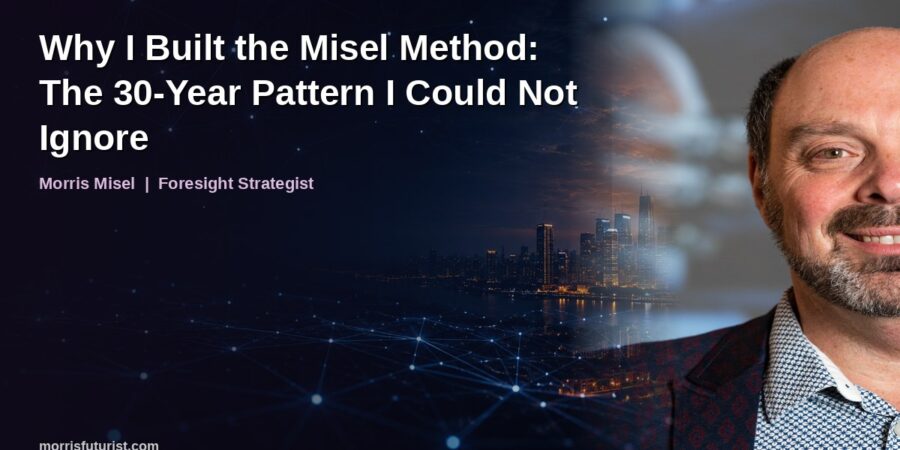
Why I Built the Misel Method: The 30-Year Pattern I Could Not Ignore
There is a moment I keep coming back to.
I am sitting in a boardroom, it could be anywhere, and someone senior is explaining their strategy for the next three years. They have done the work. The slides are good. The thinking is genuine. And as they speak, I can see exactly what is going to happen in the next six months that their plan has not accounted for. Not because I am smarter. Because I have been in this room before, with a different set of slides, in a different organisation, and I know how this particular kind of change moves.
That feeling, that gap between what is visible and what is already in motion, is what the Misel Method was built to close.
Not to make leaders dependent on a futurist. To make leaders independent of one.
Why I Stopped Giving Answers
For the first decade of my career, I thought my job was to tell people what was coming. I was the person with the signal, and my value was in translating it. Come in, explain the shifts, leave. The organisation would take it from there.
It took me longer than I would like to admit to understand why that was not enough.
The knowledge landed. But it did not stick. I would return to the same organisation twelve months later and find that nothing had changed, not because the leaders were incompetent, but because the insight I had given them had no home inside their decision-making. It existed as content, not as capacity. They had learnt about the future, but they had not learnt to see it for themselves.
That is when I started asking a different question. Not “what do these leaders need to know?” but “what do they need to be able to do?”
The answer was: they needed a practice. A way of holding the future inside everyday judgement rather than treating it as something separate that required a specialist visit.
The Misel Method is that practice.
The Problem It Is Designed to Solve
Most leaders are not short of information about the future. They have access to more of it than any previous generation of decision-makers. What most of them are short of is a way to hold two horizons in mind at the same time without being paralysed by the tension between them.
The first horizon is what I call Immediate Futures, the next layer of consequence that begins the moment a decision is made. The meeting that follows. The behaviour that shifts. The trust that is strengthened or eroded. The workload that increases somewhere else in the system before anyone notices. Immediate Futures are not about next year. They are about what is already moving.
The second horizon is what I call Inhabitable Futures, the kind of organisation the leadership team is actually trying to build. Not the future on the strategy slide, but the future that real people can live, work, trust, and thrive inside. The distinction matters because there is no shortage of impressive futures being described in boardrooms. What is rarer is a future that holds up when people actually try to inhabit it.
Most leadership strain does not come from failing to think about the long term. It comes from being pulled between these two horizons without a clear sense of how they connect. Decisions get delayed because they are weighed against distant ideals rather than present realities. Others get rushed because short-term pressure overwhelms longer-term intent. The method does not ask leaders to choose one horizon. It asks them to hold both, and to know which one each decision belongs to.
The Terrain Between Horizons
The second element of the method addresses what happens between intention and outcome.
I have sat with enough leadership teams to know that the path from a good decision to a good result is almost never straight. Decisions travel. They move through people, through culture, through informal norms, through the residue of how the last change was experienced. They interact with workload. They intersect with identity and role clarity. They arrive differently than they were sent.
I describe this terrain as Ripple Effects, not as a metaphor, but as a structural description of how decisions actually move through organisations.
The reason most leaders are surprised by the consequences of their decisions is not a failure of foresight. It is a failure of framing. When decisions are evaluated only on their intended outcomes (the metrics, the timeline, the deliverable) the ways they will travel through the organisation are invisible by design. Ripple Effects asks a different question at the moment of decision: not just what does this achieve, but what does this set in motion?
Asking that question does not require perfect prediction. It requires a broader awareness of how decisions interact with human systems over time. That awareness is learnable. It can be practised. And once it is embedded in a leadership team’s thinking, it changes how decisions feel before they are made, not just how they look in the review.
The Human Cost of Operating in This Terrain
The part of the method I was most reluctant to name publicly is also the part that resonates most when I do.
Behind every decision sits a human being carrying their own history. Not just their professional history, the deals won and lost, the turnarounds they led, the restructures they survived. Their personal history. The experiences that shaped what risk feels like to them. The moments that taught them what trust costs. The times when being wrong was expensive.
I spent fifteen years as a volunteer prison chaplain and crisis counsellor. I have sat with people at the furthest edges of the human experience, people who had lost everything, people who had hurt others, people trying to imagine a future when the present was unbearable. What I learned in those rooms, more than anything, is that the past does not stay in the past. It travels forward. It shapes what we see when we look ahead, often without us knowing it.
Leaders are not immune to this. The past experience that once earned them trust can become the very thing that makes them cautious when caution is not what is needed. The fear of repeating a painful failure can override a clear reading of a genuinely different present. The anxiety about how a decision will be judged can begin shaping choices before any evidence has arrived.
I describe this as Past Trauma, Future Anxiety, PTFA. Not a diagnosis. Not a weakness. A completely natural human response to operating in environments where the cost of getting things wrong feels amplified and the ground beneath decisions feels less stable.
The method names this because unnamed pressures are the most powerful ones. When leaders can recognise PTFA in themselves (not as a flaw, but as a natural pattern) they regain a degree of choice about how much weight to give it. That awareness alone can restore clarity and steadiness under pressure that would otherwise feel opaque.
Who Decides, and What They Actually Trust
The fourth element of the method addresses a question that has become more urgent in the last three years than in the previous thirty combined: who or what do leaders actually trust to support decision-making?
The answer has shifted dramatically. Very few leadership decisions today are made by humans alone. Even when a leader believes they are deciding independently, their judgement is shaped by systems, data, models, and increasingly by algorithmic or AI-assisted inputs. Recommendations are surfaced before humans speak. Risks are flagged. Options are narrowed. Patterns are suggested.
This is not a problem. It is a reality. What is a problem is that the boundaries of trust between human judgement and machine or AI support are often undefined. Leaders are left to intuitively decide when to rely on data and when to override it, usually without an explicit framework for doing so. My primary research, Who Decides 2025, examined this directly: where are Australian leaders drawing the line between human and machine decision authority, and why?
I describe the answer as Decision Trust Zones, the explicit, conscious mapping of which kinds of decisions are best informed by human judgement, which benefit from machine precision, and where AI can assist without displacing accountability. When these zones are undefined, leaders either over-trust systems that lack context, or under-use tools that could genuinely serve them. Both responses increase risk. The method makes the zones explicit, so trust is designed rather than assumed.
How Work Gets Misaligned With Judgement
Even when decisions are well-made, they have to be carried out. And this is where a different kind of strain enters the picture.
In most organisations, the problem is not that work is poorly designed in the abstract. It is that humans are regularly asked to work like machines, to deliver consistency, volume, and compliance at a pace that leaves no room for the judgement they were hired to exercise. Meanwhile, machines are often expected to exercise context and empathy they were never built to have. And AI is introduced into workflows before anyone has been clear about what its role actually is.
The result is misalignment. Judgement erodes because it has been squeezed out of the task design. Trust fractures because the boundaries between human and technological contribution are unclear. People feel like they are compensating for a system that was not built with them in mind, because they are.
The HUMAND framework addresses this directly. HUMAND is not a slogan about balance between humans and technology. It is a practical way of asking, of every task and every decision: who or what is genuinely best placed to do this well, and why? When that question is answered consciously, not defaulted into, work becomes more coherent. People understand their actual role in the system. Technology does what it does best without overreach. Judgement flows more cleanly into action.
Why Foresight Has to Be Practised, Not Studied
The last element is the one that ties the others together, and the one most organisations leave out.
Foresight is regularly treated as an intellectual exercise. Something that happens at the annual strategy review, or when a consultancy is brought in to scan the horizon, or when the board decides it is time to “think about the future.” This approach produces useful content. It rarely produces durable capacity.
The organisations I have worked with that are genuinely future-ready are not the ones with the most sophisticated scenario planning. They are the ones where the habit of asking “what does this set in motion?” has become part of how decisions are made in ordinary meetings, on ordinary days, under ordinary pressure. Foresight is not separate from their decision-making. It is woven into it.
This is what the Misel Method is trying to build. Not a vocabulary about the future, but a practice for operating inside it. The frameworks (Immediate Futures, Inhabitable Futures, Ripple Effects, PTFA, Decision Trust Zones, HUMAND) are not six separate tools to be deployed on separate occasions. They are a single system. Together they address the full arc of leadership decision-making: what horizon are we in, how will this decision travel, what are we carrying into it, who and what do we trust to support it, and is our work designed to let judgement survive execution?
When those questions are asked together, consistently, they change the quality of decisions in ways that periodic foresight exercises never quite manage.
Where the Method Comes From
I want to be clear about what this is and what it is not.
It is not a consulting methodology invented in a workshop. It is not a framework built from academic literature and then applied to the real world. It is a pattern that emerged from thirty years of being in rooms where real decisions were being made under real pressure, and noticing, again and again, where the thinking fell short in the same ways.
The two horizons came from watching leaders collapse their vision into the immediate or lose the immediate inside the vision, with predictable consequences in both directions. Ripple Effects came from seeing well-intentioned decisions land badly because no one had traced how they would travel. PTFA came from sitting with leaders who were clearly being driven by something older than the current situation, and from my years of understanding what past experience does to present judgement. Decision Trust Zones came from watching smart people defer to systems they did not understand, or override systems that were giving them accurate information, because they had no framework for knowing which to do. HUMAND came from watching organisations repeatedly design work as if humans and machines were interchangeable, and experiencing the quiet depletion that followed.
The method is built from evidence, not theory. Thirty years of it, across 160 industries and somewhere north of 2,800 engagements. That is not a credential claim. It is the context that makes the patterns legible.
What It Is Not
It is not a prediction service. I cannot tell you what the world will look like in ten years and I am sceptical of anyone who says they can with confidence. What I can do, what the method does, is trace the consequences already in motion from decisions already made, and build the capacity in your team to keep doing that tracing themselves.
It is not a technology solution. The questions the method asks are human questions. They require human context, human judgement, and human accountability. Technology can inform them. It cannot answer them.
It is not a quick fix. A one-day workshop can introduce the language. Embedding the practice takes longer. The organisations that have done it well have done it over time, with iteration and with honest feedback loops that the method itself is designed to support.
The Most Important Thing I Have Learned
After thirty years, the thing I keep coming back to is this: the future is not something that happens to organisations. It is something they participate in making, through every decision they take, every trust relationship they build or erode, every way they design their work and every story they tell about what they are for.
That is not optimism. It is agency. And it is the foundation the Misel Method stands on.
You can find the full framework at morrismisel.com/the-misel-method. If what you have read here resonates, I would be glad to explore what it looks like inside your organisation.
Choose Forward.
Frequently Asked Questions
What is the Misel Method?
The Misel Method is a foresight practice developed by Morris Misel over 30 years of working with leaders across 160 industries. It integrates six frameworks (Immediate Futures, Inhabitable Futures, Ripple Effects, PTFA (Past Trauma, Future Anxiety), Decision Trust Zones, and HUMAND) into a single system for leadership decision-making under uncertainty. Its purpose is to build foresight as a practised capacity in organisations, not a periodic consultancy exercise.
How is the Misel Method different from conventional strategic planning?
Conventional strategic planning typically focuses on a single desired future. The Misel Method works with futures as plural, holding two horizons simultaneously, tracing how decisions travel through organisations as Ripple Effects, and accounting for human dynamics that shape judgement under pressure. It is a practice for navigating uncertainty, not a plan for eliminating it.
What is PTFA and why does it matter for leadership?
PTFA stands for Past Trauma, Future Anxiety, a framework describing the quiet tension leaders carry into decision-making. Past experience shapes what risk feels like; anticipated future judgement shapes what is chosen before evidence arrives. Recognising PTFA restores the degree of choice that unconscious pressure removes.
What does HUMAND stand for?
HUMAND is Morris Misel’s framework for deciding what work is best done by Humans, Machines, AI, or a combination of all three. It addresses the structural misalignment that occurs when humans are asked to work like machines, or AI is introduced without clarity about its role. HUMAND asks of every task and decision: who or what is genuinely best placed to do this well, and why?
Who is the Misel Method designed for?
The Misel Method is designed for leaders, boards, and executive teams operating under uncertainty, particularly where decisions carry significant human, strategic, or organisational consequences. It is applied across corporate, government, associations, professional services, and education sectors.
The Misel Method is a framework Morris developed from 30 years of observing how organisations and leaders respond to uncertainty. It codifies patterns he noticed repeatedly: certain decisions stall progress, certain communication patterns erode trust, certain assumptions about the future blind organisations to signals already present.
Morris noticed the same mistakes, fears, and misalignments repeating across different industries, organisations, and decades. Leaders were solving the same underlying problems with slightly different tactics. Instead of offering another tool, he built a method that names the pattern itself, so clients could see their own situation more clearly.
It’s grounded in lived experience, not theory. Every principle in the method comes from work Morris has done with real organisations facing real decisions. It’s built to surface the assumptions people don’t know they’re holding, the invisible decisions that determine outcomes.
It teaches organisations to read signals early, understand their own patterns of resistance, and make decisions from clarity rather than panic. It’s not about predicting the future, it’s about building capacity to sense what’s arriving and respond with intentionality.
Because the pattern had to become undeniable. Morris needed to see it across enough contexts, enough industries, enough leadership teams to be confident it was real. A method built on three years of observation is an opinion. One built on 30 years of evidence is a tool people can trust.
The Misel Method is a framework Morris developed from 30 years of observing how organisations and leaders respond to uncertainty. It codifies patterns he noticed repeatedly: certain decisions stall progress, certain communication patterns erode trust, certain assumptions about the future blind organisations to signals already present.
Morris noticed the same mistakes, fears, and misalignments repeating across different industries, organisations, and decades. Leaders were solving the same underlying problems with slightly different tactics. Instead of offering another tool, he built a method that names the pattern itself, so clients could see their own situation more clearly.
It’s grounded in lived experience, not theory. Every principle in the method comes from work Morris has done with real organisations facing real decisions. It’s built to surface the assumptions people don’t know they’re holding, the invisible decisions that determine outcomes.
It teaches organisations to read signals early, understand their own patterns of resistance, and make decisions from clarity rather than panic. It’s not about predicting the future, it’s about building capacity to sense what’s arriving and respond with intentionality.
Because the pattern had to become undeniable. Morris needed to see it across enough contexts, enough industries, enough leadership teams to be confident it was real. A method built on three years of observation is an opinion. One built on 30 years of evidence is a tool people can trust.