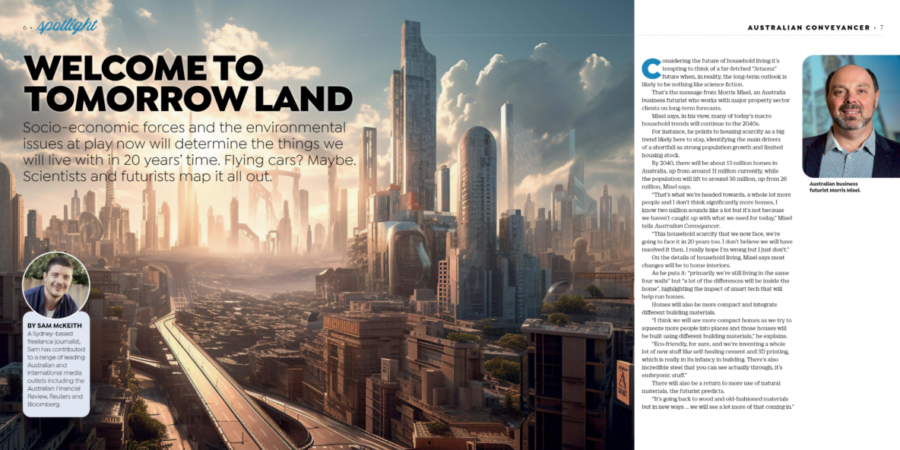
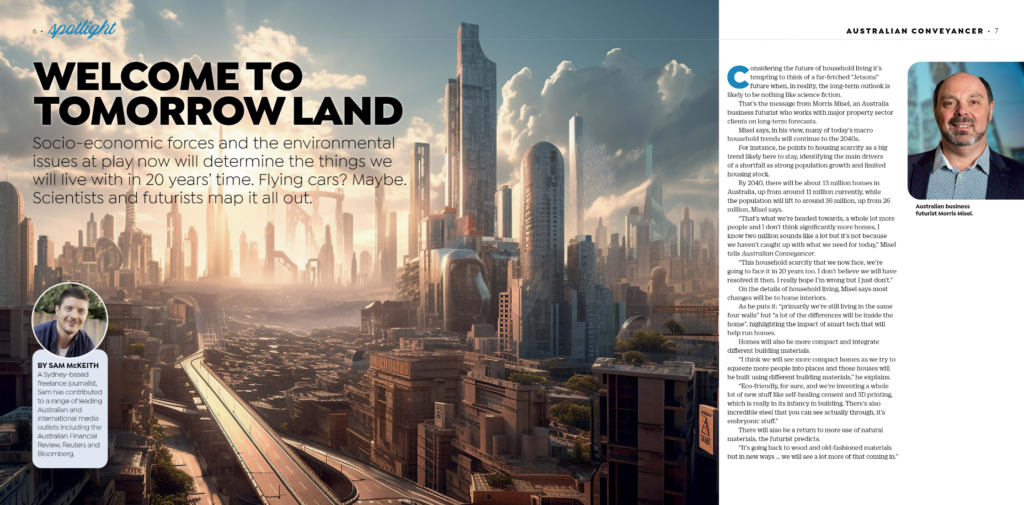
Welcome to Tomorrow Land
Socio-economic forces and the environmental issues at play now will determine the things we will live with in 20 years’ time. Flying cars? Maybe. Scientists and futurists map it all out.
Considering the future of household living It’s tempting to think of a far-fetched “Jetsons” likely to be nothing like science fiction.
That’s the message from Morris Misel, an Australia business futurist who works with major property sector clients on long-term forecasts.
Misel says, in his View, many of today’s macro household trends will continue to the 2040s.
For instance, he points to housing scarcity as a big trend likely here to stay, identifying the main drivers.
of a shortfall as strong population growth and limited housing stock.
By 2040, there will be about 13 million homes in Australia, up from around 11 million currently, while the population will lift to around 36 million, up from 26 million, Misel says.
“That’s what we’re headed towards. a whole lot more people and l don’t think significantly more homes. I know two million sounds like a lot but it’s not because we haven’t caught up with what we need for today: Misel tails Australian Conveyancer.
“This household scarcity that we now face, we’re
going to face it in 20 years too. I don’t believe we will have resolved it then. I really hope I’m wrong but! just don’t.”
On the details or household living, Misel says most changes will be to home interiors.
As he puts it: “primarily we’re still living in the same four walls” but “a lot of the differences will be inside the home·. highlighting the impact of smart tech that will help run homes.
Homes will also be more compact and integrate different building materials.
likely to be nothing like science fiction.
That’s the message from Morris Misel, an Australia business futurist who works with major property sector clients on long-term forecasts.
Misel says, in his View, many of today’s macro household trends will continue to the 2040s.
For instance, he points to housing scarcity as a big trend likely here to stay, identifying the main drivers of a shortfall as strong population growth and limited housing stock.
By 2040, there will be about 13 million homes in Australia, up from around 11 million currently, while the population will lift to around 36 million, up from 26 million, Misel says.
“That’s what we’re headed towards. a whole lot more people and l don’t think significantly more homes. I know two million sounds like a lot but it’s not because we haven’t caught up with what we need for today; Misel tails Australian Conveyancer.
“This household scarcity that we now face, we’re going to face it in 20 years too. I do not believe we will have resolved it then. I really hope I’m wrong but just don’t.”
On the details or household living, Misel says most changes will be to home interiors.
As he puts it: “primarily we’re still living In the same four walls” but “a lot of the differences will be inside the home·. highlighting the impact of smart tech that will help run homes.
Homes will also be more compact and integrate different building materials.
I think we will see more compact homes as we try to squeeze more people into places and those houses will be built using different building materials,” he explains.
Eco-friendly, for sure, and we’re inventing a whole lot or new stuff like self-healing cement and 3D printing, which is really in its infancy in building. There’s also incredible steel that you can see actually through, it’s embryonic stuff!’
There will also be a return to more use of natural materials, the futurist predicts.
“It’s going back to wood and old-fashioned materials but in new ways we will see a lot more of that coming in.
written by Sam McKeith, reprinted from Australian Conveyancer January 2024 Edition
Frequently Asked Questions
Q: What does it mean to have a foresight mindset?
It means holding uncertainty as information rather than as a problem to be eliminated. A foresight mindset recognises that the future is not predictable but is navigable. That understanding the signals, forces, and patterns in play allows you to act more wisely even without certainty about outcomes. It is the opposite of both paralysis (refusing to act without certainty) and overconfidence (assuming your prediction is correct).
Q: How do you develop a foresight mindset in practice?
By building habits of wide reading across disciplines, deliberately seeking out perspectives that challenge your existing assumptions, tracking signals over time rather than just reacting to events, and practising the discipline of asking ‘what would have to be true for this to continue?’ and ‘what second-order effects will this produce?’ These are trainable skills, not innate gifts.
Q: Is foresight the same as futurism?
Related but distinct. Futurism is often associated with prediction, declaring what will happen. Foresight is about expanding the range of plausible futures you are prepared for. The goal is not to be right about a specific prediction but to be less surprised when change arrives and better positioned to respond. Foresight is a strategic capability; futurism is often a communications register.
Q: Can Morris Misel run a foresight thinking workshop for our team or leadership group?
Yes. Foresight capability building (for boards, executive teams, and professional groups) is a core offering. Book at morrismisel.com.
Socio-economic forces and the environmental issues at play now will determine the things we will live with in 20 years’ time. Flying cars? Maybe. Scientists and futurists map it all out. Considering the future of household living It’s tempting to think of a far-fetched "Jetsons".
When signals like Welcome to Tomorrow Land emerge, organisations that engage early have the advantage of choosing their response rather than reacting to events. That gap between those who prepared and those who did not is where competitive positioning is actually made or lost.
The most important question is not whether Welcome to Tomorrow Land will matter, but how quickly it will matter in your specific context. Leaders benefit most from mapping the ripple effects early — not just the direct impact but the second and third-order consequences that arrive later and hit harder. That is the practical work of foresight.



One comment
Pingbacks and Tracebacks
[…] (Related reading: Housing 2040: A Glimpse into the Future) […]