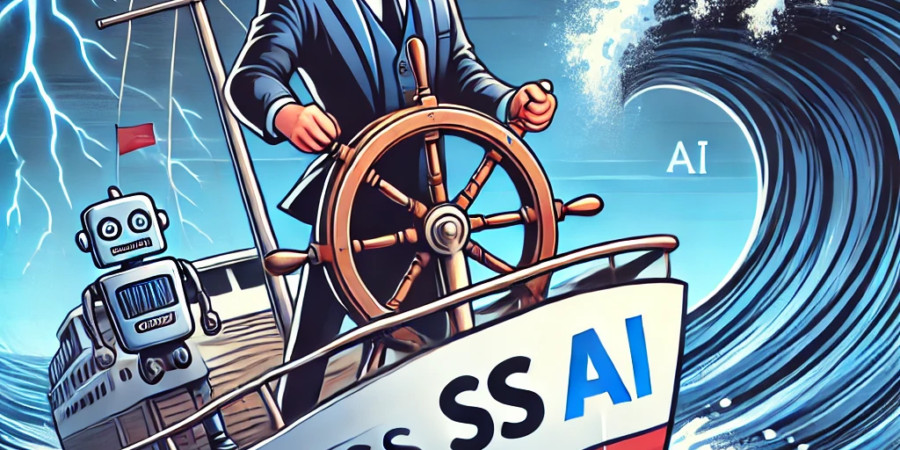
Navigating the AI Revolution: Retaining Executive Control in an Autonomous Age
The AI revolution is here.
t’s moving fast, and it doesn’t wait for executive buy-in.
While leaders hesitate, AI accelerates.
Control is slipping.
The question is: will you drive it, or will it drive you?
The Illusion of Control
Many executives believe they’re steering AI adoption.
Reality check: most aren’t.
AI isn’t waiting for a strategy meeting. It’s infiltrating workflows, shaping decisions, and learning at speeds humans can’t match.
The biggest mistake?
Assuming AI implementation is just another IT project.
It’s not.
It’s an operational, ethical, and strategic shift that requires control at every level.
Right now, three unspoken fears dominate C-suite conversations about AI:
- Loss of Decision-Making Power – AI is making autonomous calls, often in black-box systems. If you don’t understand how, you’re no longer in control.
- The Human Role is Fading – AI is optimizing, automating, and replacing. What’s left for humans?
- AI Ethics & Risk Are Unmanageable – The moral and regulatory implications of AI are enormous. A misstep could mean reputational damage, legal trouble, or worse.
Ignoring these fears won’t make them disappear.
Addressing them head-on is the only way to retain control.
How Executives Can Regain Control
AI won’t wait.
Neither should you.
Here’s how to get back in the driver’s seat.
1. Demand Transparency
Don’t trust black-box AI.
If you don’t know how a decision is made, you can’t defend it.
Push for explainability in all AI tools your company adopts.
Make it a non-negotiable requirement.
- Actionable Next Step: Implement an AI governance framework. Insist that every AI-driven decision is auditable.
- Future Insight: Regulators will soon crack down on opaque AI. Get ahead of it.
2. Redefine Human Value
AI is fast, efficient, and scalable.
Humans are adaptable, creative, and ethical.
The future isn’t AI vs. humans.
It’s HUMAND Humans, Machines and AI.
Executives need to define what humans do best and structure work accordingly.
- Actionable Next Step: Map out your workforce using a HUMAND approach: Humans, Understanding, Machines, AI, Navigation, and Design. Identify where AI enhances and where humans remain irreplaceable.
- Future Insight: The best companies will be those that create AI-augmented roles, not AI-replaced ones.
3. Set AI Boundaries Now
AI will learn, grow, and adapt.
Without clear limits, it will push into areas you never intended.
Governance isn’t just a compliance issue, it’s a survival strategy.
- Actionable Next Step: Define AI’s scope in your business. Where does it assist? Where does it lead? Where is it off-limits?
- Future Insight: Companies without clear AI boundaries will face massive legal and ethical blowback within five years.
4. Lead AI Conversations
AI decisions should not be left to tech teams alone.
Executives must drive AI strategy.
The boardroom, not just the IT department, should be discussing AI’s future impact.
- Actionable Next Step: Form an AI Steering Committee with cross-functional leadership. Make AI a standing agenda item at executive meetings.
- Future Insight: AI governance will become a core responsibility for CEOs, not just CIOs.
5. Challenge the AI Hype
AI isn’t magic. It’s math.
It’s data.
It’s code.
Yet, too many executives treat it like an untouchable force.
AI should be questioned, challenged, and refined, constantly.
- Actionable Next Step: Implement a Red Team AI Audit, a task force that actively tests and challenges AI decisions for bias, risk, and failure points.
- Future Insight: Blind faith in AI will sink businesses. Those who interrogate it will lead.
AI Isn’t Coming, It’s Here. Own It.
The worst thing executives can do right now? Hesitate.
AI is already embedded in decision-making processes, supply chains, customer interactions, and financial forecasting.
The only way to stay in control is to step up, take ownership, and set the rules before AI does it for you.
The companies that win won’t be those with the most AI.
They’ll be the ones with the best AI strategies.
So, are you leading AI, or is AI leading you?
Next Steps:
- Audit your current AI use cases
- Establish governance frameworks
- Redefine human roles in an AI-driven world
- Create an AI oversight committee
- Question, refine, and challenge AI continuously
Control isn’t lost.
It’s just waiting for those bold enough to reclaim it!
#AILeadership #ExecutiveStrategy #AIGovernance #FutureOfWork #AIInBusiness #AIDecisionMaking #HumanCentricAI #AIForCEOs #AIInnovation #AITrends #AITransformation #AIandEthics #LeadershipInAI #AIForesight #AIIntegration #CorporateStrategy #MorrisMisel #AIandBusiness #AIRegulation #AIWorkplace
Frequently Asked Questions
Q: Why is executive control of AI systems a strategic priority rather than just a governance checkbox?
Because the organisations that lose meaningful oversight of their AI systems lose the ability to course-correct when those systems produce outcomes that are inconsistent with organisational values, legal obligations, or strategic intent, and they often discover this loss only after significant damage has occurred. The failures associated with inadequately governed AI systems, reputational damage, regulatory action, customer harm, financial loss, are consistently larger and more expensive than the cost of building adequate oversight in advance. Executive control is risk management.
Q: What does meaningful executive control of AI actually require?
More than policy. It requires executives who understand enough about AI system behaviour to ask the right questions, not to be technologists, but to understand what the system is optimising for, what data it was trained on, what failure modes its developers are monitoring, and what the escalation path is when it behaves unexpectedly. It requires organisational structures that surface AI system performance issues to the level where they can be acted on. And it requires incentive structures that do not punish the people who raise AI performance concerns, which is a more common failure than most organisations acknowledge.
Q: What are the second-order consequences of organisations that cede executive control to AI systems?
Accountability gaps (when AI makes the decision, who is responsible for its consequences? Competitive brittleness) organisations that cannot modify their AI systems’ behaviour quickly when circumstances change lose strategic flexibility. And regulatory exposure, as AI governance frameworks develop, organisations that cannot demonstrate meaningful human oversight will face compliance risk that is retroactively applied to systems already in production. The governance gap between current AI deployment practice and emerging regulatory requirements is one of the most significant strategic risks facing large organisations in the next three years.
Q: Can Morris Misel speak on AI governance, executive control, and the strategic implications of AI deployment for our board or executive leadership team?
Yes. AI governance and executive strategy are core keynote and workshop topics for boards, executive teams, and governance audiences. Book at morrismisel.com.