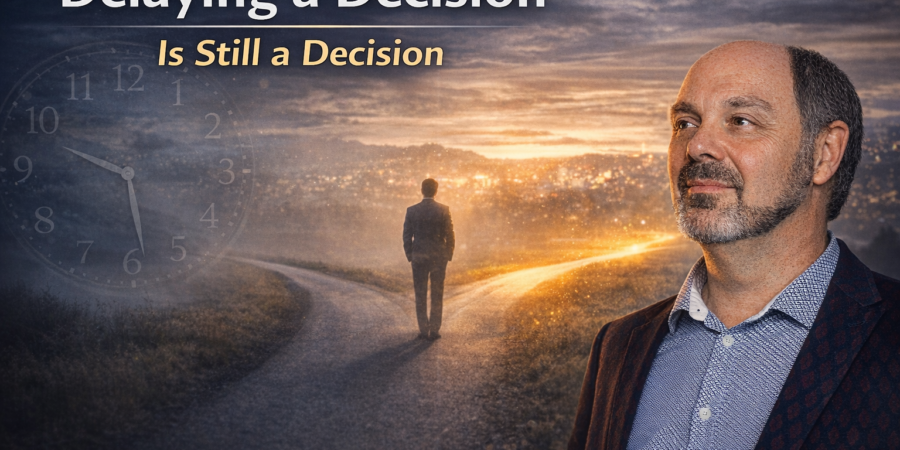
The Decisions You Delay Are Still Decisions
There’s a particular kind of conversation I find myself in more often lately.
It usually sounds reasonable.
Measured.
Thoughtful.
Responsible.
“We’re waiting for more clarity.”
Sometimes it’s phrased differently.
“We’re monitoring the situation.”
“We’re not ready to move yet.”
“We want to see how this plays out.”
On the surface, all of that makes sense.
No one wants to move too early.
No one wants to make the wrong call.
But underneath it, something else is happening.
A decision is still being made.
Delay feels safe. It isn’t neutral.
We tend to treat delay as if it’s neutral.
As if we’re holding position.
As if nothing is changing while we wait.
But that’s not how the environment behaves anymore.
Markets move.
Customers adapt.
Competitors experiment.
Technology advances.
So while you’re waiting…
the context is shifting.
Which means your “no decision yet” is actually a very real decision.
It’s a decision to:
maintain current position
accept current risks
allow others to move first
That may be the right call.
But it’s still a call.
PTFA sitting quietly in the room
This is where PTFA shows up again.
Past Trauma, Future Anxiety.
Past Trauma says:
we’ve made decisions before that didn’t land well
Future Anxiety says:
we don’t want to repeat that
So delay becomes a strategy.
Not because leaders don’t want to act.
But because the cost of being wrong feels high.
What’s often missed is that the cost of not acting is also real.
It’s just less visible.
The hidden cost of waiting
Delayed decisions rarely show up as a single obvious consequence.
They accumulate quietly.
Momentum slows.
Opportunities pass.
Confidence erodes.
Others define the pace.
By the time the impact becomes clear…
it often feels like something external has changed.
When in reality, part of that shift came from inaction.
The illusion of future clarity
There’s another assumption sitting behind delay.
That clarity will arrive.
That with a bit more time, things will become obvious.
In stable environments, that used to be true.
Today, clarity doesn’t arrive fully formed.
It emerges through movement.
Through testing.
Through small decisions.
Through adjusting as you go.
Waiting for perfect clarity often means waiting indefinitely.
Immediate Futures: acting inside uncertainty
This is where Immediate Futures becomes practical.
Instead of asking:
What will happen?
We ask:
What is already happening that requires a response?
That changes the posture.
From waiting… to engaging.
From holding back… to moving with awareness.
You’re not trying to eliminate uncertainty.
You’re learning to operate within it.
HUMAND and decision responsibility
Within the HUMAND model
(<a href=”https://www.morrisfuturist.com/workforce-revolution-why-jobs-are-over-but-work-is-just-beginning/” target=”_blank”>read more here</a>),
AI can provide input.
Machines can execute.
But the responsibility for decisions still sits with humans.
That’s not shifting.
What is shifting is the environment those decisions are being made in.
More information.
More options.
More complexity.
Which makes delay feel more justifiable.
But also more risky.
Ripple Effects of delayed decisions
Delays don’t just affect the moment.
They create ripple effects.
A delayed product decision affects customer perception.
A delayed hiring decision affects capability.
A delayed strategy decision affects positioning.
These aren’t isolated.
They compound.
And over time, they shape how the organisation is experienced.
A simple reframe
One of the most useful shifts I’ve seen leaders make is this:
Instead of asking:
Should we wait?
They ask:
What decision are we making by waiting?
That question changes the conversation.
It surfaces the reality of the situation.
And it brings ownership back into the room.
Micro-decisions vs big decisions
Another pattern worth noticing.
Leaders often hold back because they’re framing decisions as large, high-risk moves.
All or nothing.
In reality, most progress comes from smaller decisions.
Micro-decisions.
Steps that:
test direction
reduce uncertainty
create movement
generate feedback
These are easier to make.
And they build clarity over time.
What this looks like in practice
In the organisations I’m working with, this is becoming more deliberate.
Not rushing decisions.
But also not deferring them unnecessarily.
Creating a rhythm of:
observe
interpret
decide
adjust
Over and over again.
That rhythm matters more than any single decision.
The leadership signal
One of the less obvious effects of delay is what it signals internally.
Teams notice.
Even if nothing is said directly.
They pick up on hesitation.
On uncertainty.
On lack of direction.
And that shapes behaviour.
People become more cautious.
Less willing to move.
More inclined to wait for instruction.
Which reinforces the cycle.
Where this is heading
Decision-making is becoming a more visible capability.
Not because it’s new.
But because the environment is testing it more frequently.
More pressure.
More ambiguity.
More consequence.
The organisations that navigate this well aren’t the ones that always get it right.
They’re the ones that:
decide
learn
adjust
and keep moving
A final thought
If you’re sitting with a decision that keeps getting pushed back…
it might be worth asking:
Are you waiting for clarity…
or are you avoiding the responsibility of choosing?
Because either way…
a direction is already being set.
This is the space I’m spending more time in with leadership teams.
Helping clients’ move from hesitation…
to deliberate, grounded action.
Not perfect decisions.
But conscious immediate futures ones.
If that’s a conversation that would be useful in your organisation, or something to explore in a keynote or strategy session, it’s very much where I’m focused at the moment.
Choose Forward.
#MorrisMisel #ForesightStrategist #DecisionMaking #Leadership #BusinessStrategy #StrategicForesight #PTFA #ImmediateFutures #HUMAND #RippleEffects #FutureOfWork #ExecutiveLeadership #ConferenceSpeaker #KeynoteSpeaker #ChooseForward
Frequently Asked Questions
Q: Why is delaying a decision itself a decision?
Because in a dynamic environment, the status quo does not hold itself in place while a decision is being deferred. The conditions that made the decision consequential continue to change; the options available continue to shift; the competitive and environmental context continues to evolve. Delaying a decision to acquire more information is sometimes prudent. But the decision to delay is not cost-free. It has consequences for the organisation’s position, its relationships, its options, and its culture. Treating delay as neutral rather than as a choice with consequences is one of the most consistent sources of avoidable strategic damage.
Q: What are the most common costs of decision delay that leaders underestimate?
Option foreclosure: the longer a decision is delayed, the more options that were available at the time the decision first presented itself have closed. Relationship damage: stakeholders who needed a decision to plan or act experience the delay as a lack of respect or commitment, and the trust cost accumulates. Cultural signal: in organisations where delay is normalised, people learn not to bring difficult decisions forward because bringing them forward does not produce resolution. And the cognitive burden of carrying undecided questions: the mental energy consumed by open decisions is not available for the work that would benefit from it.
Q: What distinguishes prudent deliberation from costly delay?
Prudent deliberation has a defined end point, a specific decision by a specific date, and is oriented toward acquiring the information or perspective that would genuinely change the decision. Costly delay is open-ended, indefinitely deferring resolution while the situation continues to evolve. The practical discipline is to make the deferral explicit and bounded: ‘we are deferring this decision until X, at which point we will decide on the basis of the best available information’, rather than allowing it to sit unaddressed until circumstances force a resolution that is no longer on favourable terms.
Q: Can Morris Misel speak on decision discipline, the cost of delay, and building decision cultures that produce timely, quality outcomes for our leadership audience?
Yes. Decision discipline and leadership culture are core keynote topics. Book at morrismisel.com.