{Podcast} It Was Never About AI
What a family trip to Poland reminded me about how we really accept change
We were standing in front of a building in Poland, and I wasn’t sure it was the right one.
The address matched.
The street felt familiar.
But the building didn’t look the way I remembered it.
The last time I had been there was about 12 years ago. Back then, my sister and I had spent days trying to piece together fragments of family history. We went through microfiche. Old government records. Handwritten documents that were over a hundred years old. We worked with researchers. Translated texts. Cross-referenced names and addresses that didn’t always align.
It was slow.
It was deliberate.
And it mattered.
This time, we were there as a family. Three generations of us walking the streets where our story began. The homes, the schools, the places our parents and grandparents had spoken about in fragments over the years. For my sister and me, it was familiar. For the others, it was discovery.
Standing in front of that building, unsure, one of the younger members of the group pulled out her phone.
She went into Google Maps.
And then did something I didn’t even think to do.
She rewound it.
Twelve years.
And there it was.
The building as it had been when we first visited.
The one we remembered.
We stood there looking at the past and the present at the same time.
And then, almost as naturally, she started using AI-supported tools to search for more.
Names.
Addresses.
Connections.
Fragments we had spent years assembling.
Some were confirmed.
Some were extended.
Some led to entirely new threads.
And it happened in seconds.
What had taken us days, weeks, years to build wasn’t replaced.
But it was extended.
And that distinction matters more than most people realise.
The moment that didn’t feel like a moment
There was no announcement.
No sense that we were witnessing something profound.
No one said, “this is the future.”
It just… happened.
Quietly.
Naturally.
Usefully.
And that’s when it clicked for me again.
We don’t adopt technology because it’s powerful.
We adopt it when it becomes personal.
It’s not about AI
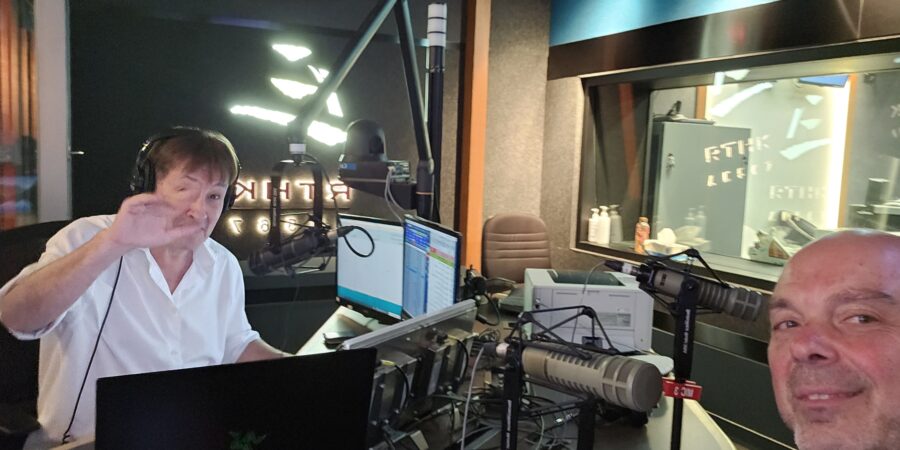
A few days later, I was in Hong Kong, sitting in a radio studio with Phil Whelan, talking about artificial intelligence.
Where it’s going.
What it’s doing.
What it might mean.
And I found myself saying something I’ve been circling for a while now.
It’s not about AI.
It really is about us.
Because every time we talk about new technology, we tend to focus on the wrong things.
We ask:
• What can it do?
• How fast is it?
• What are the risks?
All important questions.
But they’re not the ones that determine whether anything actually changes.
I was in Hong Kong just days after this trip, talking live in studio with Phil Whelan on Hong Kong radio 3 about exactly this..
Different context. Same underlying question.
How do we actually respond to change?
You can listen to that conversation here (21 minutes 03 seconds).
What struck me listening back wasn’t the technology.
It was how often the conversation came back to people.
What we accept. What we resist. And why.
The pattern we keep repeating
If you look back through history, the pattern is remarkably consistent.
Electricity.
Cars.
The internet.
Mobile phones.
Every one of them followed a similar path.
First, curiosity.
Then concern.
Then resistance.
Stories about what could go wrong.
Stories about what it might take away.
Stories about who might be affected.
And then, slowly, almost without noticing, acceptance.
Not because the technology became perfect.
But because it became useful.
Fear has a structure
In my work, I often talk about PTFA.
Past Trauma, Future Anxiety.
We carry experiences from the past.
We project them forward.
And we fill in the gaps with stories.
That’s what creates resistance.
Not the technology itself.
But what we believe it might mean for us.
Our role.
Our identity.
Our relevance.
Our sense of control.
The difference between knowing and feeling
Standing in Poland, I understood what was happening.
Of course I did.
I’ve spent decades looking at signals like this.
But what struck me was not the capability.
It was the reaction.
There was no fear.
No hesitation.
No debate about whether this was “good” or “bad”.
It was simply:
“That’s helpful.”
And we moved on.
That’s the moment adoption actually happens.
Not when people understand something.
When they feel comfortable using it.
What took years… and what took seconds
I’ve thought a lot about that contrast since.
Twelve years ago:
• days in archives
• hours with researchers
• translation layers
• interpretation
• uncertainty
This time:
• seconds of search
• immediate validation
• rapid extension
But the important part is this.
The new capability didn’t diminish the old effort.
It built on it.
The context mattered.
The history mattered.
The human connection mattered.
The technology simply accelerated what we were already trying to do.
This is where most conversations go wrong
We tend to frame technology as replacement.
Humans versus machines.
Old versus new.
That’s not what I’m seeing.
What I’m seeing is layering.
Extension.
Augmentation.
This is something I explore in my HUMAND approach
https://www.morrisfuturist.com/workforce-revolution-why-jobs-are-over-but-work-is-just-beginning/
The real question is not:
“What will AI replace?”
It’s:
“How do humans, machines, and AI work together most effectively?”
Where this shows up in work
You can already see the same pattern in business.
Tasks are being broken down.
Some remain human.
Some are automated.
Some are coordinated by AI.
The shift is subtle, but significant.
Work becomes less about doing.
And more about deciding.
That’s something I’ve reflected on over time, particularly in how leadership itself is evolving
https://www.morrisfuturist.com/1000-posts-later-morris-misel-on-foresight-leadership-and-judgement/
The real barrier is not capability
We often assume the biggest barrier to adoption is technical.
It isn’t.
It’s human.
People don’t resist because something is complex.
They resist because it doesn’t feel relevant.
Or it feels threatening.
Or it doesn’t fit into how they see themselves.
The generational trap
There’s a tendency to think this is generational.
Younger people accept.
Older people resist.
There’s some truth in that.
But it’s not the full picture.
I’ve met people in their twenties who are deeply sceptical.
And people in their sixties who are completely open.
The difference is not age.
It’s context.
What role does this play in my life?
What does it give me?
What might it take away?
The quiet shift
The most interesting changes rarely arrive loudly.
They don’t announce themselves.
They don’t demand attention.
They slip in quietly.
They solve a problem.
They make something easier.
And over time, they become normal.
We stop talking about them.
We stop noticing them.
They just become part of how things work.
The signal worth watching
If you’re trying to understand where this is heading, don’t look at the headlines.
Look at the moments.
Small, everyday interactions where:
• something becomes easier
• something becomes faster
• something becomes clearer
And no one questions it.
That’s where the real signals are.
Practical implications
So what does this mean in practice?
A few things.
1. Don’t lead with capability
Just because something can be done doesn’t mean it will be adopted.
2. Focus on context
Where does this actually fit into someone’s life or work?
3. Design for usefulness
People don’t adopt systems.
They adopt outcomes.
4. Strengthen human judgement
As systems become more capable, your ability to decide becomes more valuable.
Final thought
We spend a lot of time asking what technology will do next.
A better question is:
How will people respond to it?
Because that’s what determines whether anything actually changes.
Standing in front of that building in Poland, I wasn’t thinking about artificial intelligence.
I was thinking about family.
Memory.
Where we came from.
The technology simply helped us see it more clearly.
It didn’t replace the experience.
It extended it.
And that’s where the future tends to take hold.
Quietly.
Personally.
Almost without us noticing.
If this is a shift you’re trying to understand, prepare for, or design into your organisation, that’s the work I do.
On stage.
In boardrooms.
In strategy sessions.
Choose Forward.
Morris Misel is a foresight strategist whose ideas are tested daily in the media, shaped in boardrooms, and designed to land on stages.
He works with leaders to navigate uncertainty, understand emerging signals, and make better decisions about what comes next.
Frequently Asked Questions
Q: What does it mean that ‘it was never about AI’?
That the most consequential questions raised by artificial intelligence (about power, accountability, what we value, who benefits, and what kind of futures are being built) are not questions about the technology itself but questions about human choices. The technology is the occasion for the questions; it is not the questions themselves. And those questions (who decides, who is accountable, what trade-offs are acceptable, whose interests are being served) are political, ethical, and human questions that have always been present in how societies organise themselves. AI has made them newly visible and newly urgent; it has not created them.
Q: What are the human questions that the AI conversation most consistently fails to ask?
Whose interests are being optimised for, and whose are being traded away? Who is accountable when the AI system produces a harmful outcome, the developer, the deployer, the user, the regulator? What is being done to the human relationships, capabilities, and institutions that are being replaced or reshaped by AI, and is that what we would choose if we were choosing explicitly? And what kind of future are we building with these choices, not the future AI makes inevitable, because AI does not make futures inevitable, but the future we are choosing by the cumulative decisions being made now about how to design, deploy, and govern it?
Q: What role does foresight play in answering these questions?
Foresight’s role is to surface the questions before the choices that answer them are made by default. The futures most worth avoiding are not the ones that arrive suddenly; they are the ones that arrive incrementally through a series of individually unremarkable choices, each of which seemed reasonable at the time, that together produce an outcome nobody would have chosen explicitly. Foresight is the practice of making those cumulative choices visible while there is still room to choose differently, which is why it matters most precisely when the technology is moving fastest.
Q: Can Morris Misel speak on the human questions behind AI, what foresight reveals about where we are heading, and how leaders can engage with these questions more honestly?
Yes. The human questions behind technology and AI are a central theme of Morris Misel’s work. Book at morrismisel.com.