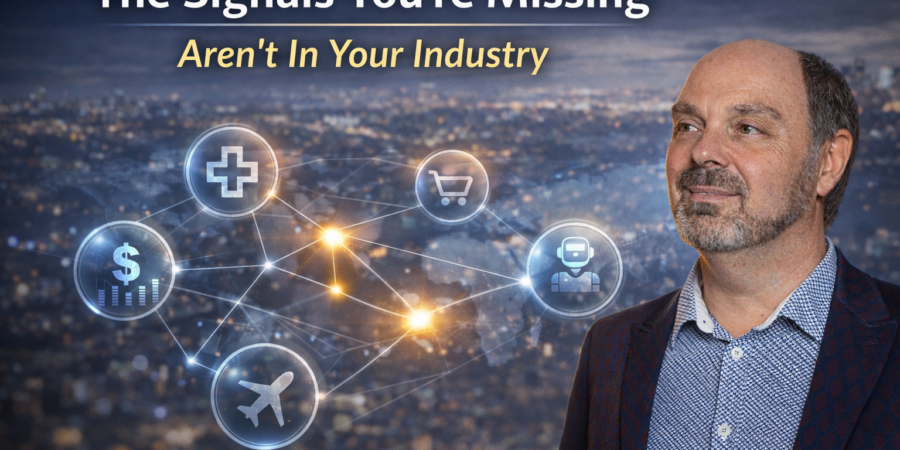
The Signals Most Leaders Miss Don’t Sit in Their Industry
A CEO said something to me recently that stayed with me.
“We’re watching our competitors closely.”
It was said with confidence.
Almost as reassurance.
And I understand why.
That’s how most organisations have been taught to operate.
Watch your competitors.
Track your market.
Benchmark your performance.
Stay close to what’s happening in your lane.
The problem is…
that’s not where the biggest shifts are coming from anymore.
The illusion of relevance
Industries used to move in relatively contained ways.
Banking competed with banking.
Retail with retail.
Education with education.
The boundaries were clearer.
The signals were easier to interpret.
Today, those boundaries have blurred.
Not slightly.
Completely.
What affects your business is no longer just what your competitors are doing.
It’s what’s happening:
in adjacent sectors
in emerging technologies
in policy shifts
in social behaviour
in customer expectations shaped somewhere else entirely
And most of that doesn’t show up neatly in industry reports.
A simple observation that changes the conversation
When I’m working with leadership teams, I’ll often ask:
What’s something outside your industry that’s quietly shaping expectations inside it?
That question usually creates a pause.
Because it’s not how most organisations are wired to think.
But once you start looking, the signals are everywhere.
Customers don’t benchmark you against your competitors.
They benchmark you against their best experience anywhere.
That might be:
a streaming platform
a logistics company
a fintech app
a healthcare provider
a travel experience
Completely different industries.
But shaping the same expectation.
Ripple Effects: where the real shifts sit
This is where Ripple Effects become useful.
A small change in one space…
creates a much larger shift somewhere else.
For example:
A breakthrough in logistics changes expectations in retail.
Advances in AI reshape expectations in customer service.
Changes in remote work influence expectations in education and training.
The original signal doesn’t stay contained.
It moves.
And by the time it reaches your industry, it often looks like a customer expectation rather than a technological shift.
That’s why it’s easy to miss.
Why this matters more now
There’s another layer to this.
The pace of cross-industry influence has accelerated.
What used to take years now takes months.
Sometimes weeks.
And AI is amplifying that.
Because ideas, models, and behaviours are being shared, adapted, and implemented faster than ever.
Which means:
by the time something shows up in your industry…
it’s already been tested somewhere else.
The risk of looking too narrowly
If your primary lens is still:
What are our competitors doing?
You’ll always be slightly behind.
Not because you’re not paying attention.
But because you’re looking in the wrong place.
Competitor analysis tells you how the game is being played.
It doesn’t tell you how the game is changing.
A different way to scan the horizon
This is where foresight becomes practical.
Not abstract.
Not theoretical.
Just a different way of paying attention.
Instead of starting with your industry…
start with:
What are people getting used to?
What are they starting to expect as normal?
What frustrations are disappearing elsewhere?
What feels slow, clunky, or outdated by comparison?
That gives you a very different set of signals.
And they tend to be far more useful.
Immediate Futures: what’s already happening
Again, this is not about distant futures.
It’s about Immediate Futures.
What is already happening…
but not yet evenly distributed.
Something might be normal in one sector…
and completely absent in another.
That gap is where opportunity sits.
And also where risk builds quietly.
PTFA and staying inside the lane
There’s a reason organisations stay focused on their own industry.
It feels safer.
PTFA again.
Past Trauma says:
we know this space
Future Anxiety says:
we don’t want to misread something outside it
So the natural response is to narrow the lens.
But that safety is increasingly an illusion.
Because the disruption isn’t coming from within the lane.
It’s coming from the side.
A practical shift leaders can make
This doesn’t require a massive transformation.
Just a simple shift in how attention is allocated.
In leadership meetings, create space for one question:
What’s happening outside our industry that we should be paying attention to?
Not as a side conversation.
As a core part of how you think.
Over time, that changes what gets noticed.
And what gets acted on.
What this looks like in practice
In the organisations I’m working with, this is becoming more deliberate.
Not just scanning more broadly.
But interpreting differently.
Connecting signals across:
technology
customer behaviour
workforce shifts
policy changes
cultural expectations
And then asking:
What does this mean for us?
That’s where clarity starts to form.
The real advantage
The organisations that do this well aren’t necessarily the fastest.
Or the most resourced.
They’re the ones that:
see earlier
connect better
interpret more clearly
and act with more confidence
Because they’re not waiting for signals to become obvious in their own industry.
They’re reading them as they move.
Where this is heading
This is a big part of the work I’m doing at the moment.
Helping organisations expand their field of vision…
without overwhelming them.
Making sense of signals that don’t sit neatly in one place.
And turning that into something practical.
Something usable.
Something that can actually inform decisions.
If your organisation is still primarily looking within its own industry for direction, it might be time to widen the lens.
Because the signals that matter most are already here.
They’re just not where most people are looking.
Choose Forward.
Frequently Asked Questions
Q: Why do the most important signals tend to arrive from outside an industry?
Because disruption and structural change almost always originate in the intersection between what is technically possible (driven by technological development that is industry-agnostic) and what customers actually want (driven by human needs that are also industry-agnostic). The organisations within an industry are typically focused on the signals inside the industry, what competitors are doing, what regulators are requiring, what customers are saying within established relationships. The signals from adjacent industries, from emerging technologies, and from changes in human behaviour in unrelated domains are systematically underattended, precisely because they require attention investment beyond the industry boundary.
Q: What kinds of cross-industry signals tend to be most consequential?
Changes in how trust is being built and broken in other industries, because trust architectures transfer across domains. Shifts in the human relationship with technology in consumer contexts, because the expectations and behaviours people develop as consumers eventually arrive in their roles as employees, patients, students, and citizens. Regulatory and governance changes in more heavily regulated industries, because they often anticipate what is coming in less regulated ones. And the emergence of new business models that are solving problems adjacent to yours, because the business model logic, once proven, tends to migrate.
Q: How should organisations build the capacity to read cross-industry signals?
By deliberately including people with diverse industry backgrounds in their sensing and strategy processes. By developing structured practices for scanning beyond the industry boundary, dedicated time for reading, conversation, and pattern-matching across domains. By building relationships with foresight practitioners and thinkers who work across multiple industries. And by cultivating the intellectual habit of asking, for any significant development in any domain: what would this mean if it arrived in our industry, and how far away is that?
Q: Can Morris Misel speak on cross-industry signal reading, foresight practice, and how to build the scanning capability that most organisations are currently missing?
Yes. Cross-industry foresight and signal reading are core keynote and workshop topics. Book at morrismisel.com.