Where the Billionaires Are Heading and What That Tells Us About the Future of Work, Wealth, and Worth
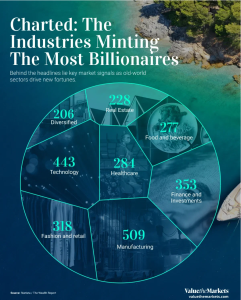
There’s a chart doing the rounds this week. It lists the top 10 industries where billionaires are minted.
It’s a tidy visual. It gives people something to repost with a pithy comment.
But look again through a foresight lens and you’ll see something else entirely: a reshaping of value creation itself.
This isn’t just a leaderboard. It’s a map of where the world thinks money, influence, and power will come from next.
And it’s already reshaping what we build, fund, educate, and dream toward.
What’s in the Chart?
According to data pulled together by Voronoi, the top 10 billionaire-minting industries right now are:
- Finance & Investments
- Manufacturing
- Technology
- Fashion & Retail
- Healthcare
- Food & Beverage
- Real Estate
- Diversified
- Media & Entertainment
- Energy
It looks obvious at first glance. But the signals beneath the surface are anything but.
What Are the Ripples?
1. “Diversified” is a Warning, Not a Category
Billionaires are hedging. The rise of “diversified” means fortunes are being built across multiple sectors not one. Why?
Because volatility is now a feature, not a bug.
When billionaires diversify, it signals they no longer trust any single vertical to stay stable long enough to bet the farm.
This tells us: the age of the single-track career or one-industry company is over. In the age of AI, adaptability isn’t a luxury. It’s a lifeline.
2. Fashion, Food, and Feelings Beat Pure Tech
Tech ranks third. But Fashion & Retail, and Food & Beverage industries we’ve historically undervalued in innovation conversations are holding strong. Why?
Because these are the industries that move emotion.
They build identity, culture, experience.
And in a world where AI can do logic faster and cheaper than you, it’s the emotional, relational, and aesthetic that remains scarce.
Human-centred innovation isn’t a nice-to-have. It’s where the next billion will come from.
3. Healthcare and Energy Are Next, But Not As You Know Them
These industries aren’t just about doctors and petrol.
The billionaires here are coming from biotech, longevity, personalised medicine, clean energy, and carbon arbitrage.
This is about solving existential problems at scale.
What does that tell us?
That inhabitable futures where we live longer, cleaner, and with more dignity aren’t a fantasy.
They’re being actively built, funded, and profited from.
If your business isn’t part of that solution, the market will move around you.
4. Wealth Is Still Privileged. But Access Is Changing.
Yes, these billionaires still come from privilege, networks, and generational assets.
But the tools they use to get there AI, platforms, fintech, biotech are more accessible than ever.
This is a two-sided coin: it means more people can start.
But it also means the pace of competition has exploded.
Standing still is now a risk.
What Would I Add to This Chart?
A “Futures” Industry
Not literally, but practically. Because what underpins all these industries is a foresight function.
Billionaires aren’t just reacting.
They’re shaping.
They’re placing bets not just on products, but on emerging behaviours, unmet needs, and weak signals.
Every leader not just billionaires should be asking:
- What conditions create value next?
- What will users expect by default in 12 months?
- What no longer counts as acceptable experience?
These are not just strategy questions. They’re survival questions.
What About Tariffs, Trump, and Global Shifts?
If we zoom out, the chart misses a crucial overlay: geopolitical volatility.
Trump’s tariffs won’t just hit exporters. It’ll warp the very industries on this list.
Manufacturing, Energy, Food, and Retail are all trade-exposed.
If borders harden and globalisation shrinks, the billionaires of tomorrow may come not from optimisation but localisation.
It’s one more reminder: the future isn’t evenly distributed.
It’s shaped by power, policy, and access.
That’s why I help leaders build inhabitable futures scenarios where humans, businesses, and communities can thrive, not just survive.
What Should You Do With This?
- Don’t just post the chart. Post a response.
- Reassess which industries your strategy favours
- Map where emotional value lives in your current model
- Look at which billionaire sectors are expanding and why
- Play the long game: what expectations are being seeded now?
And most of all, ask:
If these are the industries where the next billionaires are coming from… what kind of world are we building around them?
Because it’s never just about who gets rich.
It’s about what they reshape along the way.
Choose Forward
Want the HUMAND diagnostic to map which tasks in your business are best done by Humans, Machines, or AI? Drop “Choose Futures” in the comments and I’ll DM you a copy.
I’m Morris Misel, and I work with leaders and organisations ready to stop guessing and start preparing. Through keynotes, workshops and strategy,
I help you decode disruption and make tomorrow actionable. Heard by millions each year in the media and onstage.
Let’s talk.
#foresight #futureofwork #leadership #strategy #ai #emotionalintelligence #humand #futuretrends #immediatefutures #miselinsights #disruption #billionaires #macroshifts #valuecreation #Foresight #FutureOfWealth #Billionaires2025 #MorrisMisel #ImmediateFutures #StrategicLeadership #CEOInsights #NextGenBusiness #DisruptionSignals #ExecutiveForesight #FutureIndustries #WealthMigration #VentureCapital #InnovationEconomy #BusinessFutures #FutureSignals #FuturistSpeaker
Frequently Asked Questions
Q: Why are billionaire investment patterns a useful foresight signal?
Because large private capital, when it is genuinely speculative rather than defensive, represents a bet on specific future trajectories by people with both the resources to gather exceptional information and the financial capacity to absorb the losses that come with early-stage bets. The pattern is not the individual investment; it is the convergence of multiple large private capital allocations around the same domain. When several well-capitalised actors simultaneously increase their exposure to a specific technology, geography, or sector, it signals both their belief in the trajectory and that the enabling conditions are becoming visible.
Q: What do current patterns of large private capital allocation signal?
Longevity biotechnology, the extension of healthy human lifespan, is receiving sustained attention from multiple large private capital sources, which signals both belief in the technical trajectory and recognition that the market for effective longevity interventions is enormous. Space infrastructure (not space tourism but the commercial backbone of low-orbit satellite networks, launch services, and eventually resource extraction) is another domain of sustained large-capital commitment. And AI infrastructure (the compute, energy, and data assets required to build and run AI systems) is attracting capital at a scale that signals expected returns commensurate with the investment.
Q: How should organisations use this signal?
As a secondary confirmation of signals that are already present in other sources, not as a primary strategic guide. Billionaire investment patterns have a time horizon of 10-20 years for speculative bets, which may not align with the 3-5 year planning cycles of most organisations. But the domains where large patient capital is concentrating are worth including in scenario planning as trajectories that have both credible technical foundations and committed capitalisation behind them.
Q: Can Morris Misel speak on capital flows, future investment signals, and long-horizon strategic foresight for our financial services, investment, or strategy audience?
Yes. Capital signals and long-horizon foresight are regular keynote topics for financial services and strategy audiences. Book at morrismisel.com.


One comment
This article is rather provocative and relevant, given the pace and scale of changes happening in our world. The billionaires shaping our future are indeed working with planetary-scaled ideas and tools.
It is fascinating to see it all unfold.