
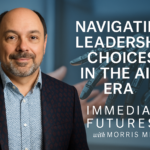
Morris Misel speaking on the Beyond Obsolete podcast about leadership, AI, and human decision-making

{Podcast} We’re Not Becoming Obsolete. We’re Becoming Overloaded.

I’ve been sitting with a feeling I hear often in briefing rooms and quiet conversations with leaders.

Not panic.
Not fear.
More a kind of cognitive heaviness.

Leadership doesn’t feel harder because people can’t keep up with technology. It feels heavier because the volume, speed and consequence of decisions has shifted faster than our thinking models have had time to adjust. This is a challenge of leadership clarity, not capability.

AI has accelerated the environment. Humans haven’t been given much space to recalibrate.

That was the thread I kept coming back to during a long, wide-ranging conversation with Ben Hayes and Grayson Genders on their Beyond Obsolete podcast, produced by Blacklight Society. The show asks a deceptively simple question: are we becoming obsolete, or are we entering a new phase of being human?

My answer remains consistent.

We’re not becoming obsolete.
We’re becoming overloaded.

What many leaders are experiencing right now isn’t a lack of capability. It’s decision congestion. AI promises time savings, but in practice it often exposes how little room we’ve left for judgement, context and reflection to occur. Tasks move faster, but decisions pile up. And when everything feels urgent, nothing feels considered.

One of the more interesting turns in the conversation was around leadership itself. Not leadership as a title or role, but leadership as a function. In subtle ways, many people have already handed parts of that function over to systems. Not deliberately. Not formally. Just gradually. Recommendations become defaults. Outputs become direction. Efficiency becomes authority.

It’s not that AI is trying to lead. It’s that humans are tired.

This is where the distinction between information, knowledge, intellect and wisdom becomes more than academic. AI is now very good at handling information. Increasingly competent with knowledge. Rapidly advancing in synthetic intellect. But wisdom, the ability to weigh context, consequence, contradiction and human impact, remains firmly human.

That matters, because the decisions that shape organisations, cultures and futures rarely sit neatly inside datasets. They ripple. They land emotionally. They change how people feel about trust, safety and meaning.

Another thread we explored was the idea that work is fragmenting into tasks rather than roles. This isn’t new, but AI accelerates it. When you look at work through a Human, Machine and AI lens, it becomes clear that not all work belongs with humans, and not all decisions should. Repetitive, rules-based tasks are better handled by machines. Patterning and synthesis sit comfortably with AI. Meaning, ethics, narrative and consequence remain human territory.

Obsolescence happens when humans carry machine work.
Evolution happens when humans stay human.

What struck me most about the conversation wasn’t any single insight, but the tone. There was space to wander, to think out loud, to resist neat conclusions. In a landscape obsessed with predictions, that felt important. The future isn’t asking us to outrun AI. It’s asking us to design leadership that gives humans enough room to think clearly inside a machine-shaped world.

Below is the full conversation for those who want to listen. It’s not a blueprint or a forecast. It’s a reflection on how leadership actually feels right now, and what we may be handing over without quite noticing.

For me, the real work ahead isn’t about smarter systems. It’s about preserving clarity, judgement and wisdom in environments that rarely slow down long enough to invite them in.

Choose Forward

#MorrisMisel #Leadership #ArtificialIntelligence #FutureOfLeadership #DecisionMaking #HumanCentredLeadership #StrategicForesight #ExecutiveLeadership #AIandLeadership #FutureOfWork

Frequently Asked Questions

Q: Why is overload a more accurate frame than obsolescence for what AI is doing to humans?

Because obsolescence implies replacement — that humans are no longer needed for the tasks they were performing. For most people, in most roles, that is not what is happening. What is happening is that the volume of tasks, information, and decisions that is being routed through human attention has increased, not decreased, as AI has become available. The tools that were supposed to reduce workload have often increased it, because they make it easier to produce more outputs — more emails, more options, more analysis — which requires more human processing, not less.

Q: What are the cognitive costs of operating in a high-volume, high-speed AI-augmented environment?

Decision fatigue at a scale and pace that human cognitive systems were not designed for. Attention fragmentation from the constant demand of high-volume digital communication. The erosion of the deep work capacity — the ability to focus on a single complex problem for extended periods — that produces the highest-quality human thinking. And the anxiety produced by the awareness of the volume of things that could be attended to, which creates a background sense of inadequacy even when actual performance is high. These are not new problems, but AI is intensifying them.

Q: What practices genuinely help leaders and knowledge workers manage overload rather than just cope with it?

Deliberate attention design — actively choosing what to attend to rather than responding to what presents itself. Protecting the conditions for deep work: time blocks, reduced interruption, single-task focus. Using AI to reduce the volume of low-value information processing rather than to enable more of it. And developing a clear framework for what is important — not what is urgent — so that attention is oriented toward genuine priorities rather than the most recent demand. These are not technology solutions; they are human discipline solutions that require deliberate practice.

Q: Can Morris Misel speak on cognitive overload, attention management, and human performance in an AI-augmented environment for our leadership, HR, or wellbeing audience?

Yes. Cognitive performance and AI-era leadership are core keynote topics. Book at morrismisel.com.

Morris Misel is a global foresight strategist and keynote speaker with 30+ years of experience across 160 industries and 25 countries. Creator of the Immediate Futures™, HUMAND™, and PTFA™ frameworks. Industry Fellow at Griffith University. Regular voice on RTHK Radio 3 (Hong Kong) and Australian media including ABC and Sky News. For keynotes, workshops, and advisory: morrismisel.com | Book Morris

Leave a comment