Our kids will live to 120, we’ll be working till we’re 90: Australia’s leading futurist explains why / The Advertiser, Adelaide
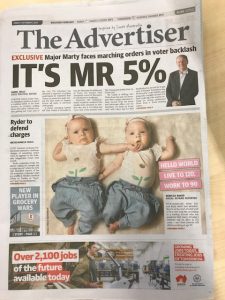
 Absolutely ecstatic, ahead of a ZestFest panel I’m on in Adelaide on Sunday, exploring what it will mean to over 50 in Australia, I made it on to the front page of this morning’s Advertiser, who also quaintly named me: “Australia’s leading futurist”, so here’s what I said that got them all fired up:
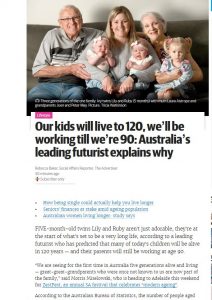
FIVE-month-old twins Lily and Ruby aren’t just adorable, they’re at the start of what’s set to be a very long life, according to a leading futurist who has predicted that many of today’s children will be alive in 120 years, and their parents will still be working at age 90.
“We are seeing for the first time in Australia five generations alive and living, great-great-grandparents who were once not known to us are now part of the family,” said Morris Miselowski, who is heading to Adelaide this weekend for ZestFest, an annual SA festival that celebrates “modern ageing”.
According to the Australian Bureau of Statistics, the number of people aged over 85 in Australia has increased by more than 140 per cent in the past two decades, compared with a total population growth of just 32 per cent.
Mr Miselowski says this has major ramifications for policymakers at all tiers of government and conversations about the nation’s ageing population are long overdue.
“The reality is people will be living 20 years beyond what their super and savings were set up to do … and I don’t think most are ready for it. We’re not going to be able to sustain our economy or our lifestyle if we push everybody off the worklist at some predetermined age of 55 or 60.”
It’s tipped that by 2050 more than a quarter of Australians will be aged over 60.
“(But) we’ve not yet began to question what it means to live happier, healthier, longer lives. It no longer makes sense not to,” he said.
Mr Miselowski is a world-renowned strategist who for the past 30 years has worked with a number of blue-chip companies, including NAB, UBS, Toll, Toshiba, Westpac, BP and BUPA.
“We are naturally living longer and the vast majority of us will live to 100 in relatively good health,” he said.
“ABS data shows life expectancy has doubled in the past 150 years (before) advances in technology allowing for pacemakers, hip and knee replacements, advanced disease treatments … and so much more.
“We’re looking to defer body disintegration even further through things such as bionic eyes. Trillions of dollars are being spent on delaying ageing. I think we are going to get to the stage … we’ll have devices that detect something is wrong with us before we physically have the symptoms of it.”
And we’ll be working much longer.
“I firmly believe we will be working when we are 90, not just to get additional income but for mental stimulation and vitality as well,” he said.
“It may not be five days a week, or 9am to 5pm. It might be volunteering, selling items online … it might be looking after the grandkids, setting up a new business but people aren’t going to retire and just do nothing else but go bowling or travelling.”
Mr Miselowski says his forecasts aren’t about “trying to be clever”.
“My belief in these vast extensions of life comes from the technologies and work being done by gerontologists, pharmaceutical companies and others, (including Google),” he said.
He argues everything from superannuation to housing, urban planning and transport needs a rethink.
“We are starting to see people plan and build multi-generational homes in response to rising property and childcare costs. Soon it won’t be unusual to have three generations living under the one roof,” he said.
While not living in the same house as their young relatives, octogenarian great-grandparents Joan and Peter May play an integral role in the life of granddaughter Laura Aistrope and her three young children, two-year-old Ivy and five-month-old twins Lily and Ruby.
“Grandma has been so incredibly supportive since I’ve had the twins and comes over every day to clean and cook and help look after the kids. I am so lucky,” Ms Aistrope said.
“And Ivy, oh my god, she absolutely adores my grandparents, who she calls Granny and Ga Ga, and they love her. They have her every Wednesday.”
ZestFest co-ordinator Jayne Boase says conversations around ageing are needed.
“Modern older lives bring possibilities not available to our parents and grandparents,” she said.
“Baby Boomers have been at the forefront of many social and cultural changes in their lifetimes. As this group transitions through older life, they may well continue to forge new expectations and new territories.”
Mr Miselowski will be centre stage at the ZestFest open panel session, part of the Open State event in Victoria Square, on Sunday from 4.30pm.
He’ll be joined by several high profile panellists to discuss, the question: “Where are we headed with old?”.
Frequently Asked Questions
Q: Is living to 120 realistic?
For children born today in developed economies, yes, at the upper end of the probability range. The combination of genomic medicine, regenerative biology, and dramatically improved early disease detection is extending healthy lifespan at a rate that exceeds most actuarial projections from a decade ago.
Q: What does a 120-year lifespan mean for retirement?
That ‘retirement at 65’ as a social norm will become economically and actuarially unsustainable. Superannuation systems, pension funds, and social welfare frameworks globally are built on mortality assumptions that are becoming obsolete. The Ripple Effects™ of longevity on financial systems are among the most underappreciated disruptions of the coming decades.
Q: How should individuals plan for a 100+ year life?
By abandoning the linear model (education, then work, then retirement) and planning for multiple phases, multiple careers, and multiple periods of learning and renewal. The individuals who will thrive in a long-lived society are those who have invested in adaptability across all phases of life.
Q: Can Morris Misel speak about longevity, retirement, and the future of working life?
Yes. For keynotes on ageing, longevity, and the future of work, visit morrismisel.com/event-organisers.
Absolutely ecstatic, ahead of a ZestFest panel I’m on in Adelaide on Sunday,exploring what it will mean to over 50 in Australia, I made it on to the front page of this morning’s Advertiser, who also quaintly named me: "Australia’s leading futurist", so here’s what I said that got.
The shift around Our kids will live to 120, we’ll be working till we’re is not purely structural. It changes what capabilities organisations value, how people find meaning in their roles, and what conditions make good work possible. Leaders who understand this early retain the talent they need and build cultures that attract it.
The most important question is not whether Our kids will live to 120, we’ll be working till we’re will matter, but how quickly it will matter in your specific context. Leaders benefit most from mapping the ripple effects early — not just the direct impact but the second and third-order consequences that arrive later and hit harder. That is the practical work of foresight.
