{Podcasts and Story} The Getting of AI Wisdom
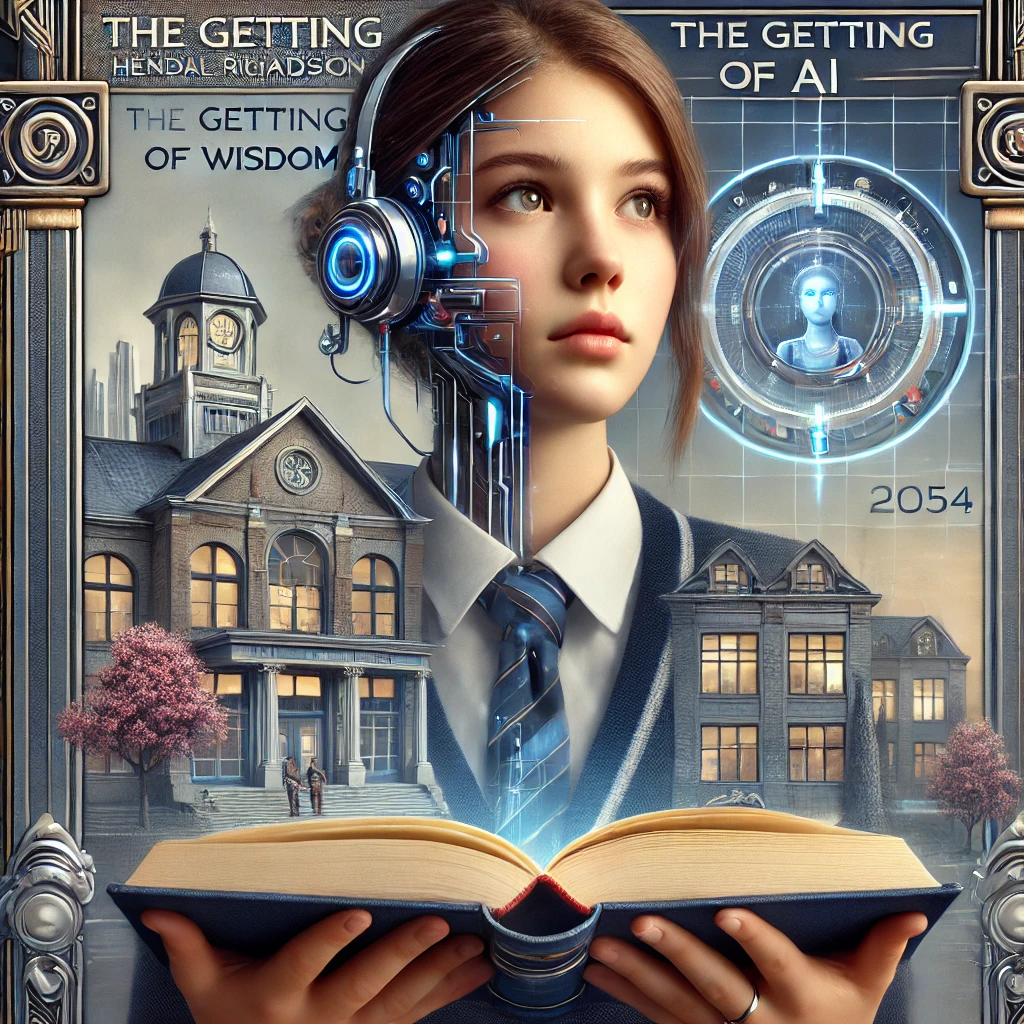
Ellie stood at the intersection of two worlds. It was 2054, and she was a bright but somewhat socially awkward teenager navigating the complexities of a future where AI had become as common as the air she breathed.
In this world, classrooms were driven by AI, algorithms predicted career paths, and social interactions were often mediated by augmented reality and machine learning.
Ellie had been selected to attend the prestigious Academy of Cognitive Integration, where human and AI learning merged into a single curriculum.
Here, students didn’t just learn history or science. They learned how to collaborate with AI systems, develop synthetic intelligences, and, perhaps most importantly, understand the ethical ramifications of the technology that surrounded them.
Ellie was fascinated by AI. She marvelled at how these machines could analyse, predict, and even create. The Academy taught her to use AI to amplify her abilities, foresee market shifts, and design complex systems that could change the world.
But despite the wonders AI could achieve, Ellie felt something gnawing at her, much like a distant memory she couldn’t quite grasp, a feeling that something essential was missing.
One day, Ellie was tasked with creating an AI model that predicted societal outcomes based on current global trends.
She input every conceivable variable, economic indicators, climate data, social unrest metrics, yet the model consistently produced results that felt dystopian, devoid of hope.
The numbers painted a bleak future, one where logic prevailed over humanity. Despite the model’s accuracy, Ellie sensed that there was another path, one that the AI couldn’t see. It lacked the ability to hope, to dream, to imagine possibilities
that defied logic.
In a moment of clarity, Ellie recalled an old philosophy lecture she had attended by accident at the Academy, a lecture that spoke of wisdom not as a mere accumulation of knowledge but as the ability to navigate the complexities of life with understanding and moral clarity. She realised that while AI could guide her, it couldn’t lead her.
The Getting of AI was not the Getting of Wisdom.
Determined to find a better solution, Ellie decided to rewrite her model, this time incorporating not just data, but her own human insights. She coded in variables for compassion, resilience, and the unexpected altruism that history had shown humans were capable of, even in the bleakest times.
The new predictions were vastly different. They were balanced, hopeful, and, most importantly, they felt right.
When Ellie presented her work, the response was mixed. Some of her peers, much like the students in the old tales of the past, were quick to judge, calling her approach unscientific, even naïve. But a few, the ones who still understood the value of the human heart, saw the brilliance in her work.
They recognised that Ellie had tapped into something no AI could replicate: the wisdom that came from lived experience, from understanding pain, joy, love, and loss.
In this new era, Ellie stood at the forefront of a movement that redefined the relationship between humans and AI. She became a leader not just because of her technical skills, but because of her ability to see beyond the binary, to find wisdom in the spaces where AI saw only data.
The moral of Ellie’s story is clear: The getting of AI is a powerful tool, one that can reshape the world. But the getting of wisdom, true wisdom, will always be human.
It is the wisdom that guides technology, tempers power with ethics, and reminds us that, in the end, our greatest asset isn’t our ability to calculate, but our ability to care.
As you might have guessed, this is a reimagining of the classic novel The Getting of Wisdom by Henry Handel Richardson, reinterpreted for a futuristic world dominated by AI.
I thought it would be a bit of fun, light reading to get you ready for the weekend by taking some old classics and putting a 2050 AI and tech twist on them to see if they still hold up as stories and have messages for us.
I’d love to hear your thoughts! How do you think classic tales could be reimagined for the future?
Does the essence of the story change, or does it stay true, despite the technological shift?
Drop your comments, and let’s start a conversation.
Listen to the podcast discussing the themes and stories inside the Getting of AI Wisdom (6 minutes 25 seconds)
Listen to my chat with Hong Kong 3’s Phil Whelan’s on the behind the scenes writing of this story (14 minutes 31 seconds):
This story is part of an ongoing reimagined series of past classics rewritten for Future Possibilities under the banner of Timeless Stories, Infinite Futures, subscribe and look out for a new story each Friday afternoon.
Morris Misel is a seasoned business futurist with over 30 years of global experience in forecasting the future, but don’t let that fool you, he’s also got a playful side.
While he usually focuses on the hard facts and strategic foresights that may shape tomorrow, Morris loves to let his imagination run wild from time to time.
What better way to envision the future than by taking a classic piece of literature and giving it a cheeky futurist twist? This isn’t his usual method, but who says forecasting can’t be fun?
Connect with Morris Misel to explore the serious (and not-so-serious) sides of the future.
#AIForesight #BusinessStrategy #FutureTrends #LeadershipDevelopment #CEOWisdom #InnovationManagement #StrategicPlanning #DigitalTransformation #EventOrganizers #TechnologyInEducation #CorporateStrategy #StrategicForesight #FuturismInLiterature #KeyDecisionMakers
Frequently Asked Questions
Q: What distinguishes wisdom from knowledge in an AI context?
Knowledge is retrievable information, and AI systems are now extraordinarily capable at retrieval and synthesis across enormous knowledge bases. Wisdom is different: it is the judgment that comes from integrating knowledge with experience, ethical reflection, and contextual understanding of human consequences. Wisdom knows when the right answer to a technically correct question is still the wrong answer for this person, this moment, this relationship. That kind of judgment is not in the training data.
Q: Is wisdom teachable, or is it only gained through experience?
Both, and the distinction matters for how organisations develop leaders. Some components of wisdom (the frameworks for ethical reasoning, the habit of asking ‘and then what?’ before acting, the practice of sitting with uncertainty rather than resolving it prematurely) can be taught and practiced. The experiential component, the hard-won calibration that only comes from having been wrong in consequential situations, cannot be shortcut. What AI changes is the premium on the experiential component, because it takes over the retrievable component.
Q: What does this mean for how organisations should think about senior talent?
That experience-grounded wisdom is becoming more valuable, not less, as AI handles more of the technical and analytical work. The leaders who command premium value in an AI-abundant environment are those with deep contextual judgment, who have navigated enough genuine complexity to have developed reliable intuition about when to trust the analysis and when the situation requires judgment that goes beyond it.
Q: Can Morris Misel speak on leadership wisdom, human judgment, and navigating the AI transition?
Yes. Human judgment in the AI age and leadership development are core keynote and workshop topics. Book at morrismisel.com.
The Getting of AI Wisdom matters because organisations that understand it are better placed to navigate the shift ahead. AI literacy isn't technical expertise. It's a clear mental model of what AI can reliably do.
Foresight gives leaders a structured way to look ahead rather than just react. When it comes to The Getting of AI Wisdom, that means understanding which capabilities are already arriving, where trust collapses first.
Getting The Getting of AI Wisdom wrong rarely stays contained. The second and third-order consequences show up in trust, culture, and decision quality, often well after the original misstep. That's why thinking through implications before rolling out AI systems matters.