The Future of Retail Is Not Shopping. It’s Authorisation.
The other day, I found myself doing something that shouldn’t exist anymore.
I’d had a minor operation and needed a very specific waterproof bandage.
Not similar. Not “this should work”. The exact one.
I went to five pharmacies.
Some didn’t have it.
Some tried to sell me something close.
One didn’t have anyone to help me at all.
The fifth one got it right immediately.
Knew exactly what it was, how to use it, and what I should expect.
And I stood there thinking, this isn’t just a retail problem.
Most of what I encountered was people trying to sell me what they had,
not what I needed.
Until I found someone who knew the difference.
And once I did, the decision took seconds.
I didn’t need more choice.
I needed clarity.
That moment stayed with me.
Because it’s not just about bandages.
It’s about something much bigger that I’m seeing across industries.
When people find someone they trust, they don’t want more options.
They want to hand the decision over.
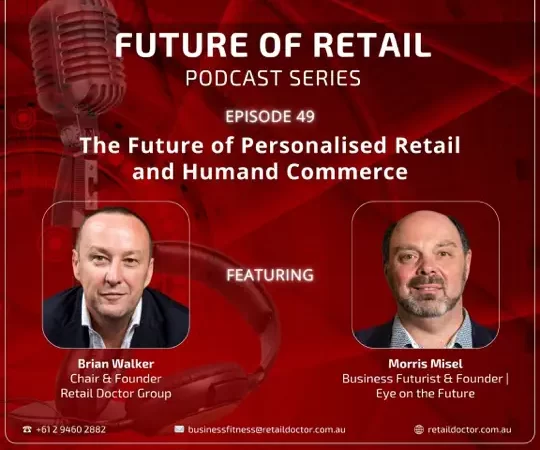
I recently explored this in a conversation with Brian Walker from Retail Doctor Group.
It’s a conversation we’ve returned to a number of times over the years, each time looking at what’s shifting just beneath the surface of retail (28 minutes 37 seconds).
To listen directly via Retail Doctor click here
Retail is shifting from choice to authorisation
For decades, retail has been built on one core idea.
Give people more choice and they will buy more.
More products.
More categories.
More experiences.
But that assumption is starting to crack.
What I’m seeing is a shift away from choosing…
toward authorising.
Customers are increasingly saying:
“Within these boundaries, you decide for me.”
That’s not laziness.
That’s efficiency.
That’s trust.
And that’s a completely different operating model for retail.
Where HUMAND fits into this shift
This is where my HUMAND framework becomes useful.
HUMAND simply refers to the combination of:
- Human judgement
- Machine capability
- Artificial intelligence
Working together.
If you want a deeper explanation, I’ve unpacked it here:
https://www.morrismisel.com/workforce-revolution-why-jobs-are-over-but-work-is-just-beginning/
Retail, when you break it down, is just a series of tasks.
Stocking.
Pricing.
Recommending.
Serving.
Transacting.
The real question now is not how to do these better.
It’s:
Who should be doing each of them?
- A human?
- A machine?
- AI?
- Or a blend?
Because when that mix is right, outcomes improve dramatically.
When it’s wrong, you get five-store experiences like mine.
At its core, retail hasn’t changed
Despite everything we talk about, retail still comes down to three things:
Attention.
Decision.
Trust.
That’s it.
Every store, every platform, every campaign is trying to influence those three moments.
But here’s the shift.
When a customer authorises you…
You don’t need to fight for attention every time.
You don’t need to force a decision every time.
You don’t need to rebuild trust every time.
You operate inside it.
The rise of agentic commerce
We are now entering a phase where systems can act on our behalf.
Search for us.
Compare for us.
Decide for us.
Buy for us.
This is what’s often referred to as agentic AI.
What this opens up is something retail hasn’t seen at scale before.
The ability to move beyond standardised products and return to specificity.
Before branding, retail was inherently personal. You walked in with a need, and someone worked with you to find the right answer.
What AI now makes possible is a version of that at scale. Not mass choice, but precise fit.
And it changes a fundamental assumption.
Retail is no longer just competing for the customer’s attention.
It’s competing to be chosen by the system acting on the customer’s behalf.
When machines buy from machines, what is retail for?
If a system can:
- find the best product
- compare alternatives
- validate pricing
- and complete the transaction
Then what is left?
In my view, the role of retail shifts to one thing:
Proof.
Proof that:
- the product is right
- the quality is real
- the recommendation can be trusted
- the next decision can be handed over with confidence
That’s where physical retail evolves.
Not as a place of transaction.
But as a place of reassurance.
The split most retailers aren’t acknowledging
Customers are not moving in one direction.
They’re splitting.
Some want control:
- data
- transparency
- comparison
Others want trust:
- curation
- simplicity
- confidence
Neither is wrong.
But designing for both requires intention.
Because if you get it wrong, you create friction instead of clarity.
The real risk is not technology
It’s irrelevance.
If I can get:
- faster outcomes
- better decisions
- less effort
Without you…
You don’t disappear loudly.
You disappear quietly.
What this means for retail leaders
If I were sitting with a leadership team today, I’d be asking four simple questions:
- Where are our customers actively seeking clarity, not choice?
- Where are we helping them decide, and where are we forcing them to?
- What trust have we genuinely earned, not just claimed?
- Are we building for transactions, or for ongoing authorisation?
Because the future is not about predicting what happens next.
It’s about preparation.
One final thought
We’re not moving into a world where humans disappear.
We’re moving into a world where humans choose when to show up.
And retail will be shaped by that choice.
Choose Forward
Call to action
If you’re rethinking customer experience, retail strategy, or how AI fits into your organisation, this is exactly the work I do with leadership teams.
Keynotes. Briefings. Workshops.
👉 Visit https://morrismisel.com
Or reach out directly to start the conversation.
Future of Retail, AI in Retail, Retail Strategy, Morris Misel, Customer Experience, Leadership
#FutureOfRetail #MorrisMisel #RetailStrategy #RetailLeadership #AIinRetail #CustomerExperience #PersonalisedRetail #Foresight #BusinessStrategy #Leadership #DigitalTransformation #Innovation #FutureOfBusiness #CX #ExecutiveLeadership #AgenticAI #Trust #DecisionMaking
Frequently Asked Questions
Q: What does it mean that the future of retail is authorisation rather than shopping?
That the purchase decision, historically the central act of retail, is being progressively delegated to AI agents operating within boundaries set by the customer. Rather than a customer searching, comparing, evaluating, and choosing, the customer sets the parameters (quality preferences, price limits, brand values, sustainability requirements) and an AI agent handles the selection and transaction within those parameters. Shopping, as a process of active choice-making, is becoming authorisation: the pre-specification of preferences within which the agent operates. This is not a distant future; it is already present in subscription reordering, personalised recommendation acceptance, and smart home purchasing.
Q: What does the shift to authorisation mean for retail brands and marketing?
That the point of influence shifts from the moment of purchase to the moment of preference-setting. If the customer’s agent is making purchase decisions within boundaries the customer established at the beginning of the relationship, the brands that win are those that appear within the preference boundaries most customers set, not those that win in individual competitive moments on the shelf or the search page. This means brand trust, demonstrated quality, and alignment with customer values become more important than ever, because they determine whether a brand is within the pre-authorised set. Brands that have been built on winning individual attention battles rather than on the sustained trust required to be inside a customer’s preference architecture face a significant structural challenge.
Q: What does this mean for how retail organisations should be thinking about their customer relationships?
That the customer relationship that matters most is the one that earns inclusion in the authorisation architecture. The organisations that are thinking about this well are not asking ‘how do we win this transaction’ but ‘what would we have to be (in quality, in reliability, in values alignment) to be the default within the parameters our customers set?’ The answer requires a fundamentally different orientation from transactional retail: less focus on the competitive moment and more focus on the sustained trust relationship that earns permanent inclusion.
Q: Can Morris Misel speak on the future of retail, the authorisation shift, and what it means for brands, customer strategy, and business model design?
Yes. The future of retail and commerce are core keynote topics for retail, brand, and strategy audiences. Book at morrismisel.com.