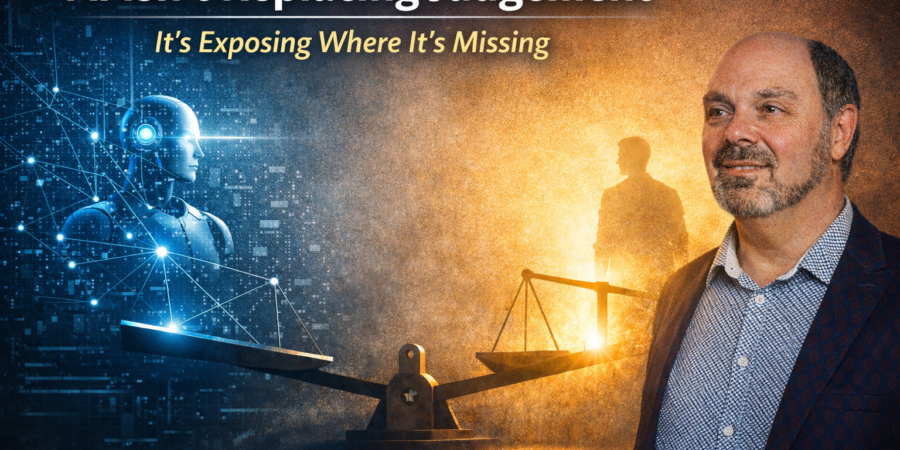
AI Is Not Replacing Judgement. It’s Exposing Where It’s Missing.
There’s a quiet shift happening in how AI is being used.
Not in what it can do.
But in how people are leaning on it.
At first, most organisations approached AI as a tool.
Something to assist.
Something to accelerate.
Something to experiment with.
That phase is still there.
But underneath it, something else is starting to show up.
People aren’t just using AI to do more.
They’re using it to decide.
And that’s where things get more interesting.
The moment AI moves from tool to substitute
I’ve been in a number of conversations recently where the question isn’t:
Can AI help us with this?
It’s closer to:
What does the AI say we should do?
That sounds like a small shift.
But it’s not.
Because the role of AI has changed.
From support… to influence.
And in some cases, from influence… to default.
Not because people don’t have judgement.
But because the environment has become harder to read.
More variables.
More uncertainty.
More possible outcomes.
So the temptation is understandable.
If something can process more than we can, why not lean on it?
PTFA and the quiet outsourcing of thinking
This is where PTFA shows up again.
Past Trauma, Future Anxiety.
Past Trauma says:
we’ve been wrong before
Future Anxiety says:
we don’t want to be wrong again
So when AI presents an answer that looks coherent, structured, and confident…
it feels safer to follow it.
Not blindly.
But with less resistance than we might have applied before.
What’s happening here isn’t laziness.
It’s risk management.
But over time, it creates a subtle shift.
We start to outsource not just the work…
but the thinking behind it.
The illusion of confidence
One of the challenges with AI-generated output is how it presents itself.
Clear.
Structured.
Well-formed.
It looks like certainty.
Even when it’s not.
And that matters.
Because human judgement doesn’t just respond to accuracy.
It responds to confidence.
When something sounds right, it’s easier to accept.
Especially in environments where time is tight and decisions need to move.
This is where the risk sits.
Not in the technology itself.
But in how easily it can shape the direction of thinking.
What AI is actually revealing
If you step back from this, a different interpretation starts to emerge.
AI isn’t replacing judgement.
It’s exposing where it’s weak.
Where organisations don’t have clear frameworks for deciding, AI fills the gap.
Where context isn’t well understood, AI offers a version of it.
Where priorities are unclear, AI generates options.
It becomes a proxy.
Not because it should.
But because something else is missing.
HUMAND: putting things back in balance
This is where the HUMAND model becomes more than just a concept.
In the <a href=”https://www.morrisfuturist.com/workforce-revolution-why-jobs-are-over-but-work-is-just-beginning/” target=”_blank”>HUMAND model</a>,
work is distributed across Human, Machine, and AI.
AI is excellent at:
processing
generating
analysing
Machines are excellent at:
executing
scaling
repeating
Humans are at their best when they are:
interpreting
contextualising
judging
deciding
The issue isn’t that AI is doing too much.
It’s that humans are sometimes stepping back from the parts only they can do.
Immediate Futures vs imagined futures
Another pattern I’m seeing is how AI expands the range of possible futures.
Ask it a question, and it will give you multiple scenarios.
Possible directions.
Alternative strategies.
Different outcomes.
Again, useful.
But it also expands the field of consideration.
Which brings us back to the earlier problem.
Too many possibilities.
This is where an Immediate Futures lens becomes critical.
Instead of asking:
What could happen?
We ask:
What is already happening that we need to respond to now?
That shift reduces noise.
And it brings judgement back into the centre of the conversation.
Ripple effects of over-reliance
When organisations lean too heavily on AI for direction, a few ripple effects start to show up.
Subtle at first.
Then more visible.
Decisions start to feel less owned.
Teams rely more on outputs than discussion.
Context gets flattened into generalised answers.
Nuance begins to fade.
And over time, something else shifts.
Confidence in internal judgement weakens.
Not because people are less capable.
But because they’re using that capability less.
A simple test
If you want to see how this is playing out in your own environment, try this.
In your next discussion where AI-generated input is used, pause and ask:
Do we agree with this because it’s right…
or because it’s well presented?
That question tends to create a different kind of conversation.
It brings judgement back into the room.
The real opportunity
It would be easy to frame this as a risk.
But I don’t think that’s the most useful way to look at it.
The real opportunity is this:
AI is making judgement visible again.
In a world where information and analysis are abundant, the differentiator shifts.
Not to who knows more.
But to who can:
make sense of it
apply it in context
decide what matters
and act with clarity
That’s not something AI replaces.
It’s something it highlights.
Where this is heading
Across the work I’m doing, this is becoming a more central conversation.
Not “how do we use AI?”
But:
Where should we rely on it?
Where should we challenge it?
Where do we need to strengthen our own judgement?
That’s a different level of thinking.
And it’s where the value sits.
This is the work I’m increasingly doing with organisations.
Helping them use AI effectively…
without stepping away from the judgement that actually makes it useful.
If that’s a conversation you’re starting to have, or something that would be useful to explore in a strategy session or conference setting, it’s very much where I’m focused at the moment.
Choose Forward.
#MorrisMisel #ForesightStrategist #AI #DecisionMaking #HumanJudgement #FutureOfWork #BusinessStrategy #StrategicForesight #HUMAND #PTFA #ImmediateFutures #RippleEffects #Leadership #ConferenceSpeaker #KeynoteSpeaker #ChooseForward
Frequently Asked Questions
Q: How does AI expose judgment deficits rather than replace judgment?
By making the judgment that was previously embedded in process, habit, and tacit expertise visible and examinable. When a human expert makes a decision, the reasoning is often implicit. It feels like intuition but is actually the accumulated pattern recognition of experience. When an AI system makes a recommendation or generates an analysis, the recommendation can be compared to what the expert would have said, and the comparison surfaces questions: why do they differ, which is more reliable, what is each missing? This comparison did not exist when the expert was the only available source of analysis. The AI’s presence creates the contrast that exposes where the judgment is strong and where it is thin.
Q: What does this mean for organisations discovering that AI and their experts disagree?
That the disagreement is information rather than a problem to be managed. When an AI recommendation and a human expert recommendation diverge, the interesting question is not ‘which one should we follow’ but ‘what does this disagreement reveal about the assumptions each is relying on?’ The AI is drawing on patterns in data; the expert is drawing on patterns in experience. When these patterns conflict, the conflict often reveals a genuine difference in what is being optimised for, or a change in the environment that has made historical patterns less reliable, or a domain where the data the AI was trained on was systematically unrepresentative. All of these are worth knowing.
Q: What should organisations do with what AI exposes about their judgment capability?
Treat it as diagnostic rather than threatening. Invest in the processes that allow the exposed gaps to be addressed, whether through better data, better training, better decision structures, or clearer articulation of what the organization is actually trying to optimise for. And resist the temptation to suppress the diagnostic by simply adopting the AI’s recommendation in all cases, the goal is better judgment, not the substitution of AI output for the judgment that was previously, imperfectly, human.
Q: Can Morris Misel speak on AI as a diagnostic tool for organisational judgment, what it reveals, and how to respond to what it exposes?
Yes. AI and judgment quality are core keynote topics. Book at morrismisel.com.