The Checking Tax
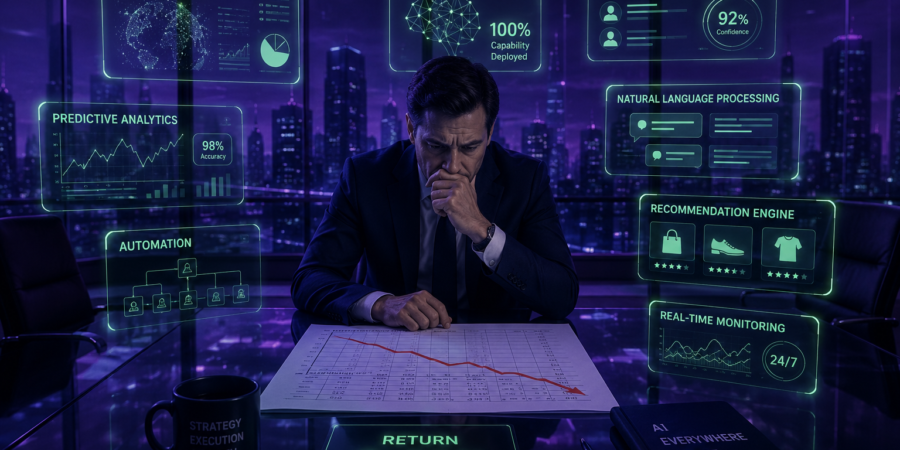
The AI gave you the answer in forty-five minutes. Your team spent thirty-five minutes checking it before it went anywhere. You gained ten.
That’s the Checking Tax. It’s invisible in every AI business case I’ve seen this year. And it accounts for a significant portion of the gap between what AI investment was supposed to deliver and what’s actually showing up in the numbers.
New McKinsey research on AI trust maturity shows that senior leaders are spending almost as long verifying AI outputs as generating them. Think about what that means in practice. You deployed a tool that cuts the time to produce a market analysis from four hours to forty-five minutes. Congratulations. If your people spend thirty-five minutes checking it before it moves anywhere, you’ve gained ten minutes. Not the four hours the capability promised.
Gartner’s data on AI project returns tells the same story from a different angle: only 28 per cent of AI projects deliver against their ROI expectations. Less than 1 per cent of executives report returns of 20 per cent or greater from their AI investment. The National Bureau of Economic Research found that 89 per cent of executives report no measurable labour productivity impact from their AI investment.
These aren’t outlier findings. They’re a pattern. And I don’t think poor implementation or immature tooling explains most of it.
I think a significant portion of the gap lives inside the checking.
The number that should be in every board report right now
The 2026 AI Trust Report includes a finding I’ve been using in leadership sessions because it names something most leaders are experiencing but haven’t yet quantified.
Seventy-seven per cent of leaders hit what researchers call a structural trust ceiling weekly.
I want to unpack that phrase because “structural trust ceiling” sounds like academic language, and the thing it’s describing is actually very concrete.
A structural trust ceiling is the point where you stop delegating to the AI because the organisation hasn’t told you what it’s authorised to decide.
Not personal doubt, though that exists too. Structural doubt. The absence of institutional permission. Your organisation has deployed the capability but hasn’t built the governance that tells you which decisions AI can produce without a human review, and which ones still need one. So in that absence, the rational default is to check everything.
That’s not a behaviour problem. That’s an architecture problem. And when 77 per cent of leaders are hitting it weekly, it’s compounding into a very large invisible cost.
Why the gap exists between the people who see the capability and the people who use it
There’s a signal buried in the same research that matters more than the headline number.
CIOs and CTOs are five times more likely than COOs to say their workforce is ready for AI adoption. Five times.
That’s not a confidence gap between techies and operators. It’s a comprehension gap between the people who can see what the capability does and the people who are responsible for the decisions the capability is supposed to support.
My own Who Decides research (a study of AI decision-making comfort across Australian and US organisations, which we completed before this governance conversation reached most boardrooms) makes this concrete. Tech roles average 72% comfort with AI as a decision support tool. Finance sits at 68%. Operations lands at 54%. HR is at 38%. The people most responsible for the decisions AI is supposed to improve are the least comfortable letting it near them.
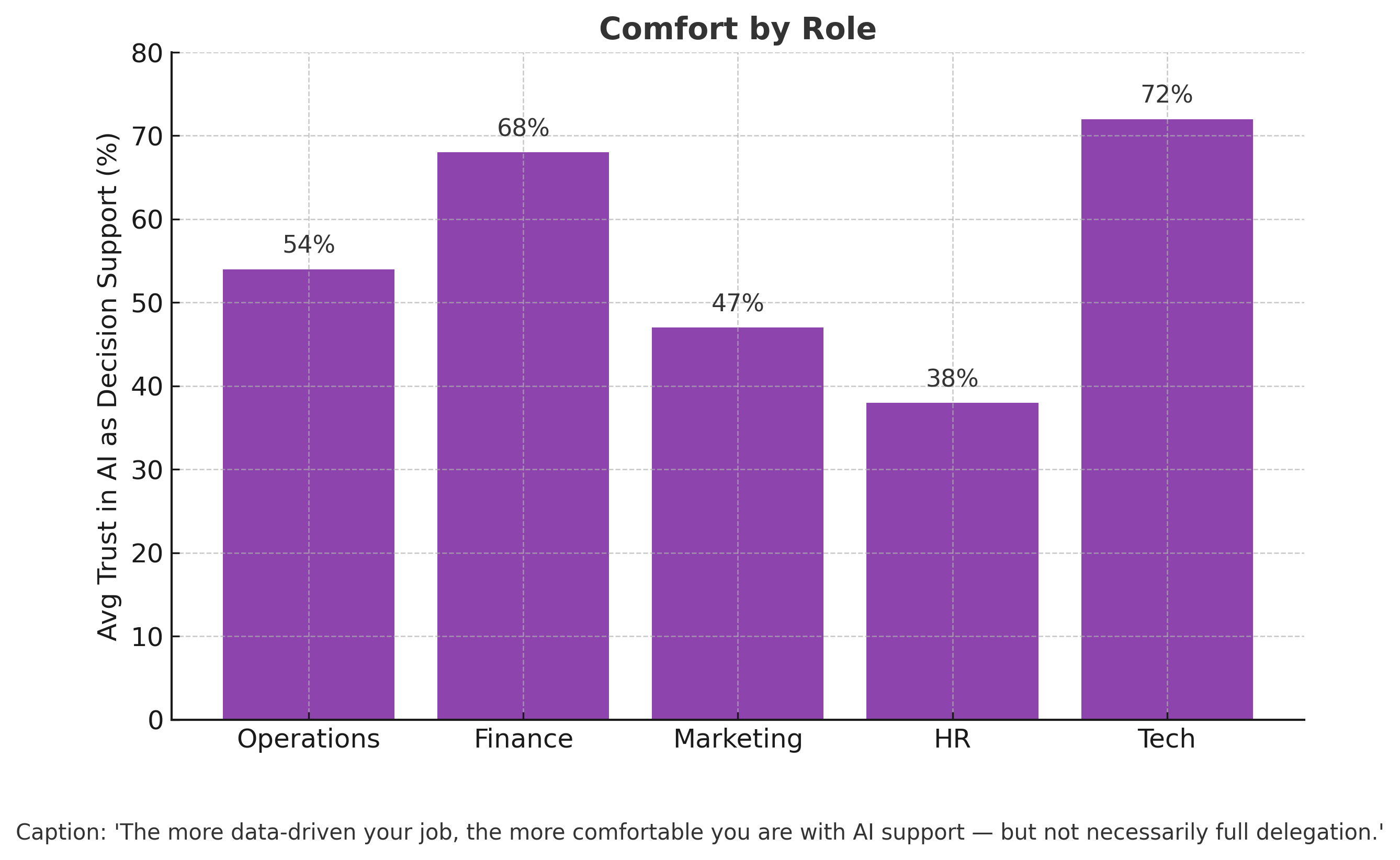
Operations leaders,— the people managing the actual processes that AI is meant to transform — don’t feel ready. And when people don’t feel ready, they default to verification. Which is the Checking Tax in its most structural form.
The technology team has deployed a capability. The operations team is experiencing a responsibility they haven’t been given clear permission to delegate. Both are right. And nobody has built the bridge between them.
The McKinsey trust maturity data makes this concrete. Organisations with clear AI governance ownership (where someone has actually defined what AI is authorised to do and at what level of human oversight) score 2.6 on the trust maturity index. Organisations without it score 1.8. That 0.8 gap isn’t a measurement artefact. It’s the difference between AI adoption that compounds into genuine advantage and AI adoption that plateaus at what I’ve described elsewhere as the 74 and the 20: seventy-four per cent of organisations experimenting, twenty per cent of the value concentrating in the handful who’ve built the governance to make it work.
What the Checking Tax looks like at ground level
Let me be specific, because this problem is easy to reduce to abstraction.
Picture a knowledge worker in a financial services firm. Or a project manager in professional services. Or a policy analyst in a government agency. They’ve been trained on the AI tools. They use them daily. And every time they generate a report, a draft, a recommendation, a summary, they review it before it moves.
Not because they’ve been told to. Because they don’t know what happens if they don’t. Who’s accountable if the AI got it wrong and they acted on it? Is there a policy? Does this output cross a threshold that requires human sign-off? Nobody said. So they check.
Two minutes per output. Conservative.
Now run that across a team of twenty. Across a division of two hundred. Across eight hours a day, five days a week, across twelve months. The number you get is the Checking Tax for that organisation. It doesn’t appear on any productivity dashboard. It doesn’t show up in any utilisation report. But it shows up in the ROI calculation that doesn’t close.
Here’s the thing about the Checking Tax that makes it genuinely hard to see from above. Individually, each check is rational. Each person making the decision to verify is doing exactly what a careful professional should do when the organisation hasn’t told them where the accountability sits. The problem isn’t the individual check. The problem is that the sum of individually rational checks becomes collectively irrational overhead.
That’s a governance failure, not a people failure.
The framework that addresses it: Decision Trust Zones
I want to be direct about what this problem is not, so we’re clear about what it actually is.
It’s not an AI reliability problem. The tools are improving faster than organisations can absorb the changes. It’s not a training problem. More hours on the AI platform doesn’t resolve the underlying question of what the organisation trusts AI to decide. And it’s not an individual behaviour problem. The person checking the output isn’t the problem. They’re the symptom.
This is an architecture problem. The organisation deployed a capability without building the governance structure that tells people where to put it.
For more than a decade I’ve been working with organisations on what I call Decision Trust Zones: a framework for mapping where in an organisation different types of decisions should be made, by whom, and with what level of human involvement required. It existed before the AI era as a tool for clarifying accountability in complex, multi-layered organisations. In the AI era, it’s become one of the most urgent governance frameworks I work with.
Applied to AI adoption, Decision Trust Zones answers four questions that most deployment plans never ask.
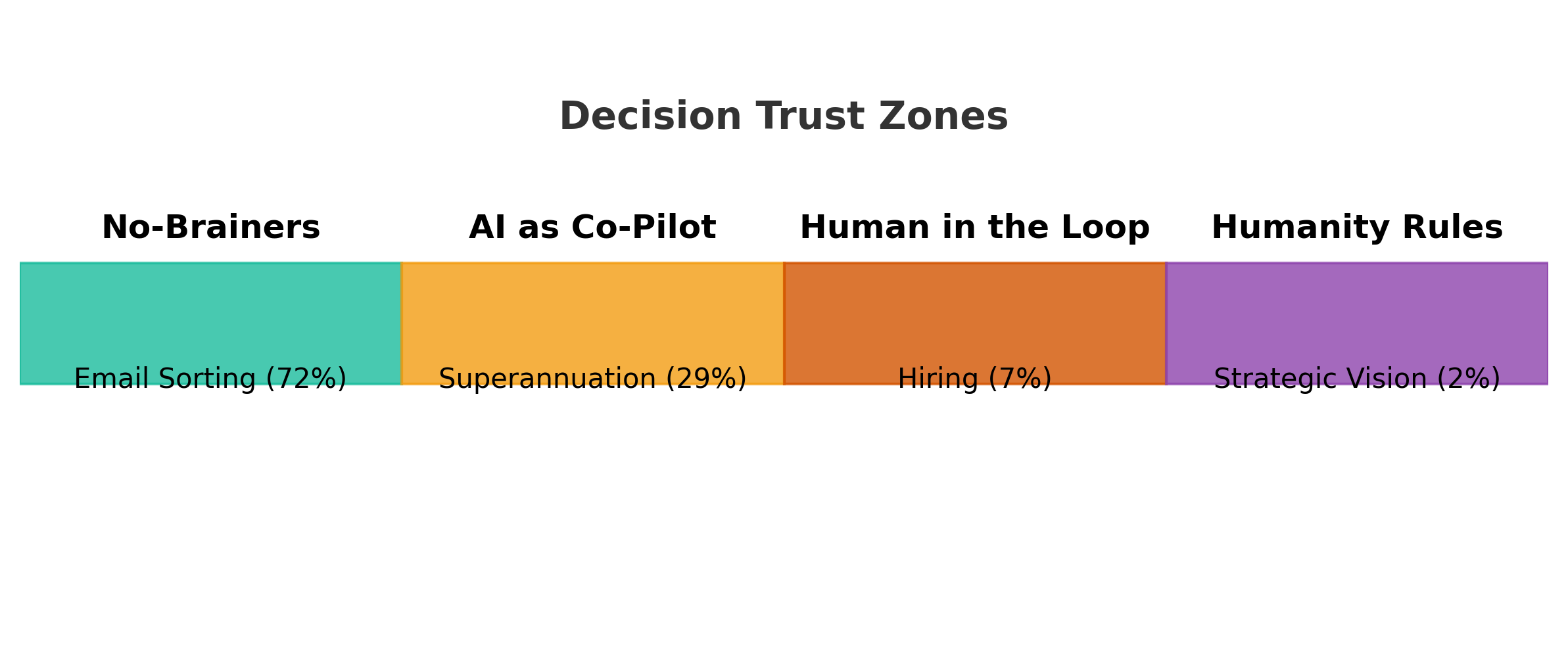
What can AI decide without human review? Every organisation has categories here. High-frequency, low-stakes, pattern-matching decisions where the cost of a wrong answer is low and the volume of decisions is high. Routing. Categorisation. Standard report formats. First-draft generation for low-risk internal use. Scheduling and logistics. In most organisations, this represents the majority of what AI currently handles. And the majority of it is being checked anyway. That’s wasted overhead with no corresponding risk reduction. Defining this zone clearly eliminates the Checking Tax on the decisions that don’t need it.
What needs AI assistance but requires human judgement to finalise? This is where most substantive knowledge work lives. The AI generates; the human evaluates and decides. Checking here is appropriate, but it should be structured and purposeful, not reflexive. A review of an AI-generated analysis before a board presentation is appropriate. A full re-examination of every line of an AI-generated draft before anyone else sees it is the Checking Tax at full expression. Defining this zone means defining what the review is actually checking for, and how long it should reasonably take.
What requires human authority without AI involvement? These decisions exist in every organisation, and it matters that they’re named explicitly. Significant performance decisions. Commitments with material financial or legal consequence. Matters touching ethics, values, or organisational culture. The instinct to extend AI into these areas often arrives before the governance thinking does. Getting clear about where AI genuinely shouldn’t be is as important as getting clear about where it should.
Who owns and updates these zones over time? This is the most underrated question of the four. AI capability is evolving fast enough that a trust zone definition that’s right today won’t be right in eighteen months. The zones need an owner who reviews and updates them as both the capability and the organisational context change. In most organisations, nobody holds this role. Which means the zones are either never set or set once and never revisited. Both produce the same result: individual default, checking everything, the Checking Tax.
The Australian context: why this matters right now
Australian boards are beginning to ask the ROI question in a way they weren’t eighteen months ago.
It’s no longer “are we using AI?” That question has been answered in most boardrooms. The question now is “what is the return on what we’ve spent, and what does it tell us about what we should spend next?” And when the Gartner data (one in five AI projects with any return, one in fifty with transformational return) starts landing in board papers, the people accountable for those numbers need an answer that goes beyond “the tools are being adopted.”
The answer that actually holds up is a governance answer. Not capability governance. Organisations have spent considerably on policies about what AI can and can’t be used for. I mean decision governance: what is AI authorised to decide in this organisation, at what level of autonomy, with what level of human review, and who holds the accountability when the answer is wrong?
Without that answer, you have what I’ve been calling the Confidence-Preparedness Gap: the pattern where organisations believe they’re more ready for what’s arriving than they actually are. In the AI context, the confidence is real. Most organisations can demonstrate adoption metrics. The preparedness gap shows up in the checking. In the ROI numbers that don’t reconcile. In the board conversation where the investment case is solid and the return isn’t appearing.
That’s not a technology problem. It’s a governance architecture problem.
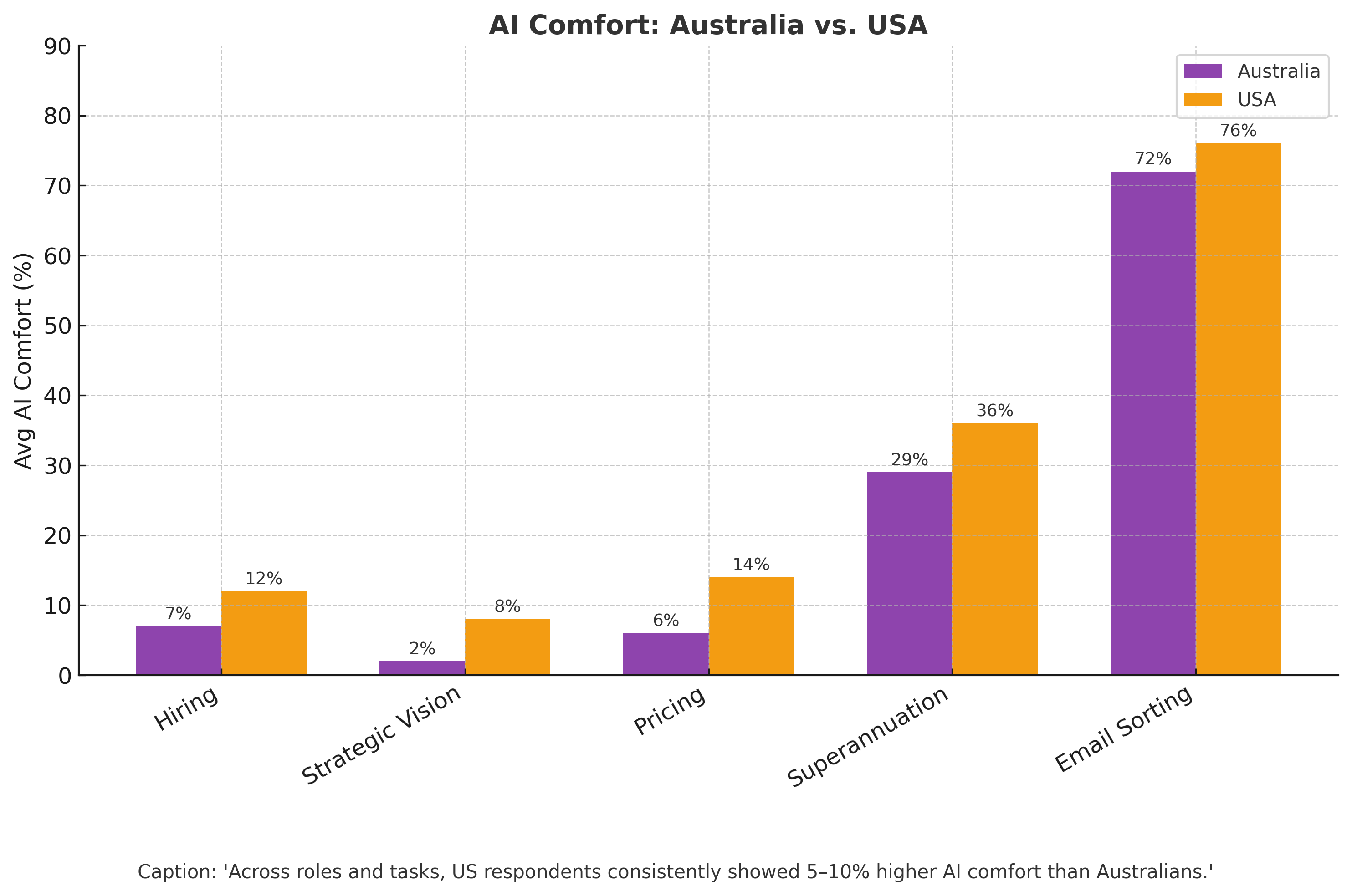
The Who Decides research adds a specific Australian dimension to this. Across every task type we measured (from email sorting to hiring to strategic vision), Australian respondents showed 5 to 10 percentage points lower AI comfort than their US counterparts. We’re not behind on capability. We’re behind on permission. And that gap is showing up in the checking.
Download the Who Decides report: The full findings on AI decision-making comfort, trust architecture, and the gap between what leaders believe and what their organisations are ready for. Read it here →
And Australian organisations have a genuine window to address it. The regulatory environment is still forming. The Privacy Act amendments coming into effect in December 2026 will add automated decision-making transparency requirements that make the Decision Trust Zones question unavoidable. Better to build the architecture in advance of obligation than to be scrambling to document it after.
What to actually do about this
The Checking Tax is an actionable problem. That distinction matters.
Step one: run a verification audit. For one week, ask a cross-section of knowledge workers to log two numbers alongside their AI use: how long they spent generating content or decisions with AI assistance, and how long they spent reviewing or verifying that output before acting on it or sharing it. The ratio tells you your actual trust maturity score, in your organisation, with your people and your current tools. Most leaders I’ve done this with are genuinely surprised by the number. The gap between capability time and verification time is larger than expected, and it’s consistent across levels.
Step two: apply the Decision Trust Zones question to your three highest-volume AI use cases. For each one: has the organisation explicitly decided whether the output requires human verification before it moves? If the answer is “we haven’t decided that formally,” you have your answer. The default is individual judgement, individual judgement defaults to checking, and the Checking Tax is embedded in those use cases. The fix isn’t to tell people to check less. It’s to define what verification is actually for in each case, what it should surface, and when output can move without it.
Step three: assign ownership of the zones. This is the governance step that most organisations skip, and it’s the one that determines whether you’ve made a one-time improvement or built a compounding capability. The AI context is changing fast enough that any zone definition needs to be live. Someone needs to hold the question: as the capability evolves, as our use cases expand, as the regulatory environment shifts, do these zones still reflect where we want human authority to sit? Assign that question to a person or a structure. Without it, the zones calcify or they fragment. Either way, the checking creeps back in.
None of this requires new tools. It doesn’t require another AI platform licence or another training programme. It requires a conversation that most organisations haven’t had yet, because it’s a governance conversation that looks like a technology conversation from the outside. The technology team thinks it’s someone else’s problem. The operations leaders think the technology team is handling it. The result is the 0.8 trust maturity gap that McKinsey is measuring across organisations globally.
The invisible line item
Every AI ROI model has a numerator and a denominator.
The numerator is what AI produces: tasks completed, decisions accelerated, time saved, throughput increased. The denominator is what it costs to deploy: licences, integration, training, change management. The ROI is the ratio.
The Checking Tax is a third number that isn’t in the model. It’s the cost of every minute your people spend verifying output that could have moved without a review, if the organisation had been clear about what it was authorised to trust. In most organisations, that number is substantial. In some, it’s large enough to account for much of the gap between what the business case projected and what the P&L is showing.
The organisations that close this gap won’t close it by having better AI. They’ll close it by having clearer governance. Not because governance is inherently valuable on its own. It’s valuable because it converts a capability into a decision. And in the end, AI is only worth as much as the decisions it actually produces.
Right now, a significant portion of that value is going into the checking.
Naming it is the first step. Building the architecture to fix it is the next one.
Choose Forward.
Morris Misel is a foresight strategist and business futurist with 30+ years of experience working with boards, leadership teams, associations, and government on preparing for what’s already arriving. His Decision Trust Zones framework maps where decisions belong in organisations navigating AI adoption. More at morrismisel.com.
Frequently Asked Questions
What is the Checking Tax in AI adoption?
The Checking Tax is the verification overhead that accumulates when knowledge workers review every AI output before acting on it. Not because checking is wrong, but because the organisation hasn’t defined what AI is authorised to decide without human review. When 77% of leaders hit this ceiling weekly, the cost compounds into a significant gap between AI capability and AI return.
Why don’t most AI ROI calculations show a positive return?
Gartner’s research shows only one in five AI projects delivers measurable return and only one in fifty delivers transformational value. A significant contributor is that ROI models count what AI produces but not what it costs people to verify that output. The verification overhead can approach parity with the productivity gain, substantially eroding the business case.
What are Decision Trust Zones?
Decision Trust Zones is a governance framework that maps where different types of decisions should be made in an organisation: what AI can decide autonomously, what requires AI assistance with human judgement, and what requires human authority only. In an AI adoption context, it defines what the organisation has explicitly authorised AI to decide, reducing reflexive checking and the associated overhead.
How does the structural trust ceiling affect AI adoption?
When an organisation deploys AI capability without defining decision authority (without telling people what AI is authorised to decide without human review), the rational individual default is to check everything. This is what researchers call the structural trust ceiling: the point where trust runs out not because of personal doubt but because of absent institutional permission. Seventy-seven per cent of leaders hit it every week.
What’s the first practical step to reduce AI verification overhead?
Run a verification audit: ask a cross-section of knowledge workers to log the time spent generating content with AI assistance alongside the time spent reviewing that output before acting on it. The ratio reveals your organisation’s actual trust maturity. Then apply the Decision Trust Zones question to your three highest-volume AI use cases and define explicitly what verification is for in each case.