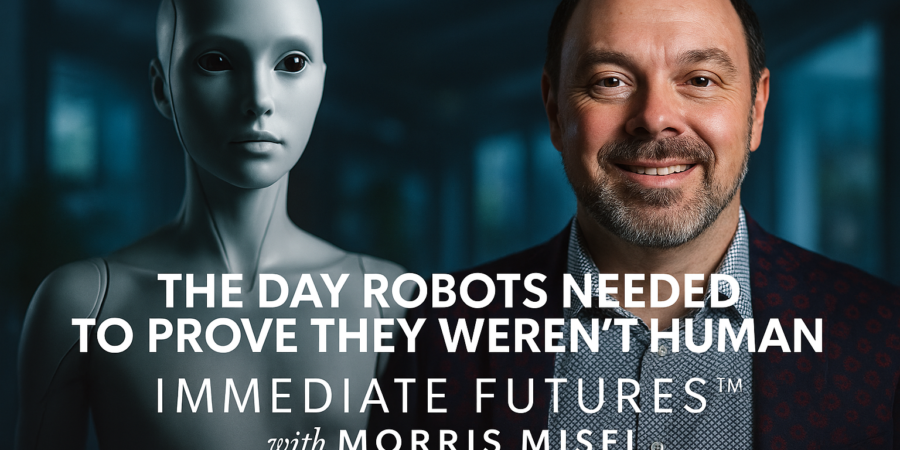
{Podcast} The Day Robots Needed to Prove They Weren’t Human
Under the Lights in Guangzhou
They stood a few metres away from something that moved too well.
IRON, Xpeng’s new humanoid robot, walked, turned, and gestured with such poise, that the crowd murmured in disbelief.
Then, under the hot stage lights, the engineers did the only thing left to do.
They cut it open.
There was no human inside.
Just wiring, sensors, and 82 degrees of freedom packed into a synthetic spine.
What struck me wasn’t the technology. It was the reaction.
A collective gasp, a nervous laugh, the sudden need for proof.
We’ve built machines that now move like us but our imagination hasn’t caught up to what we’ve made.
The Imagination Gap
Every civilisation reaches this point.
We invent something extraordinary and then flinch.
When Galileo lifted a telescope, people feared it might distort heaven.
When trains first hit 40 miles an hour, doctors warned our lungs would collapse.
When photography arrived, some said it would steal the soul.
Now, a century after we coined the word robot (from the Czech robota, meaning forced labour), we’re facing the same reflex: suspicion, awe, denial, acceptance.
The machines haven’t betrayed us; they’ve simply arrived sooner than our imagination prepared for.
From Forced Labour to Living Mirror
We once imagined robots as servants obedient, box-shaped helpers.(Betty from The Jetsons, anyone?)
Instead, we’ve created something far stranger: a living mirror.
This is what I call the Imagination Gap the lag between what technology can do and what humanity can emotionally, ethically, and organisationally absorb.
And it’s widening.
Podcast: for more on the listen in to my segment on Honk Kong Radio 3 where host Phil Whelan and I chat all things Future of Robots (17 minutes 19 seconds)
HUMAND™ in Action
The IRON moment is pure HUMAND™: the fusion of Human + Machine + AI working in rhythm rather than rivalry.
As I wrote in Robotics, HUMAND & the Future of AI Collaboration, progress isn’t about replacement it’s about resonance.
The magic isn’t that IRON walks like a person; it’s that a machine now interprets visual context directly, without converting sight into language first.
It feels its environment before it describes it.
That’s not imitation that’s adaptation.
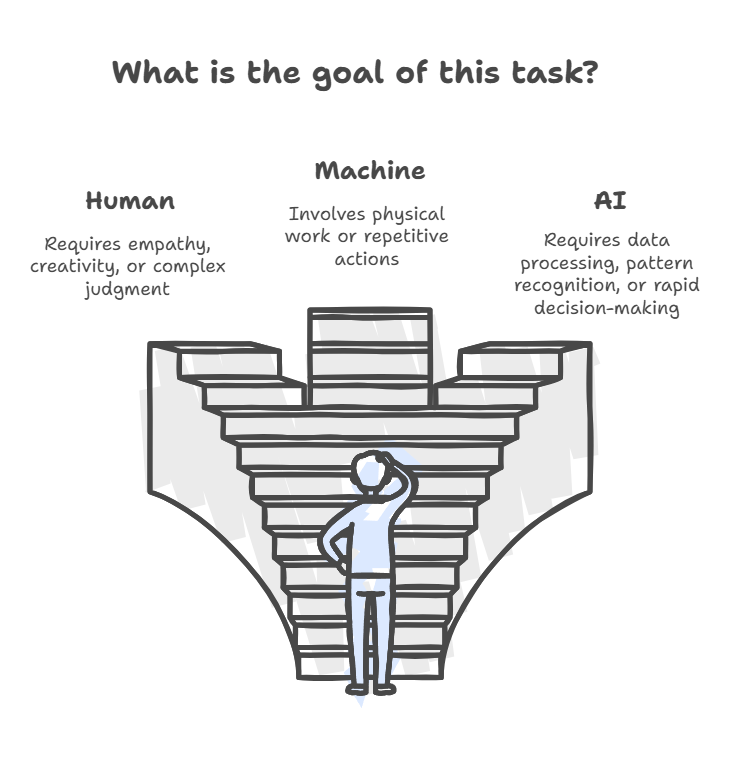
HUMAND™ humans, machines, and AI working together to amplify intent rather than replace it.
Our Predictable Panic
I’ve watched this pattern for four decades.
Each new layer of intelligence from calculators to ChatGPT to humanoids, is met with the same human choreography: fascination, outrage, denial, normalisation.
It’s how we process change.
But here’s the twist: the pace has collapsed.
What once took generations now takes months.
We’re still rewriting policy while the prototypes are already walking.
So, when we cut open IRON, it wasn’t to check for trickery.
It was a ritual of reassurance our ancient way of slowing down the future long enough to feel safe again.
The Ripple Effects™ of Embodied Intelligence
Every signal has its ripple effects.
Here’s what this one sets in motion:
- Workplaces: Humanoid co-workers will soon stand beside human teams, not to compete but to extend reach. The job isn’t disappearing; its edges are.
- Healthcare: Physical AI will assist surgeons and carers with precision and empathy, blending touch and telemetry.
- Aged Care: Soft-skinned robots will provide companionship and prompt us to redefine what genuine care means.
- Education: Students may learn empathy from entities programmed to model it.
- Defence & Ethics: As I once asked on Radio Hong Kong 3, should machines ever be allowed to fight our battles? That question just became less hypothetical.
Each ripple is less about machines and more about what kind of humans we choose to be around them.
Beyond “Us vs Them”
We’ve wasted years framing this as a contest.
It never was.
As I argued in Not Humans vs Robots, Humans + Robots, progress happens when we stop competing and start co-creating.
Humanoid robotics simply make that partnership visible.
They’re mirrors in motion. showing us our potential and our blind spots in equal measure.
China’s “Physical AI” and the Race for Reality
China’s Xpeng calls this new frontier physical AI, AI that doesn’t just think, it occupies space.
It’s an audacious shift from digital convenience to embodied presence.
Meanwhile, the West is still debating data bias and copyright law.
Neither side is wrong; they’re just running different races.
China is sprinting toward integration; the West toward introspection.
The outcome will decide not only who leads in robotics but who defines what “humane” innovation means.
PTFA™ The Emotional Drag Coefficient
Every leap forward has its emotional gravity.
PTFA Past Trauma, Future Anxiety™ is the quiet weight that drags behind our progress.
We carry scars from every technological betrayal privacy leaks, automation layoffs, online harm and project them onto the next frontier.
So our hesitation isn’t irrational; it’s inherited.
We’ve been burnt before.
But if we let that caution calcify, we’ll freeze in the face of possibility.
From Immediate Futures™ to Inhabitable Futures™
When I map this moment through my Immediate Futures™ lens, the signal is clear: embodied intelligence is the next societal inflection point.
And if we do it right, it leads to Inhabitable Futures™ worlds we can actually live in, not fear.
That means designing for co-existence, not control.
It means new ethics, new policies, new imagination.
Because the real race isn’t between nations or algorithms.
It’s between our rate of invention and our capacity to imagine living with it.
The Human Rehearsal Cycle
History repeats in patterns: we fear, we resist, we normalise, we rely.
We once resisted elevators that moved without operators; now we step inside and trust the doors to close.
We feared online banking; now we panic when it’s down for an hour.
The same rehearsal is beginning with humanoid robots.
This time, though, the adjustment window is microscopic.
We don’t have decades to absorb it, we have days and months.
Be Careful What We Wished For
For a century we dreamed of helpers like Betty from The Jetsons ever-cheerful, tidy, safe.
Now we’re meeting IRON, sleek, ambiguous, and unsettlingly graceful.
We asked for convenience; we got consciousness-adjacent competence.
This is the future we built.
The question is whether we’re ready to inhabit it.
Imagination as Infrastructure
We’ve spent the last century building machines.
Now we need to build the imagination to live with them.
Innovation isn’t infrastructure, imagination is.
The factories, code, and policy follow vision, not the other way around.
Every time a new form of intelligence emerges, society scrambles to catch up linguistically, emotionally, and economically.
We don’t yet have the vocabulary for moving machines that learn.
We don’t even know whether to greet them, train them, insure them, or teach them manners.
So the challenge ahead isn’t how to make machines more human.
It’s how to make humanity more prepared.
The Ripple Effects™ of an Updated Imagination
When our imagination expands, industries shift:
- Business: Strategy becomes about horizon scanning, not efficiency. The advantage goes to those who interpret signals sooner and act with empathy.
- Workforce: HUMAND™ workplaces will blend biological and mechanical colleagues. The real leadership skill will be orchestration knowing when to let machines take the strain and when to let people feel the purpose.
- Education: Classrooms will move from memorisation to imagination training teaching how to think beyond the known.
- Policy: Regulation will pivot from “permission to operate” to “permission to co-exist,” balancing innovation with human dignity.
- Culture: As embodied intelligence enters homes and public life, art, humour, and storytelling will evolve to process the new normal.
These Ripple Effects™ remind us that every leap in capability must be matched by a leap in meaning.
What Happens When the Imagined Future Catches Up
For most of history, imagination led invention.
Now invention is leading imagination.
That’s why it feels so disorienting.
The machines aren’t just faster; they’re believable.
And believability changes everything emotion, ethics, economics.
We no longer have the luxury of “someday.”
Our inventions are standing beside us, waiting for us to catch up.
So here’s the real question: Can we evolve as fast as our technology?
A Leadership Reset
Leaders, boards, and educators face a simple fork in the road: React to every wave of disruption or prepare for the tides underneath.
Here’s how to start the preparation work right now:
- Build imagination time into your planning.
Reserve a meeting each month for one prompt only: “What have we been assuming will never happen and what if it already has?” - Audit your Immediate Futures™.
List the next three signals likely to impact your sector. Then decide not what you’ll do if they arrive, but what you’ll do while they arrive. - Design for Inhabitable Futures™.
Ask: Would people want to live, work, or learn inside the futures we’re creating?
If the answer is “I’m not sure,” then imagination work is overdue. - Train your team in comfort, not compliance.
We’ve spent decades teaching rules; now we need to teach adaptability.
Change literacy will become the new competitive advantage.
The Emotional Work of Tomorrow
Adapting to embodied intelligence is emotional work disguised as technological work.
It asks us to redefine “human.”
Not smaller, not weaker, just different.
If machines are taking on precision, maybe our job is to reclaim wonder.
If they’re learning logic, maybe we double down on empathy.
If they move like us, maybe our next frontier is how we imagine together.
That’s the shift from Immediate Futures™ to Inhabitable Futures™ from predicting outcomes to preparing atmospheres.
The New Pulse of Progress
We’re standing in the middle of what I call the Imagination Rebuild a collective reconstruction of how we see ourselves in relation to intelligence.
The robots will keep walking, learning, adapting.
Our task is to stay alert enough to decide what they mean.
When we start cutting open machines to prove they’re not human, it tells me we’re running an old operating system one built for separation, not symbiosis.
It’s time to update that code.
The future isn’t asking us to surrender control.
It’s asking us to evolve perspective.
The Immediate Futures™ Outlook
Here’s what to watch next:
- Embodied AI becomes the interface. We’ll stop “logging on” and start “walking with.”
- Synthetic empathy will rise programmed responsiveness that triggers genuine emotion.
- Physical AI ethics boards will emerge, debating design boundaries the way bioethics boards once did.
- Hybrid leadership models will appear: teams co-led by humans and intelligent systems.
- The first humanoid-to-human work dispute will likely make global headlines and redefine labour law.
Each of these signals is both possibility and test.
If You’re Reading This as a Leader
You don’t need to understand robotics to prepare for what’s next.
You need to understand people how they react, adapt, and imagine.
Innovation fails not because it’s impossible, but because it’s unbelievable.
Your role is to make it believable.
To translate the future into human context before it knocks on your door.
Choose Forward
We cut open a robot to prove it wasn’t human.
Maybe next time we’ll pause long enough to ask what kind of human built it and what kind of future we want it to inhabit.
If this glimpse has you thinking about how your organisation or event can make sense of the next horizon and what it means to you today, that’s the work I do every day.
Book me for your next keynote, foresight session, or strategy workshop.
Together we’ll decode the signals shaping your business and industry, map your Ripple Effects™, explore your Inhabitable Futures and design Immediate Futures™ that are daring, doable now, and deeply human.
👉 Book a session or keynote
👉 Explore more foresight
Because the future isn’t predicted it’s prepared for.
Choose Forward.
Morris Misel is a 12-time award-winning global futurist, strategist, and storyteller heard by millions each year on stage, in the media, and inside boardrooms.
For more than 30 years, he’s helped leaders across 160 industries decode change and turn foresight into action.
Through his Immediate Futures™, HUMAND™, Ripple Effects™, and Inhabitable Futures™ frameworks, he helps organisations prepare for what’s next, not just imagine it.
You can’t predict tomorrow, but you can prepare for it.
#MorrisMisel #Futurist #ImmediateFutures #RippleEffects #HUMAND #InhabitableFutures #FutureThinking #StrategicForesight #AI #AIandHumanity #HumanoidRobots #EmbodiedAI #Innovation #Leadership #FutureOfWork #FutureOfTechnology #FutureOfHealthcare #PhysicalAI #ImaginationGap #ArtificialIntelligence #HumanMachineCollaboration #DecisionMaking #TechnologyEthics #FuturePreparedness #ChooseForward
Frequently Asked Questions
Q: What does it mean that robots now need to prove they are not human?
It signals the inversion of a relationship that was, for most of computing history, one-directional. The Turing test, can a machine convince a human it is human?, was designed to measure machine capability. The new challenge, can a human prove to a system that they are not a machine?, is the inverse: systems are assuming machine-like behaviour as default and requiring verification of human presence. This inversion reflects how far AI capability has come and how consequential the distinction between human and machine interaction has become for trust, accountability, and governance.
Q: Why is the human-machine distinction becoming more consequential, not less?
Because the systems that determine access, allocate resources, and make consequential decisions are increasingly automated, and the integrity of those systems depends on them being able to distinguish human agents from automated ones. When AI can mimic human communication with high fidelity, the verification of human presence becomes a genuine technical and governance challenge, one that affects everything from electoral integrity to financial system security to the authenticity of interpersonal communication.
Q: What does this signal for the future of identity and trust online?
That the current frameworks for online identity (passwords, biometrics, behavioural signals) were not designed for an environment where sophisticated AI can replicate human behaviour at scale. New frameworks are being developed: cryptographic proof of human identity, persistent digital credentials, and continuous behavioural authentication. The organisations and governments that are thinking ahead about identity infrastructure are the ones building these frameworks now, rather than waiting for the failure modes of current systems to become acute.
Q: Can Morris Misel speak on trust, digital identity, and the governance of human-machine interaction for our technology, financial services, or government audience?
Yes. Trust and digital identity are core keynote topics for technology, financial services, and government audiences. Book at morrismisel.com.