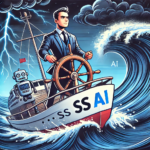
What makes you irreplaceable?
AI isn’t coming for your job.
But if you don’t redefine your role, irrelevance might.
The Real Threat Isn’t AI, It’s Inaction
Executives, leaders, decision-makers, AI isn’t replacing people.
It’s replacing tasks.
The biggest risk?
Assuming your role is untouchable.
AI is fast, scalable, and precise.
But it lacks what makes us human.
Intuition. Creativity. Ethical judgment.
The future of work isn’t AI vs. humans.
It’s HUMAND – Humans + AI + Machines.
The question is, what’s your value in this equation?
Right now, companies are automating at scale.
Leaders are scrambling to restructure. But most are missing the real shift.
AI isn’t taking over, it’s forcing us to redefine human purpose.
What AI Can’t Do, And Never Will
- Intuition & Pattern Recognition – AI detects patterns in data, but it doesn’t “sense” trends before they emerge. It doesn’t get gut feelings. Human foresight, industry instinct, and contextual awareness still outpace algorithms.
- Creativity & Innovation – AI remixes, but humans create. It generates from past data, but it doesn’t imagine entirely new concepts. The biggest breakthroughs? Still human-led.
- Ethical Judgment & Decision-Making – AI follows rules. It doesn’t navigate moral grey areas. Trust, fairness, and ethics remain human territory.
- Complex Relationship Management – AI analyzes people. It doesn’t connect with them. Human relationships, negotiation, empathy, leadership, aren’t programmable.
- Adaptability & Resilience – AI optimizes for efficiency. It doesn’t pivot under pressure. Humans can rethink strategies in real time. AI can’t.
These aren’t soft skills.
They’re power skills.
And they’re the only ones that matter in the AI age.
Redefining Work: Where Humans Excel
Leaders need to rethink roles, fast.
Instead of replacing jobs, future-ready businesses will restructure around human-AI collaboration.
Here’s how:
1. The New C-Suite Mandate: AI-Enhanced Leadership
Executives must shift from decision-makers to strategic orchestrators.
AI crunches data. Humans drive vision.
The best leaders will master AI without outsourcing their judgment.
Next Step: Establish an AI Steering Committee to integrate AI insights into leadership decisions, without handing over control.
2. AI as the Assistant, Humans as the Architects
Repetitive tasks? AI’s got it.
Big-picture strategy? That’s still human.
The future workforce won’t be AI-run.
It’ll be AI-augmented.
Next Step: Audit job roles using the HUMAND framework, Humans, Understanding, Machines, AI, Navigation, and Design. Identify which tasks are best suited for AI and which demand human expertise.
3. Creativity & Innovation: The Competitive Edge
The highest-value roles won’t be the most technical.
They’ll be the most creative.
AI can automate, but it can’t innovate.
The next wave of competitive advantage?
Human-led ideation.
Next Step: Invest in cross-disciplinary problem-solving teams, mix tech, strategy, and creative thinkers. The best ideas won’t come from silos.
4. Human-Centric AI Governance
Bias. Ethics. Trust.
The AI future depends on human oversight.
If AI makes high-stakes decisions, humans need to be accountable.
Next Step: Build an AI Ethics & Governance Council to monitor decision-making algorithms and ensure responsible AI use.
5. Future-Proofing Skills: Adaptability Over Specialization
In a world where AI learns at scale, the best human skill is learning itself.
Static expertise is dead.
The ability to unlearn, relearn, and pivot will define future careers.
Next Step: Embed continuous learning into company culture. Micro-skilling, scenario training, and AI fluency should be standard.
AI Won’t Replace You. But Someone Who Masters AI Will.
The biggest leadership mistake today?
Ignoring AI, or fearing it.
The winners will be those who redefine their roles, amplify human strengths, and leverage AI as an enabler, not a threat.
🚀 Next Steps:
- Assess how AI is reshaping decision-making in your organization.
- Map out where human intuition, creativity, and ethics add irreplaceable value.
- Build AI-human collaboration models to maximize strengths on both sides.
- Upskill teams to ensure adaptability, strategic thinking, and AI fluency.
- Lead AI conversations, don’t just react to them.
AI is evolving. Are you?
The future of work won’t be AI-dominated.
It will be led by those who know how to use AI without losing what makes them human.
#AILeadership #FutureOfWork #AIHumanCollaboration #AIForesight #HumanCentricAI #ExecutiveStrategy #AIandBusiness #AIInnovation #AIWorkplace #LeadershipInAI #AIandEthics #CorporateStrategy #DigitalTransformation #TechDisruption #AITransformation #StrategicLeadership #AIResilience #AIIntegration #AIandCreativity #AIHumanPartnership #AIandDecisionMaking #AIandJobs #TheFutureOfAI #AIandLeadership #AIandTrust #BusinessFuturist #WorkforceEvolution #AIandStrategy #EthicalAI #ResponsibleAI #LeadershipDevelopment #AIandAutomation #AIandRisk #AIandProductivity #AIFluency #AIandGovernance #AIAdaptation #BusinessResilience #AIHumanAugmentation #AIEnhancedLeadership #FutureProofing #AIAccountability #InnovationLeadership #StrategyExecution #CEOInsights #ExecutiveForesight #AITrust #AIHumanEmpowerment #HumanCreativity #AIInTheBoardroom #AIandFutureSkills #FutureOfLeadership #BusinessEthics #AIandNegotiation #DigitalSkills #AdaptiveWorkforce #AIandProblemSolving #AILeadershipDevelopment #TheAIWorkforce #AIandTheC-Suite #AIJobEvolution #AIandInnovation #AIandDecisionMakers #AIandFutureRoles #WorkforceOfTheFuture #NavigatingAI #AIThinkTank #AIConsulting #AIandCorporateCulture #AIandCreativityMatters #FutureSkills #AIFutureLeadership #AIandImpact #AIandAdaptability #FutureCareerPaths #TheNewWorkforce #AIHumanBalance #AIHumanSynergy #NextGenLeadership #AIDrivenFuture #LeadershipTransformation
Frequently Asked Questions
Q: What actually makes a person irreplaceable in an AI-integrated workforce?
Not the tasks they perform, tasks are substitutable. What makes people irreplaceable is the judgment they bring to situations that cannot be resolved by pattern matching on historical data, the relationships they hold that are built on genuine trust and contextual understanding, the creative synthesis they perform across domains in ways that generate genuinely novel solutions, and the accountability they carry for decisions that affect people’s lives and livelihoods. None of these are reducible to tasks, which is why they are not substitutable by systems optimised for task performance.
Q: How should people be developing these capabilities deliberately rather than assuming they will accumulate naturally?
By choosing work and learning experiences that develop judgment in novel situations rather than efficiency in familiar ones. By investing in genuine relationships rather than transactional networks. By practising synthesis across domains (reading widely, working across sectors, connecting ideas from different fields. And by taking accountability for decisions rather than avoiding it) because accountability is where judgment is actually developed. The irony of AI augmentation is that the work that develops irreplaceable capability is often the harder, slower, less efficient work that augmentation tools make it easier to avoid.
Q: What is the HUMAND framework’s perspective on irreplaceability?
HUMAND provides a structured way to map which tasks in any role are candidates for human, machine, AI, or combined execution, and specifically what the human contribution should be in each case. The framework identifies the human-only contribution space: the tasks where human judgment, relationship, creativity, and accountability are not just preferable but required for the output to have the value it is supposed to have. Building your capability profile around that space is the strategic response to AI augmentation at the individual level.
Q: Can Morris Misel speak on future-proof human capabilities, the HUMAND framework, and individual career strategy in an AI world for our workforce or education audience?
Yes. Human capability futures and the HUMAND framework are core keynote and workshop topics. Book at morrismisel.com.