{Radio} We found the centre of the earth!
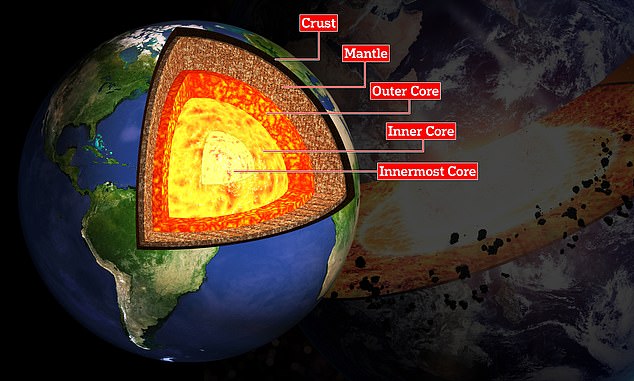
6,370 kilometres beneath our feet, (the distance from Melbourne to Hong Kong) Australian scientists have discovered a 5th layer of our earth’s core, a 650-kilometre metallic ball called, unimaginatively, but ever so scientifically, the inner-inner layer.
The technology used to discover this was not Jules Verne’s 1864 sci-fi personned rocket to the earth’s core, but AI boosted dense bouncing travel time data seismic waves, collected from existing earthquake measurements.
This new technology has also led scientists to posit that we have an internal underground ocean that surrounds our core, that was most likely created by tectonic plates crashing together billions of years ago that pushed the water from the oceans they displaced underground and that its evolved purpose is to regulate the temperature of the earth’s 5,400 Celsius core temperature, which coincidently (or is it?) is roughly the same temperature of our sun. Whilst other scientist have used similar techniques to show the earth’s inner core rotation might be slowing down
Exploration of the inner earth is a daunting task due to the harsh and challenging conditions, but the latest advancements in drilling and sensing technologies have made it possible to reach deeper than the 12.2-kilometre hole the Russian’s drilled in 1992, was abandoned as the 365 Celsius temperature they landed at and the increasing amount of liquid they were finding made it impossible to continue.
But, companies are investing in research and development to create drill bits and sensors that can withstand extreme temperatures and pressures, as well as detect and analyse minerals and gases found beneath the earth’s surface.
One of the most exciting advancements in the technology of inner earth exploration is the use of artificial intelligence and machine learning algorithms to process and analyse the vast amounts of data collected during expeditions. These tools allow researchers to identify patterns, correlations, and other insights that can help them better understand the geology and resources of the inner earth.
Exploring the inner earth is important to our future and to preventing and tackling natural disasters and climate changes.
The knowledge we gain from studying the inner earth can help us better understand the forces that shape our planet and predict natural disasters such as earthquakes and volcanic eruptions. This information is vital for the safety and wellbeing of communities around the world.
Moreover, the inner earth is believed to contain vast reserves of minerals and resources that could be critical for future technologies, including renewable energy sources. By exploring and mapping these resources, we could unlock new opportunities for sustainable development and reduce our reliance on non-renewable resources.
Geothermal energy is another area of interest in inner earth exploration. By tapping into the heat beneath the earth’s surface, we could create a reliable source of renewable energy that could power communities around the world. Research and development in this area could have enormous benefits for the environment and the future of energy production.
Exploring the inner earth is not without its challenges, however. The harsh conditions and complex geology make it a dangerous and difficult environment to navigate. But the potential rewards are vast and well worth the effort.
In addition to the scientific and technological advancements, exploring the inner earth also reminds us of the wonder and mystery of our planet. It connects us to our history and the forces that have shaped our world over billions of years. It inspires us to continue to push the boundaries of what’s possible and unlock the secrets of the unknown.
The technology of inner earth exploration is rapidly advancing, opening new opportunities for scientific discovery, technological innovation, and sustainable development.
By exploring the depths of our planet, we can gain insights into its past, present, and future, and build a brighter and more resilient future for all.
As a Foresight Strategist that embraces his inner childlike curiosity, I love knowing that there is so much around us that we fail to see or don’t yet know about and harnessing this uncertainty to spur me and my audiences and clients to learn more, see more, experience more and do better.
Let’s continue to push the boundaries of what’s possible and keep unlocking the secrets of the inner earth and ourselves.
Listen live to Hong Kong Radio’s 3’s Phil Whelan and I chat about this in our weekly on air all things future chat (16 minutes and 30 seconds)
Frequently Asked Questions
Q: What did scientists discover about the centre of the Earth?
Research published in 2023 provided strong evidence for a fifth layer of the Earth, an ‘inner inner core’ distinct from the previously understood inner core. This was inferred from the behaviour of seismic waves passing through the planet during earthquakes. The discovery suggests the innermost region has a different crystal structure from the surrounding inner core, possibly reflecting a distinct phase in Earth’s formation history.
Q: What does this discovery tell us about the limits of our knowledge of our own planet?
That we are still genuinely discovering things about the most basic physical system we inhabit. We have mapped the surface of Mars in more detail than we understand the interior of our own planet. The inner Earth is effectively inaccessible to direct observation, everything we know about it comes from seismic inference. This is a reminder that apparent certainty about well-studied systems can mask genuine unknowns.
Q: Why does a foresight strategist care about deep earth science?
Because the pattern of discovery, new tools revealing hidden complexity in well-studied systems, is a recurring foresight signal. It applies equally to medicine (the microbiome revealed a whole ecosystem we didn’t know existed), neuroscience (default mode network, glymphatic system), and ecology. Wherever we look more carefully with better instruments, we find more structure than we assumed. This should make us appropriately humble about what we think we know.
Q: Can Morris Misel speak on science frontiers and what new discoveries mean for our understanding of the world?
Yes. The intersection of science signals and strategic foresight is a regular theme in his keynote work. Book at morrismisel.com.
6,370 kilometres beneath our feet, (the distance from Melbourne to Hong Kong) Australian scientists have discovered a 5th layer of our earth’s core, a 650-kilometre metallic ball called, unimaginatively, but ever so scientifically, the inner-inner layer. The technology used to di.
When signals like We found the centre of the earth! emerge, organisations that engage early have the advantage of choosing their response rather than reacting to events. That gap between those who prepared and those who did not is where competitive positioning is actually made or lost.
The most important question is not whether We found the centre of the earth! will matter, but how quickly it will matter in your specific context. Leaders benefit most from mapping the ripple effects early — not just the direct impact but the second and third-order consequences that arrive later and hit harder. That is the practical work of foresight.