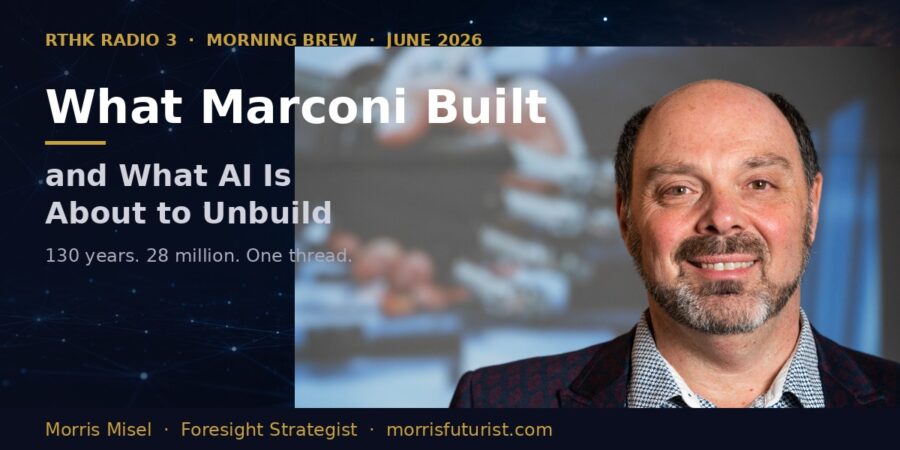
What Marconi Built and What AI Is About to Unbuild
In June 1896, a 21-year-old Italian-Irish man walked into the British patent office with a sketch and a problem. The problem was specific: he wanted to send a signal across his father’s estate in Italy without running a wire. The Italian government had looked at his idea and passed on it. He went to Britain. On 2 June 1896, Guglielmo Marconi filed British Patent 12,039, which he described, in the plainest possible language, as “improvements in transmitting electrical impulses.”
He was not trying to invent radio. He was trying to avoid a wire.
One hundred and thirty years later, Phil Whelan and I talked about this on RTHK Radio 3 Morning Brew. On radio. On the 130th anniversary of the patent that made radio possible. Phil noticed it before I could say it: we were sitting inside Marconi’s ripple effect, discussing the moment it began.
You can listen to the full segment with Phil Whelan on RTHK Radio 3 Morning Brew below:
The Practical Problem and the Transformative Result
I find myself returning to Marconi’s story every few years, and each time the thing that strikes me is the same thing. He did not set out to change communication. He set out to solve a small, specific, personal irritation. He wanted to send a message without the bother of a wire. The scale of what followed from that practical frustration is almost impossible to hold in your mind at once.
By 1901, Marconi transmitted the first trans-Atlantic wireless signal, the Morse code letter “S,” from Cornwall to Newfoundland. By 1922, the BBC was broadcasting. By 1932, the ABC began in Australia. Today, radio reaches approximately five billion people weekly. Not because Marconi had a grand vision. Because one 21-year-old wanted to avoid running a cable across a field.
The line I kept coming back to on air: Marconi didn’t build radio. He solved a small, specific, personal problem, and the world did the rest. That is almost always how transformative technology actually works. Not grand vision. A practical irritation, imperfectly solved, that turns out to matter enormously.
And then I said to Phil: we are inside exactly that same moment right now with AI. The people building the current tools do not know what they are actually building. The thing that will matter most about what is being constructed in 2026 is almost certainly not what anyone intends. It is the ripple effect nobody has named yet.
Phil nodded. And then he said: but you were actually up at 6 AM for a different reason this morning, Morris.
He was right.
The Odometer and the 28 Million
I had been awake since before 6 AM on Tuesday 2 June, watching a number. The Australian Bureau of Statistics Population Clock, a statistical model that estimates one birth every 2 minutes 16 seconds, one death every 3 minutes 33 seconds, net overseas migration, ticked over to 28 million people at six o’clock in the morning.
I published a long piece about what that number means and where it is taking us. You can read the full argument at Australia at 28 Million: The IKEA Moments We Need to Name. What I want to do here is stay close to what actually came up in the conversation with Phil, because what he asked, and what he read aloud on air, tells you something important about what this moment needs.
The image I had in my head as I watched the clock: a car odometer rolling from 27,999,999 to 28,000,000. Except the digits are people. Every colour, every background, every story.
Phil read that line on air. Then he sat with it for a moment. Then he said: “I want to sit with that image for a moment before I say anything useful.”
That pause is the thing. Numbers give us permission to pause. Like a birthday or an anniversary, nothing fundamentally changes at the moment a count rolls over. But something becomes possible that wasn’t quite possible the moment before. We can look back. We can look forward. And we can ask whether the direction we’re travelling still makes sense.
What I wanted to do with this milestone was resist the reflex to turn it immediately into a debate. Because the debate that is currently running in Australia around 28 million people is mostly a proxy war. Immigration, housing, cost of living, these are being run as a single argument, and they are not a single argument. They need to be separated before any of them can be thought about honestly.
IKEA Moments and the Quarter-Acre Block
I introduced a concept on air that I have been thinking about for a few months: IKEA moments.
An IKEA moment is the point at which you fall so in love with what you have built that you stop being able to see it clearly. You followed the instructions. You assembled it. It is standing in the room. And you love it too much to notice that the room has changed around it.
Australia has several of them. The deepest, in my view, is the belief that stable, dignified life requires homeownership. Specifically: a freestanding house on a block of land, owned outright, passed down. The quarter-acre block as the fundamental unit of belonging.
We assembled that furniture over generations. And we built an entire policy architecture around making it achievable for the people who almost had it, rather than asking what secure, dignified housing actually looks like for the people who never could afford it, and what it might look like now that the numbers have changed.
On air, Phil asked the question that question always produces: “Are you saying people shouldn’t want to own their home?”
My answer: not at all. Ownership is one flavour of ice cream. What I am saying is that we have spent forty years arguing about the price of that one flavour while forgetting there are others. The thing people actually want is security, stability, roots. A place that is genuinely theirs. There is more than one way to deliver that. Germany has a homeownership rate of 49 per cent. Switzerland, 36 per cent. Neither country is in crisis. What they have built instead is a legal framework: inheritable tenancies, regulated rent, housing as a human need rather than an investment class.
The housing affordability crisis in Australia has structural roots that predate the recent migration surge by twenty years. Negative gearing, planning restrictions, land banking, a tax system that treats residential property as the primary vehicle for wealth building, we created conditions that make building expensive and slow. The people arriving did not create those conditions. We did. But I also want to be honest: 311,000 net arrivals in a single year puts real, rapid pressure on systems that were already failing. The pace matters. The problem is we are running two different arguments and pretending they are one. They need to be separated, or neither gets resolved.
Phil mentioned the grandchildren. I do too.
I have a second grandchild who arrived three weeks ago. A third on the way. She has no idea what country she is in. She arrived into the 27,999-somethings and the number changed around her. She is going to see 30 million before she starts school. The long piece I published on Tuesday is, in some ways, addressed to her. What do we will into being for the people arriving now, and the ones arriving next?
The Shared Signal and What AI Is Building in Its Place
Here is the connection I kept returning to, and the reason these two topics belong in the same conversation.
Marconi built a medium that, for the first time in human history, sent the same signal to millions of people simultaneously. A shared experience, at scale, in real time. Before radio, information travelled person to person, institution to institution, slowly and unevenly. After radio, a whole nation could hear the same voice at the same moment. That is what built national identity, not just in Australia, but everywhere that mass broadcasting took hold. The ABC connecting a continent. The BBC during wartime. RTHK Radio 3 creating a morning community across one of the world’s most complicated cities.
Shared signal. Shared moment. Shared story.
What I kept thinking about on the anniversary of Marconi’s patent, watching 28 million people accumulate, is this: AI is building the opposite.
Not a signal to everyone. A signal to each person, curated individually. Hyper-personalised audio, content, news, commentary, everything filtered through what the system has learned about you specifically. By 2030, AI will be able to generate any voice, any accent, any tone, in real time, in any language. The radio content you consume may be constructed for you alone, in ways that feel seamless and trustworthy, because the voice has been trained to feel exactly that way to you.
That is remarkable technology. It is also removing something we have not named yet.
What happens to the IKEA moments, the shared furniture of a national identity, when nobody is getting the same broadcast anymore? What happens to the fair go, the common story, the sense that we are all, at some level, inside the same frame, when the frame is different for each person?
Marconi’s problem was: how do I send a signal without a wire? He solved it, and the shared signal became the infrastructure of modern democratic society. The problem AI is solving right now is: how do I give each person exactly the signal they want? And the answer to that problem, applied at scale, may quietly undo what the answer to Marconi’s problem built.
I do not know how to fix that. I am not sure it is fixable in the way a policy problem is fixable. But I think it is worth naming. Because what you cannot name, you cannot prepare for.
Three Things I Recommend You Do
The first thing to do is separate the housing debate from the immigration debate in your own thinking, and in the conversations you lead. These are not the same problem. Conflating them means neither gets the specific attention it needs. Australia’s housing affordability crisis has structural roots. Its pace-of-migration question has real consequences for infrastructure and social cohesion. Both deserve honest analysis. The IKEA moment, the assumption that homeownership is the only legitimate form of stable housing, belongs in the first conversation, not the second.
The second thing to do is ask, in your organisation, what you are building that assumes a shared signal. Your internal communications, your culture, your strategy, how much of it depends on people having a common frame of reference, a shared set of stories and facts and assumptions? As AI personalises information at scale, that common frame becomes harder to maintain. Organisations that build deliberately for shared meaning, not as a soft value but as a structural choice, will be better placed than those that discover the absence of it after the fact.
The third thing to do is listen to what Phil Whelan did at the start of that conversation. He read a passage from my article, aloud, on radio, and then he stopped and said he wanted to sit with it for a moment. That is the practice. Before you move to the argument, sit with the image. 28 million people. Every colour, every background, every story. The odometer rolling over in the grey-blue light of a winter morning. What does that image make possible that the argument does not?
If this connects to decisions your organisation is navigating, whether about workforce, housing, identity, or the ripple effects of AI on shared culture, I work with leadership teams and boards on exactly these questions. Get in touch.
You can also subscribe to my Immediate Futures briefing, a short, weekly read on the signals worth paying attention to, written for leaders who want to stay ahead of what is already arriving.
About Morris Misel
Morris Misel is a foresight strategist, keynote speaker, and media commentator. He works with leaders, executives, boards, and associations worldwide, helping them read the signals, map the ripple effects, and make better strategic choices in conditions of genuine uncertainty. His work spans Asia-Pacific, North America, and Europe, across financial services, healthcare, government, professional services, and technology. He is a regular commentator on RTHK Radio 3 Morning Brew in Hong Kong.
Enquire about a keynote or workshop → · Subscribe to Immediate Futures →
Choose Forward.
#Marconi #Australia28Million #AustraliaPopulation #SharedSignal #AIPersonalisation #Housing #FairGo #FutureOfMedia #IKEAMoments #MorrisMisel #RTHK #MorningBrew #ChooseForward
Full Segment Transcript, RTHK Radio 3, The Brew, 2 June 2026 ▼ Click to expand
Morris Misel speaking with Phil Whelan on RTHK Radio 3 Morning Brew. Transcribed via Whisper (first 6 minutes, full transcript to be added).
Like that, new from Micah on Radio 3, that is called excuses for love, Tuesdays, and you are listening to the brew of wewis to St. Kilderingonzee to say hi to our friend and the business futurist Maurice Mislavowski. How’s it going? Very, very good. Happy Tuesday, everyone. Happy Tuesday, two years, quite an interesting birthday today, but before we get to that Maurice clocked, get a clocked, a groundbreaking statistic this morning and about six o’clock. Now, was that out time all your time, Maurice? Out time. Out time. Is that all yours? That’s what happened. So about 451, your time. So there’s Australian brew of statistics said that at 6.51 a.m. out time, Australia’s population reached 28 million people. That’s crazy, that he don’t know. Isn’t there it is? Small, isn’t it? Like nothing. It’s such a small number. It absolutely is compared to the rest of the world, but for us it’s extraordinary, isn’t it? So it made me open. It made me think about days of past and what 28 million Australians would have seen in the old days. And more importantly, where we’re headed. And I write strangely enough, an article this morning about all of those things. Maurice futurist.com, go to the blog bit. Is this one of those ones that just went blah, and there it was? Yeah, pretty much, also. Pretty much. I mean, there were lots of things that I had wanted to say for a while, have been saying for a while, haven’t put really, really put into an article. And I thought that if we’ve reached that milestone of 28 million, we might as well be being me, I might as well put it down on paper. Yeah. So I started off by saying I’m in 28 million is a nominal figure. Nobody went around and counted, you know, people’s heads. And any of that, it’s all statistics, it’s based on the…number of people that are born, number of people that are die, number of people that migrate in and out of the country, and they do as a statistical analysis about every 50 seconds is what the ADS, so in just statistics at every 50 seconds, one Australian is added to our numbers. So you had to get into that quick this morning, then, really, didn’t you? Well, I did. I didn’t Australian enough. I mean, I know it just means a very, very sad life. I didn’t wake up to do it, but I woke up this morning early as I knew I’m we do, and I actually knew the story was going to happen. I’ve been watching it for a few days, and strangely enough this morning, as I watched the tick off, literally went to 28 million. Well, have a look at Morris’ article, because he obviously goes off in various directions in this. The image in my head is a car odometer. Tell us more about that. Yeah, it is. Because what I was seeing in front of him, he really was the odometer, you know, the thing on the car that tells us how many miles or kilometres were done, and it ticking over. And the thought that was in my head was really, we were talking about coulombs, we were talking about souls, we were talking about human beings. Yeah. It’s human beings literally being alive and living on this little bit of dirt, called Australia. And it kind of worries me lately, I mean, maybe because I’m getting older and crankier, but it kind of worries me lately, because there’s a lot of conversation about things not going well, about people that might be causing it, and about all these, what I think, a really glib response is, you know, ways that if this happened, then the world would be automatically in technically like it was in the good old days of, you know, Wizard of Oz, and nothing could be further than the truth. Let me just talk a bit of drama in here. I’ve had a bit of fun this morning, reading Morris’ article. There are people, every colour, every race, every ability, every stated territory, every age, every story, rolling over in the grey blue light of a winter morning. I want to sit with that image for a moment before I say anything useful. That was great. It could be. It could be. Thank you. Thank you. Yeah, I got casual. I did. Because it is what I said. That’s how dominant I have in my head. And I don’t think that that picture. I mean, nobody has to share my pictures, you know, some of them terrible inside my head. But I think that if we had that kind of an image of…what any country is, not just Australia, any country is, then I think we make better decisions. We have to realize it’s not a country full of just me or people who will like me, it’s a country full of every kind of possibility on this planet. And as long as we all play nicely together, seriously, White House, we just get a long and do it. Is this you being a business now, Est? No, it’s really me being everything. This was a very human article, I hope most of mine are, but I was kind of looking back looking forward, so it’s a couple of weeks ago that I didn’t, but much, I had my second grandchild, third on the way. I always get a bit nostalgic around that time. I also wrote another long piece two years ago, almost three years ago, my first grandchild was born. This to me is a similar piece. It really is looking ahead. It’s from my angle, and only my angle, you’re pulling out. Yeah, exactly, calling out what’s happening. There’s too much conversation going on in Australia about housing and everybody having to own a home. I think that’s detrimental. And we’ve had a lot of our taxes, a lot about politics, everything geared towards making sure that people who are younger can own a home, where did this come from most? Because we had mentioned this before, it’s like, you’re defying by your first square walls and your four wheels. And you think, yeah, yeah, yeah, I, well, I can tell you why. And I don’t think it’s a good thing. And I talk about that in this article as well. Australia has always had this quadratic block fascination. And when people died, hopefully after a very long healthy life, when they passed on, the thing that was often spoken of them was that they left a clean mortgage. And that was kind of like, oh, so I had a good life. And it was, I mean, it truly was. And living in a quarter acre block, the other end of Australia is a really big country. We had more dirt than really 20 million people should have. It was relatively easy to divide up this bit of dirt. We can argue about where we got it from. We shouldn’t. I do in this article. But we divided up, we wouldn’t quarter acre blocks. And up until, which is the euphemism for what we have in Australia, with each other. And up until maybe 20 years or so ago, it was on average, maybe.
This post is based on my segment with Phil Whelan on RTHK Radio 3 Morning Brew, 2 June 2026.
Frequently Asked Questions
What did Marconi actually build and why does it matter now?
Marconi built the first commercially viable wireless radio transmission system, bridging continents that had previously been days apart by cable or ship. What made it significant was not the technology itself but what it restructured: time, geography, and the economics of information. The parallel to AI is direct. AI is not just a faster tool. It is restructuring how decisions get made, how organisations allocate attention, and who controls the flow of consequential information.
What does Australia’s 28 million investment signal about where AI is heading?
Scale investment of that kind signals that governments and institutions are treating AI as infrastructure, not software. When radio became infrastructure, every industry that depended on communication had to rethink its operating model. The same is now true for AI. The 28 million figure is less important than what it represents: a commitment to build foundational capacity rather than wait for commercial adoption to set the terms.
What is the Ripple Effect of AI replacing knowledge workers?
The first-order effect is task displacement. The second-order effect is credential devaluation: the qualifications that once signalled reliable competence become less reliable signals when AI can replicate the outputs. The third-order effect is a shift in what organisations actually need from human workers: less production of known outputs, more capacity to navigate genuinely uncertain situations. That third-order shift has barely begun.
How should leaders prepare for this kind of structural change?
The organisations that navigated the radio era well were not the ones that adopted radio fastest. They were the ones that understood what radio made possible and restructured accordingly. The same applies now. Preparation means developing foresight capacity, building decision architectures that can handle accelerating change, and being honest about which human capabilities are actually irreplaceable rather than just currently unreplicated.
Is Morris Misel available to speak on AI and organisational foresight?
Yes. Morris Misel works with boards, executive teams, industry associations, and conference audiences on how to read accelerating technological change and make better strategic choices inside uncertainty. Enquiries can be directed to morrisfuturist.com.