The Death of the Click? Why AI Summaries Are Quietly Rewiring the Internet
“Click here” used to mean something…
It used to be the heartbeat of the internet.
That one tap or press meant a human was curious. Investigating. Exploring. Looking deeper.
But something has shifted. Not loudly. Not abruptly. Not even obviously. It has crept in sideways just like all major disruptions do. And it’s quietly dismantling one of the internet’s oldest human rituals: the click.
At the centre of this shift? AI summaries.
You know them, those instantly generated, pre-digested blurbs that now greet you at the top of many Google searches. The ones that say: “Here’s everything you need to know, no need to look further.”
But here’s what no one’s saying out loud: these AI summaries are rewiring how we search, how we trust, and how we decide what’s worth our attention.
And the ripple effects are going to be massive.
We are not witnessing a redesign of the internet.
We’re witnessing its rewiring.
And the human brain, and business model, behind the browser is next.
The Data No One Can Afford to Ignore
Pew Research just dropped a quietly explosive insight:
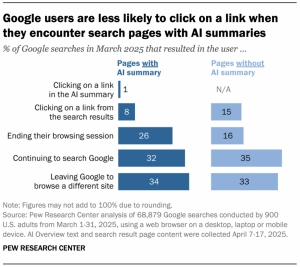
In March 2025, Google users were nearly 50% less likely to click on a search result when an AI summary was present.
Let that settle in.
Here’s the breakdown:
| User Behaviour | Pages with AI Summary | Pages without AI Summary |
|---|---|---|
| Clicking on a link from the search results | 8% | 15% |
| Ending their browsing session | 26% | 16% |
| Continuing to search Google | 32% | 35% |
| Leaving Google to browse a different site | 34% | 33% |
Oh, and clicking on the AI summary itself? A measly 1%.
One percent.
In a world where attention is currency, that’s a monumental collapse in engagement.
Here’s what this chart (and trend) screams to me:
-
We’re teaching humans to trust summaries over sources.
-
We’re creating an interface that rewards passivity, not inquiry.
-
And we’re centralising decision-making power in a single AI layer, controlled by a handful of tech titans.
In short: we are no longer searching. We are being searched for.
This Isn’t Just About Google. It’s About How We Think.
If you’ve followed my work, you’ll know I often say:
“You can’t predict the future. But you can prepare for it.”
So let me put it this way:
We’re preparing for a future where human curiosity is optional and increasingly rare.
What started with auto-suggestions and autocomplete has evolved into full cognitive outsourcing. Why think through something when the AI has already summarised it?
And yet… in a recent workshop with a group of executives from education, media and retail sectors, the same comment kept surfacing:
“We’re not getting clicks like we used to.”
No, you’re not. Because we’re not browsing like we used to.
We’re scanning. Skimming. Absorbing AI’s version of the answer. And moving on.
The Ripple Effects: Who Loses When Humans Don’t Click?
Let’s talk about impact.
This isn’t just a minor UX tweak. This is a value chain disruption:
1. Publishers & Content Creators
Their hard-won articles, insights, and thought leadership now sit behind an AI wall. Summarised. Flattened. Decontextualised. No click = no traffic = no revenue.
The death of the click is the death of the indie thinker if we’re not careful.
2. Marketers & SEO Strategists
Entire industries are built on getting people to click. If behaviour shifts from “click to explore” to “read and bounce,” entire campaigns collapse.
We are heading into what I call the Zero-Click Economy, where visibility no longer guarantees engagement.
3. Brands & Trust
When users stop interacting with your actual content, your brand voice is muted. AI summaries become the new narrators of your story. And let’s be honest, they don’t always get it right.
Who owns your narrative when no one clicks through?
The Psychological Shift: From Explorers to Acceptors
Let’s not overlook the human psyche here.
The original internet was built for seekers digital explorers surfing from site to site.
Today’s AI-layered web? It’s for settlers.
People who want the answer fast, frictionless, and final.
We’re outsourcing our epistemology, the very process of how we know what we know.
And the irony? Most people don’t even realise it’s happening.
Wait… Aren’t Summaries Helpful?
Yes. Massively. I use them. You use them. They’re convenient, fast, often accurate.
But here’s the caution flag:
When convenience becomes replacement, we stop thinking.
And when summaries become all we consume, we stop seeing the full picture.
This isn’t a rant against AI. It’s a plea for conscious digital literacy.
As I wrote recently in my LinkedIn reflection on this trend:
“AI isn’t just changing how we search. It’s changing how we believe, who we trust, and when we stop asking questions.”
Where This Is Going: Signals You Need to Watch
This isn’t a one-off. It’s part of a deeper strategic foresight horizon I’ve been tracking. Here are the next layer signals you should be paying attention to:
Rise of “summary SEO”
Optimising not for human readers, but for the AI summary engines. Expect new metadata, prompt-tuning services, and re-bundled content designed for machine-first consumption.
Clickless analytics platforms
We’ll see a surge in tools that measure implied engagement (scroll speed, dwell time, AI inclusion) rather than just traditional click metrics.
Lawsuits & Licensing Wars
Who owns the summary? The AI model or the original publisher? Expect legal and ethical fights to erupt, especially in news and education.
Psychological side effects
A generation growing up never needing to read the second paragraph. What does that mean for empathy, critical thinking, and wisdom?
How to Prepare: Your Strategic Moves
This is the part I live for, helping leaders navigate the now while preparing for the next.
Here’s what I’m advising clients right now:
1. Rebalance your content strategy
Don’t just optimise for clicks, optimise for citability. What part of your insight will make it into the AI summary? Lead with punchy, sourceable insight that models will quote.
2. Create ‘AI-repellent’ or ‘AI-attractant’ content on purpose
Sometimes you don’t want your content summarised. Other times you do. Tailor your structure accordingly.
3. Educate your audience
Include statements like:
“Want the full context? You’re only seeing the summary. Click to read the real story.”
Even a 3-word prompt at the top of your article (“This isn’t a summary.”) can act as a beacon to real readers.
4. Use the HUMAND™ model
My proprietary HUMAND™ framework helps teams assess which tasks are best done by humans, machines, AI, or combinations of all three.
In this new world, deciding how much to outsource cognition becomes a leadership competency.
The Broader Implication: We’re Not Just Losing Clicks. We’re Losing Curiosity.
And that’s not something you can track in analytics.
What worries me most isn’t the loss of traffic, it’s the loss of thinking.
When the summary becomes the story, we lose the nuance, the depth, the tension. We lose the opportunity to question, explore, disagree, reflect.
We become recipients, not participants.
And the web, once a digital playground of curiosity, becomes a corridor of conclusions.
Final Thoughts: This Isn’t the End of Search. It’s the Start of a New Era.
Let me be clear:
We’re not going back.
The AI-layered web is here to stay. But we do have a choice in how we engage with it.
Do we teach future generations to accept the first answer as gospel?
Or do we remind them, and ourselves, that the second page, the deeper dive, the click still matters?
We must protect human curiosity like the sacred resource it is.
Because in an age of instant answers, those who still ask good questions will shape what comes next.
Resources and Visuals
Here’s the key chart again from Pew Research (July 2025), visualising the seismic behavioural shifts AI summaries are triggering:
Original article:
Pew Research: Google users are less likely to click on a link when AI summaries appear
Take Action
Whether you’re a content strategist, educator, executive or everyday user, it’s time to audit your digital habits.
-
Are you clicking beyond the AI layer?
-
Are your teams creating content that can survive and thrive in the Zero-Click era?
-
Are you helping others (clients, learners, stakeholders) think for themselves?
Want to Explore This for Your Organisation?
I work with companies and leaders worldwide to make sense of what’s coming next and help shape it.
Whether through keynotes, workshops, or strategic foresight sessions, we can build clarity where there’s confusion.
🔹 Book a session: www.morrisfuturist.com
🔹 Read more of my thinking: My Blog
🔹 Subscribe to my LinkedIn Glimpses from the Future newsletter
About Morris
Morris Misel is heard by millions each year in the media and onstage.
A trusted futurist, strategist, and creator of frameworks like HUMAND™ and UNFAIR™, he helps global clients decode disruption, navigate uncertainty, and lead with clarity.
Across 160+ industries and decades of shifts, his foresight remains rooted in human insight, not just tech hype.
#FutureOfSearch #AISummaries #ForesightStrategy #DigitalLiteracy #ZeroClickEconomy #HumanCuriosity #HUMAND #AIUX #MorrisMisel #ImmediateFutures #StrategicForesight #AIandSearch #DecisionMaking #FutureOfSearch #SearchEngineShift #LeadershipStrategy #AIinBusiness #KeynoteSpeaker #AIBehaviourChange #SearchEngineMarketing #ConsumerInsights #FutureThinking #ExecutiveStrategy #GoogleAI #SearchDisruption #DigitalForesight #AIUX #MiselOnAI #ImmediateFutures #2025SearchTrends
Frequently Asked Questions
Q: How are AI summaries changing the economics of the web?
By inserting an AI synthesis layer between the user’s query and the websites that previously answered it. When Google, Perplexity, or any AI-powered search interface answers a question with a generated summary rather than a list of links, the traffic that would previously have gone to the source websites does not materialise. For content-dependent businesses (media organisations, information services, educational platforms) this is a structural change in the economic model, not an incremental shift. The ‘click’ that funded the web’s content economy is being replaced by an AI answer that cites the source but does not send the visitor.
Q: What are the second-order consequences for content quality and information ecosystems?
If websites receive less traffic from search, the economic incentive to produce high-quality, original content for those websites weakens. If the AI systems are trained on that content to produce their summaries, the quality of the summaries depends on the quality of the underlying content, which is being financially undermined by the summary model. This is a potential feedback loop with systemic implications for information quality: AI summarises content, reduces the economics of producing it, the quality of future content declines, future AI summaries decline in quality. The governance and compensation frameworks to break this loop are in early development.
Q: What should content-dependent organisations be doing in response?
Developing audience relationships that do not depend entirely on search-driven discovery. Building email lists, community memberships, and direct subscription relationships that provide access to audiences without the search intermediary. Producing content that AI systems cannot synthesise adequately, long-form investigative work, proprietary data, experiential content, community-generated content. And engaging with the developing governance conversations about how AI systems should compensate the content sources they are trained on and cite.
Q: Can Morris Misel speak on the future of media, AI and content economics, and digital strategy for our media, marketing, or publishing audience?
Yes. Media futures and AI content economics are core keynote topics. Book at morrismisel.com.