28 Million Australians. The Number Is Made Up. That’s Exactly Why It Matters.
There is an image I cannot shake this morning.
At 06:51 on the 2nd of June, 2026, the Australian Bureau of Statistics Population Clock ticked over to 28 million. Not with a ceremony. Not with an announcement. Not with anyone in particular paying attention. The way all genuinely significant moments arrive: quietly, in the middle of ordinary life, while most of the country was still asleep.
I was not asleep. I was thinking about a three-week-old child who arrived into this world recently, who has no idea what country she is in, what language surrounds her, or that the place she has just landed has, by the reckoning of our statisticians, just accumulated 28 million souls. She was here before this number was.
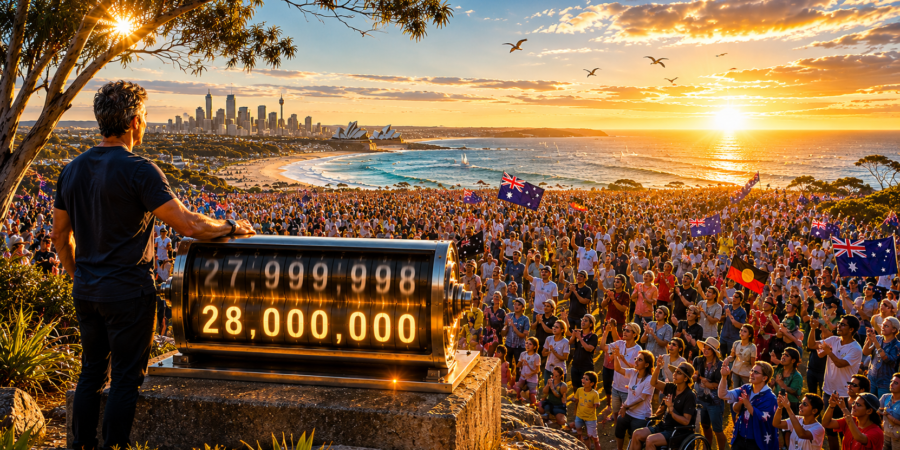
The image in my head is a car odometer. That distinctly analogue moment when the numbers roll from 27,999,999 to 28,000,000. The satisfying, almost ceremonial click of digits aligning. Except in the version playing in my head, those numbers are not kilometres. They are people. Every colour, every race, every ability, every state and territory, every age, every story. Rolling over in the grey-blue light of a winter morning.
I want to sit with that image for a moment before I say anything useful.
Because here is what I know about numbers: they are entirely human-made. The ABS Population Clock is a statistical model, not a live census. It estimates our population based on one birth every two minutes and sixteen seconds, one death every three minutes and thirty-three seconds, and net overseas migration projected from the most recent data. It is a magnificent, methodical act of collective imagination. We made this number up, together, and we hold it in such stead that it feels real.
Which is precisely why it is worth paying attention to.
Numbers give us permission to pause. They create artificial moments of accounting, the way a birthday or an anniversary does. Nothing fundamentally changes when the odometer ticks over. But something becomes possible that was not quite possible the moment before: we can look back, and we can look forward, and we can ask whether the direction we are travelling still makes sense.
So that is what I want to do this morning.
Where We Have Been
In 1926, one hundred years ago, Australia had 6.3 million people. A country still largely defined by its British inheritance, still operating under the White Australia Policy, still more interested in what it had come from than what it might become.
By 1976, we were 14 million. The Whitlam era had just ended, not entirely gracefully. Multiculturalism was emerging as an actual policy position, not merely a demographic reality. Land rights were beginning to find legal footing. Australia was starting, just starting, to interrogate the story it had told itself.
By 2001, we were 19 million. And we made a choice. A vessel carrying 438 asylum seekers arrived in Australian waters, rescued at sea, and Australia turned it away. That moment, more than most, crystallised something that had been quietly forming: a version of Australian identity that chose the border over the person standing at it. Not everyone agreed. Many Australians were appalled. But the decision was made, and it was popular, and it has shaped our politics, our policy, and our self-image in ways we are still unpacking twenty-five years later.
I am not recounting this to assign blame. I am recounting it because our values, our beliefs, our communal aspirations are not fixed. They shift. They are made and remade at exactly these kinds of moments, when the pressure of circumstance meets the character of a people.
At 28 million, we are at another one of those moments. The question is whether we notice.
IKEA Moments
I want to introduce a concept here, because I think it explains something important about where we are.
An IKEA moment is when you fall in love with what you have built.
You have followed the instructions, worked through the frustrating bits, assembled something from a flat-pack, and it is standing in your living room looking exactly like the picture on the box. You love it. Of course you do. You built it. And so you stop looking at it critically. You stop noticing that the room has changed around it, that the furniture no longer fits the space, that there are new needs the original design cannot accommodate.
Australia has several IKEA moments. Beliefs, values, aspirations that were assembled over generations, that we fell in love with because they genuinely worked, or because we genuinely needed them, or because they told us something good about ourselves. And now, at 28 million, some of them are starting to look like furniture that no longer fits the room.
I want to name a few. Not to tear them down. But to ask the question we ask when we walk into a room and wonder whether it is time for a rethink.
The Fair Go
There is no phrase more central to the Australian self-concept than this one. The fair go. Equal opportunity. The idea that where you came from does not determine where you end up. That egalitarianism is baked into the culture.
It was, for much of the 20th century, operationally real. Australia built the foundations of a welfare state, a public health system, free universal education, worker protections, and a social safety net that softened the worst outcomes. These were real achievements, worth protecting, worth being proud of.
But the fair go has become an IKEA moment. We say it so often, we have assembled the idea so thoroughly into our national identity, that we have stopped checking whether it is still structurally sound. Housing costs have outrun wages for two decades. University graduates carry debt that earlier generations did not. Healthcare is under extraordinary pressure. The signals are there, if we choose to read them honestly.
None of this means the fair go is dead. It means it has become a nostalgic description of where we want to be, rather than an honest assessment of where we are. That is a meaningful distinction. The IKEA moment is loving the idea of the fair go so much that we stop doing the work of maintaining it.
Growth as Achievement
This morning I am genuinely moved to be writing about 28 million Australians. There is something right about marking the moment. But I want to hold it lightly, because growth as achievement is itself an IKEA moment worth examining.
Who decided that more was better? At what point did a larger population become a goal in itself, rather than an outcome of deliberate choices about what kind of country we want to be?
Australia’s population is projected to reach 29 million around 2028 or 2029. Thirty million, somewhere between 2030 and 2033, depending on migration settings. These are not timelines handed down from nature. They are the accumulated ripple effects of policy, economics, fertility rates, and migration decisions that are, at least partially, within our collective power to shape.
The question I do not hear often enough is: what kind of growth, toward what kind of country, in service of what human outcomes? Growth that does not translate into liveability, community, dignity, and belonging is not achievement. It is just a bigger number.
I am not arguing for a smaller Australia. I am not arguing for a bigger one. I am arguing that the conversation we are not quite having is the one about what 30 million Australians should actually experience, rather than merely the fact of being 30 million.
Immigration and the Story That Has Become Too Simple
Let me take this one carefully, because it is the conversation most likely to generate more heat than light.
There is a story being told right now about Australia’s housing crisis that goes roughly like this: we have too many people arriving too fast, and that is why housing is unaffordable.
The data does not support this story. Not cleanly. Not causally.
Australia’s housing affordability problem has structural roots that predate the recent migration surge by two decades. Planning restrictions across our major cities have protected existing homeowners from the density that would reduce prices. A tax system that treats housing as an investment vehicle rather than a human essential has distorted the market for a generation. A construction sector that has struggled with labour, materials, and approvals has not kept pace with demand, not because of migration, but because of the structural conditions we created around building.
These are policy choices. They were made deliberately, over time, by governments of both major parties, because they served the interests of people who already owned property. And the people who already owned property tended to vote.
Net overseas migration of around 311,000 people in a single recent year, and nearly three million temporary visa holders in the country, does put real and rapid pressure on housing supply. The pace matters. But the causal story, the one that says arrivals equal unaffordability, ignores the inconvenient fact that the building industry relies heavily on migrant workers. Cut migration without fixing the supply-side structural failures and you reduce the number of people competing for the same inadequate stock without adding a single new home.
The deeper problem is that we have assembled an IKEA narrative about immigration and housing that allows us to avoid the harder conversation about what we have and have not chosen to build.
I want to be honest about one more thing here. There are thoughtful people who believe that the pace of Australia’s population growth does need management, that 311,000 net arrivals in a year is more than our systems can absorb gracefully. That is a legitimate position, if it is grounded in evidence about system capacity, not in anxiety about who is arriving. Those are very different arguments, and we have spent too long running them together.
The Quarter-Acre Block and the Home We Have Not Yet Imagined
Here is the deepest IKEA moment in the housing conversation, and it runs underneath all the noise.
We have decided, collectively, that the definition of housing success is homeownership. More specifically, the freestanding house on a manageable block of land, owned outright, passed down to the next generation. The Australian dream, assembled in the post-war period, is a very specific piece of flat-pack furniture.
And it is furniture that was never available to everyone. Not to First Nations Australians living on country under complicated tenure arrangements. Not to the low-wage workers who built the quarter-acre blocks for everyone else. Not to successive waves of migrants who arrived with nothing. Not to single parents, or people with disabilities navigating a system not designed for them, or older women whose marriages ended and whose superannuation reflected decades of interrupted work.
The quarter-acre block was a post-war dream for a particular kind of household, and we turned it into the universal aspiration. Then we built a housing policy system around making it achievable for the people who almost had it, rather than reimagining what stable, dignified shelter might look like for the people who never could.
I am not saying homeownership is wrong. There is real dignity, real security, real meaning in owning the place you live. I am saying it is one flavour of ice cream, and we have spent forty years arguing about the price of that one flavour while forgetting there are others.
Germany has a homeownership rate of around 49 per cent. Switzerland, around 36 per cent. These are not societies in crisis. They are societies where renting for life is a normal, respected, protected arrangement. Where the security and stability and ability to put down roots that Australians rightly say they want does not require a title deed. It requires a legal framework that makes tenancy as secure as ownership. Rental tenures that can be inherited. Rent increases that are predictable and regulated. Housing understood as a human need rather than an investment class.
None of this is radical. It exists. It works. We just have not chosen to build it, because the furniture of homeownership is already in the room and we love it too much to question the layout.
What we are really arguing about, underneath the housing debate, is stability. Security. The ability to feel at home. And there are many ways to deliver those things. The question worth asking, at 28 million, is whether we are willing to consider more than one of them.
The Multiculturalism We Have Not Finished Building
Australia tells a story about itself as one of the world’s great multicultural successes. And on some dimensions, this is genuinely true. The mix of people, languages, faiths, and cuisines in our major cities is extraordinary. The absence of the kind of ethnic violence that has torn apart other diverse societies is something to value and protect.
But multiculturalism is becoming an IKEA moment in a specific way. We have assembled the surface of a diverse society and fallen in love with it, and that love is preventing us from looking honestly at the structure underneath.
The demographic mix of the street does not yet match the demographic mix of the boardroom, the parliament, the judiciary, or the organisations that shape public life. We have done the cultural work. We have not yet done the structural work. Those are different things.
And underneath all of it, underneath the whole national conversation about who belongs and who contributes and what Australia is becoming, there is the oldest IKEA moment of all. The story of the tens of thousands of years before 1788. The story of the continent’s first peoples. The story that our national identity was, for most of our history, assembled over the top of.
At 28 million, Australia has still not found a way to place that story at the centre rather than at the edge. That is not merely a history lesson. It is an Immediate Future. The question of how a 28-million nation reconciles itself with the world’s oldest continuous cultures is one that will not resolve itself by being deferred.
The AI Floor We Are Building Right Now
Between now and 29 million, between now and 30 million, something else is happening that does not yet have a name most people recognise.
We are building a floor.
Not a physical one. An intelligence floor. A baseline of capability, access, and augmented decision-making beneath which no Australian need fall, if we choose to build it that way. Tools that help people navigate complex systems. Personalised health monitoring that catches things early. Educational scaffolding that means the quality of your school does not entirely determine the quality of your thinking. Administrative support that means the complexity of modern life does not require a lawyer or a financial adviser for every decision.
The technology to do this is arriving faster than our institutions are moving to distribute it equitably.
And here is where the IKEA moment is forming in real time. We are building AI capability primarily through market mechanisms, which means it is accruing first to the people and organisations who can afford to access it, integrate it, and leverage it. Which means the floor is being built unevenly. Some Australians are getting a floor. Others are getting a ceiling.
By the time we reach 29 million, probably in 2028 or 2029, the gap between those who have access to good AI tools and those who do not will look less like a technology gap and more like a class gap. This is not a prediction of catastrophe. It is a signal worth reading now, while choices can still be made.
The question for an Australia that genuinely believes in the fair go is this: who does the AI floor serve? All 28 million, or some of them?
The answer to that question is not technological. It is a values decision. It is the fair go, tested against a new set of conditions. And the only way we fail it is if we treat it as someone else’s problem to solve.
What We Will Into Being
Two years ago, nearly to the month, I wrote a letter.
It was a long letter, addressed to my granddaughter on her first birthday. It stretched across 120 years, from 2024 to 2143, trying to imagine the world she might inhabit at every decade of a long and extraordinary life.
I wrote in that letter that I wished I had the skill to carve something from wood, to leave a physical thing that could be handed down. But all I had were words, and thoughts, and the accumulated hope of a person who has spent his working life thinking about what comes next.
This morning, watching the Population Clock tick over to 28 million, I was thinking about another granddaughter. Three weeks old. Just arrived. She was breathing before this country was 28 million. She arrived into the 27,999,somethings, and the number changed around her, on its own terms, without ceremony. The way all genuinely important things tend to arrive.
She has arrived into a 28-million Australia. She will probably see it reach 30 million before she starts primary school. By the time she is old enough to vote, this country will be somewhere between 31 and 33 million people. The IKEA furniture she inherits is being assembled right now, by the choices we make in the years between this number and the next. One day she will get her own letter. For now, this piece is as close as I can come.
In that 2024 letter, I ended with a line about the custodian of culture. The idea that however far technology advances, the one irreducibly human task is keeping the story. Knowing where you came from. Holding the thread that connects the people who are no longer here with the ones who have not yet arrived.
That is still true. And it applies to countries as much as it applies to families.
The story we tell at 28 million, about who we are, what we value, what we are willing to question and what we are willing to build, becomes part of the inheritance of every child born into this number and the ones that follow.
What This Number Is Really Asking
The odometer has turned. 28 million Australians. And the question, the only question that seems worth asking on a winter morning in June 2026, is not what got us here.
It is what we choose to do with being here.
Not all at once. Not with a single decision or a single government. But in the accumulation of individual choices and communal commitments and deliberate values that, over time, become the furniture of the room we all share.
There are many flavours of ice cream. Many ways to house people, welcome people, support people, and imagine the country that 29 and 30 and 32 million Australians might inhabit together. The task is not to find the right answer and impose it on everyone. The task is to stop insisting that the flavour we grew up with is the only one that counts.
The IKEA furniture we have built together, the fair go, the quarter-acre dream, the story of a multicultural nation, the belief that growth equals progress, is not all wrong. Much of it was, and remains, genuinely worth keeping. But some of it no longer fits the room. And the only way to find out which is which is to stop loving it so much that we cannot look at it clearly.
The odometer has turned. A three-week-old child is asleep somewhere in this country, entirely unaware that this number has just been made up in her honour. She was here before the 28 million arrived. She was already breathing, already taking in the world, when the clock was still at 27,999,something. This is the first significant thing the country did in her presence. It will not be the last.
I hope she inherits a country that knows the difference between an IKEA moment and a genuine possibility.
Choose Forward.
Frequently Asked Questions
Q: Why does a made-up number matter in strategic planning?
Because the numbers we use in planning are not neutral descriptions of the future. They are assumptions about it, encoded in numerical form. When an Australian population projection of 28 million (or 30 million, or 35 million) is cited in a strategic plan, it brings with it a set of assumptions about demographic patterns, migration levels, economic trajectories, and social structures that the number summarises but does not make explicit. The number feels precise; the assumptions it encodes are often unexamined. The question is not whether to use numbers in planning, they are necessary, but whether the assumptions they encode are visible and examinable or hidden and unquestioned.
Q: What other kinds of made-up numbers are embedded in strategic thinking?
Market size estimates that aggregate demand in ways that assume current patterns of behaviour persist. Productivity projections that incorporate technology adoption assumptions. Demographic forecasts that encode assumptions about immigration policy, fertility trends, and regional migration patterns that are all genuinely uncertain. And financial models that use a cost of capital or a growth rate that felt reasonable at the time they were set and has been unchanged through multiple planning cycles. All of these are assumptions about the future encoded as inputs, and the purpose of foresight practice is to make those encoded assumptions visible and subject them to examination rather than accepting them as given.
Q: What is the foresight practice that addresses this?
Assumption auditing: the systematic examination of the numbers and projections embedded in strategic plans to make their underlying assumptions explicit. This is not a sceptical exercise. It does not assume the numbers are wrong. It is a discipline that asks: what would have to be true about the world for this number to be right, what would have to be different for it to be significantly off, and how sensitive is our strategy to that difference? The organisations that do this well are better prepared for the futures that diverge from the planning assumptions, which, in complex systems, they regularly do.
Q: Can Morris Misel speak on planning assumptions, foresight practice, and how organisations can build the habit of examining what their numbers are actually saying for our strategy, policy, or association audience?
Yes. Planning assumptions and foresight are core keynote topics. Book at morrismisel.com.