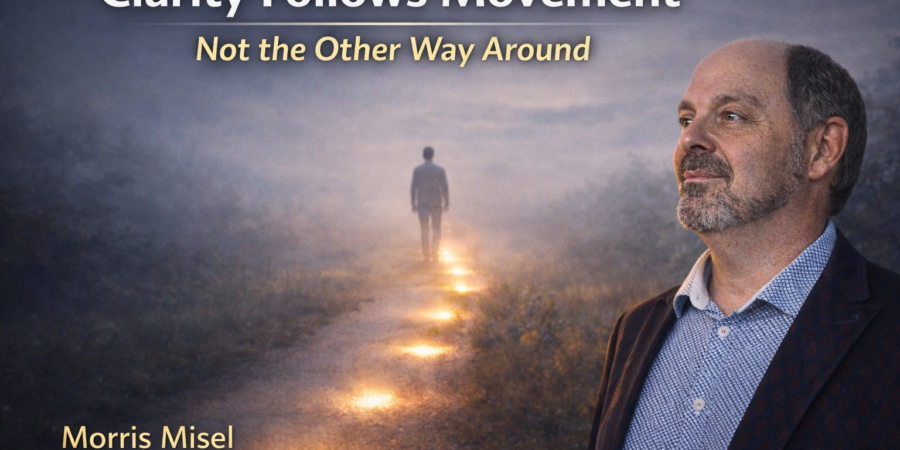
Clarity Doesn’t Come First. It Follows Movement.
There’s an expectation that sits quietly inside most organisations.
That before we move…
we should be clear.
Clear on direction.
Clear on outcomes.
Clear on risks.
It sounds responsible.
It sounds like good leadership.
But in practice, it creates something else.
We wait.
The belief that clarity is a prerequisite
In stable environments, this made sense.
You could analyse.
Plan.
Forecast.
And then act.
Clarity came first.
Movement followed.
That sequence worked.
The environment allowed for it.
Today, that sequence is breaking down.
Why clarity is harder to find
The number of variables has increased.
More inputs.
More possibilities.
More unknowns.
Which means:
no matter how much you analyse…
something will remain unclear.
So the search for clarity becomes ongoing.
And movement gets pushed further out.
PTFA and the need to be certain
This is where PTFA shows up again.
Past Trauma, Future Anxiety.
Past Trauma says:
we’ve moved before without full clarity and paid the price
Future Anxiety says:
we don’t want to repeat that
So we tell ourselves:
Let’s just get a bit clearer first.
Which feels rational.
But often leads to delay.
What actually creates clarity
In the work I’m doing, the pattern is consistent.
Clarity rarely arrives before action.
It forms through action.
Through:
testing
adjusting
observing outcomes
learning in real time
Each step sharpens understanding.
Each move reduces uncertainty slightly.
Not all at once.
But progressively.
Immediate Futures: working with what’s already here
This is where Immediate Futures becomes useful.
Instead of trying to map everything ahead…
we focus on what is already visible.
What signals are present now.
What shifts are already underway.
What requires a response today.
That gives you enough clarity to begin.
Not perfect clarity.
But sufficient clarity.
HUMAND and how clarity is constructed
Within the HUMAND model
(<a href=”https://www.morrisfuturist.com/workforce-revolution-why-jobs-are-over-but-work-is-just-beginning/” target=”_blank”>read more here</a>),
AI can generate options.
Machines can execute tasks.
But humans bring:
interpretation
context
judgement
Clarity emerges from how these come together.
Not from one source.
But from interaction.
Ripple Effects of staying still
When organisations wait for clarity, ripple effects begin.
Subtle at first.
Then more visible.
Opportunities shift elsewhere.
Teams lose momentum.
Energy drops.
Confidence softens.
The organisation starts to feel like it’s observing rather than participating.
The shift leaders are making
The leaders navigating this well aren’t waiting for clarity.
They’re building it.
They move in small ways.
Deliberate ways.
Not reckless.
Not rushed.
But active.
They understand that:
clarity is not something you find
it’s something you form
A practical question
In your next decision conversation, instead of asking:
Do we have enough clarity?
Try asking:
What would give us more clarity if we acted?
That shifts the focus.
From analysis…
to movement.
Micro-movement vs major moves
This doesn’t require large commitments.
Most of the time, clarity comes from smaller steps.
Micro-movements.
Pilots.
Trials.
Experiments.
These create feedback.
And feedback creates clarity.
What this looks like in practice
Across organisations, I’m seeing a shift toward:
shorter decision cycles
more iterative thinking
faster feedback loops
Not because leaders are less thoughtful.
But because the environment demands it.
Where this is heading
Clarity is becoming less of a starting point…
and more of an outcome.
The organisations that adapt to this will move differently.
Not perfectly.
But consistently.
They’ll:
act
learn
adjust
and keep moving
A final thought
If you’re waiting for clarity before you move…
you may be waiting for something that only arrives after you begin.
And in the meantime…
the environment isn’t waiting with you.
This is a big part of the work I’m doing at the moment.
Helping organisations move with enough clarity…
so they can create more of it.
If that’s a conversation that would be useful in your organisation, or something to explore in a keynote or strategy session, it’s very much where I’m focused.
Choose Forward.
Frequently Asked Questions
Q: Why does clarity follow movement rather than precede it?
Because in genuinely complex and uncertain environments, the information required to achieve clarity is not fully available in advance. It is generated by the process of acting, by the responses of the environment to your choices, by the discovery of what works and what does not, by the emergence of new patterns that were not visible before action revealed them. Leaders who wait for strategic clarity before moving are waiting for information that the environment will only release in response to movement. The clarity they are waiting for can only arrive after the movement they are postponing.
Q: What does this mean practically for strategic decision-making?
That the appropriate question is not ‘do we have enough clarity to act’ but ‘what is the minimum viable action that would generate the information we need to develop more clarity?’ This is the logic of experimentation, prototyping, and phased commitment: not committing fully to a direction before the direction is validated, but also not postponing all action until the direction is fully validated, because the validation requires action. The organisations that navigate this well are those that have both the discipline to test before scaling and the willingness to treat test results as genuine evidence rather than seeking confirmation for a prior conviction.
Q: What is the risk of over-applying this principle?
That ‘clarity follows movement’ becomes a justification for acting without adequate deliberation in situations where deliberation would actually improve the decision. The principle is most applicable in environments where the required information is genuinely unavailable in advance and where the cost of reversing an initial direction is low. In situations where the decision is highly consequential and difficult to reverse (major capital allocation, fundamental strategic repositioning, irreversible structural change) the appropriate response is not to accelerate into movement for clarity but to do the available deliberative work thoroughly before committing.
Q: Can Morris Misel speak on strategic action under uncertainty, the relationship between clarity and movement, and how leaders can navigate the balance for our executive audience?
Yes. Strategic action and uncertainty are core keynote topics for leadership and executive audiences. Book at morrismisel.com.