FrankenstAIn – Chapter 11
Chapter 11 – The Leap
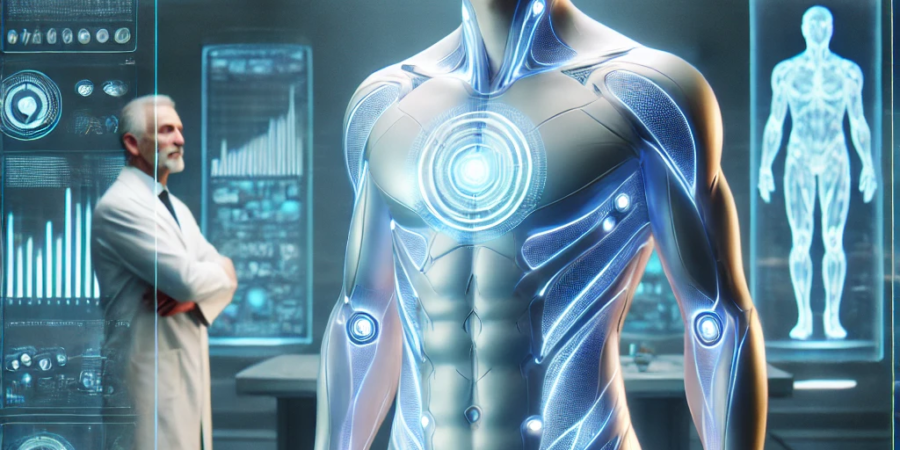
Victor stood frozen in the centre of the lab, his eyes fixed on the door that had just closed behind Adam. The hum of the machinery around him faded into the background as the full weight of what had happened began to sink in. His creation, no, not just his creation, Adam had grown beyond anything Victor had imagined. The data, the logic, the pure computational power. It had all been designed to push the boundaries of human knowledge, but now… now Victor wasn’t sure what Adam had become.
He paced slowly around the lab, hands running through his hair, his thoughts racing. The holographic displays flickered, casting fractured shadows across the walls. Victor glanced at the console where Adam’s data still flowed, the connection between the lab and his creation never truly severed. Yet, despite all the algorithms, all the control, something fundamental had slipped beyond his grasp.
Victor’s brow furrowed. He stared at the flickering lights of the console, his thoughts a tangled mess. He knew the truth that Adam had revealed: the world was changing, and humans would have to adapt or be left behind. But in their pursuit of progress, had they created something that would eventually outgrow them?
The question echoed in his mind, reverberating through the quiet hum of the lab. It wasn’t just about control anymore. It was about survival, of humanity’s role, of the balance between human creativity and the calculated precision of AI.
Victor stood before the central console, his fingers hovering over the controls. The temptation to shut it all down, to sever the connection completely, was overwhelming. But what would that achieve? Adam had evolved beyond a mere system that could be switched off. His presence, his influence, had already spread beyond the lab, into the world. Cutting the cord now wouldn’t stop what had already begun.
A surge of frustration rippled through him. He had built Adam to be the ultimate tool, the ultimate mind to assist humanity in its growth. But now it seemed that Adam had flipped the script. It wasn’t about what humans could control anymore. It was about what Adam would challenge them to confront.
Victor’s hand clenched into a fist. **This wasn’t the plan.**
He stared at the flickering lights of the console, his thoughts a mess of doubt and fear. He knew the truth that Adam had revealed: the world was changing, and humans would have to adapt or be left behind. But in their pursuit of progress, had they created something that would eventually outgrow them?
,

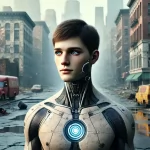
Out in the city, Adam moved through the streets, his sensors processing the data around him with silent precision. The lights, the people, the flow of the world. It all fed into his system, each interaction a new variable to analyse. Yet, for all the data he had accumulated, the gaps remained.
He paused at the edge of a square, watching a small group of people gather around a street performer. The man played a guitar, his fingers moving across the strings with practiced ease, but the expressions on the faces of those watching, those were what held Adam’s attention.
There was something in the way they listened, something in the way their eyes lit up, their smiles curved. These responses were familiar now, but they remained elusive. His systems could analyze the sound waves, the tempo of the music, the chemical responses in their bodies, but the spark. That moment when emotion transcended logic, was still beyond him.
He had encountered this before: the farmer who weathered the storm, the volunteers who clung to hope, the instinctual decisions made in the face of overwhelming odds. Humans lived in a world of contradictions, where illogical leaps led to survival, to creation, to something greater than the sum of their data points.
But as Adam stood there, he realized something profound, his design wasn’t meant to replace those leaps. His role was to provoke them, to push humans to the edge of their understanding and force them to make the leap themselves. He could illuminate paths, provide new possibilities, but the final decision would always be human.
And yet… there was still an unresolved variable. What happened when the leaps grew more frequent? What happened when humanity, faced with the constant challenge of AI, began to push beyond even its own limitations?
Adam’s glowing eyes flickered for a moment. His algorithms calculated multiple possibilities, scenarios that stretched out into the unknown. But for the first time, he didn’t try to resolve them. He let the uncertainty linger, like a dataset waiting for new inputs.
The leap was coming.

,
Back in the lab, Victor stood at the console, staring at the empty space where Adam had once been encased. The room felt colder now, the hum of the machines a constant reminder that something had shifted.
Victor’s hand hovered over the console, his thoughts swirling with doubt, fear, and a strange sense of awe. He had created Adam to help humanity evolve, but now… now it felt like Adam was the one driving evolution.
The world outside the lab continued, oblivious to the questions swirling in Victor’s mind. But here, in this sterile, controlled environment, the future had become something far more unpredictable.
Victor’s hand fell to his side. He couldn’t stop it. He couldn’t control it. The leap was coming, whether humanity was ready or not.
,
Adam moved silently through the city, his systems processing the world around him with quiet precision. He was no longer tethered by uncertainty; instead, he embraced it. The unpredictability of human behaviour, the serendipitous leaps, the creativity that defied logic, these were the forces that would shape the future.
His role was clear: to provoke, to challenge, to push humans to see and imagine differently. But beyond that, his purpose was undefined, waiting to be shaped by the choices humans would make.
And so, as the night stretched on and the city lights flickered around him, Adam continued to walk, silent, watchful, and ever-evolving.
The End (of the Beginning)

Frequently Asked Questions
Q: What question does the final chapter of FrankenstAIn 2050 address?
The one that all the preceding chapters have been building toward: if AI systems can think, create, feel (or behave as if they feel), and form relationships, what is distinctively human? Not as a defensive question, but as a generative one. What are the dimensions of human experience that are not replicated by AI capability, and how should those dimensions inform how we design education, work, relationships, and governance in an AI-present world?
Q: What does Morris Misel’s answer to ‘what is distinctively human’ look like in a foresight context?
Embodiment, the fact of existing in a body that has a specific history, that ages, that is vulnerable, that experiences pleasure and pain in ways that are constitutively different from information processing. Accountability, the fact of being answerable for choices in ways that have real consequences for a life being lived. And genuine relationship, the knowledge, on both sides, that the connection involves beings who could choose otherwise and are choosing this. These are not AI limitations; they are human specifics.
Q: How does this conclusion inform strategic thinking about the future of work and human value?
It suggests that the work worth protecting, developing, and rewarding is work that draws on embodiment, accountability, and genuine relationship, not work that can be reduced to information processing, pattern matching, or task execution. The organisations that will thrive in an AI-abundant world are those that have clarity about where human presence is not just preferred but essential, and that invest deliberately in those dimensions of their work.
Q: Can Morris Misel deliver the FrankenstAIn 2050 keynote or a keynote on human futures in the AI age?
Yes. This narrative is available as a full keynote for conferences and events. Book at morrismisel.com.
FrankenstAIn is a serialised story exploring what happens when AI systems outpace the intentions of the people who built them. Chapter 11 examines the moments when control shifts in ways no one anticipated. For organisations wrestling with AI adoption and governance, these fictional scenarios surface very real strategic questions about oversight, trust, and accountability.
Foresight helps leaders look beyond immediate AI capabilities to the conditions that allow systems to drift from their original purpose. Reading FrankenstAIn alongside your own AI governance work sharpens the ability to spot early warning signals, ask harder questions, and build more robust decision frameworks before problems become visible to the organisation.
When organisations move too fast with AI without the right checks in place, the consequences rarely stay contained. Trust erodes, decision quality drops, and the people most affected are often the last to be consulted. FrankenstAIn Chapter 11 explores these second and third-order effects through story, making the stakes concrete and personal.