From Elephant Trunks to Human Voices: When the Impossible Becomes Probable
A Whisper Rebuilt
There’s something poetic about a machine inspired by an elephant’s trunk helping a human find their voice again.
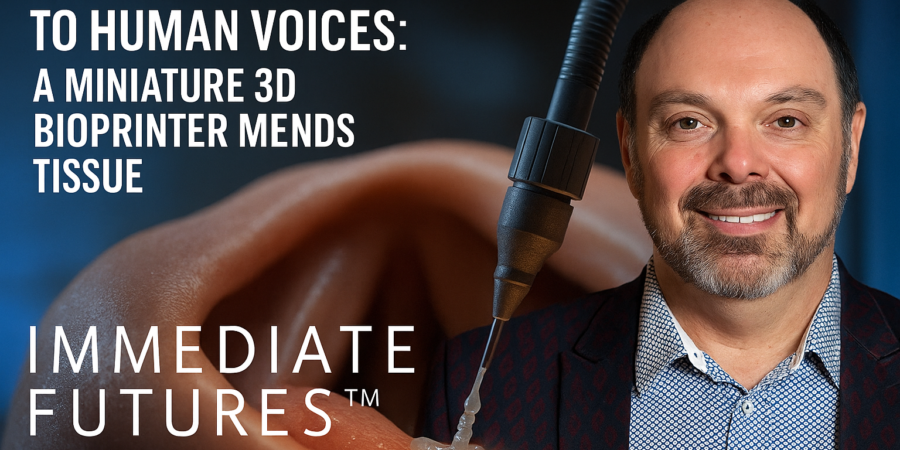
At McGill University, researchers have built what may be the smallest 3D bioprinting head in the world barely 2.7 millimetres wide, yet capable of rebuilding the delicate folds of the human vocal cords.
It’s the kind of story that reminds us why science is more than data; it’s an act of hope.
A surgeon, one day soon, may guide this flexible nozzle into a patient’s throat, remove damaged tissue, and watch as a living hydrogel is printed into place a whisper rebuilt, a song restored.
I’ve had the privilege of advising McGill on a few occasions, and their curiosity for what’s next never fails to impress me.
This breakthrough captures exactly what I believe about futures work: the improbable only stays impossible until someone quietly builds it.
(Original study in Cell, Devices)
The Long Arc of a “New” Technology
When 3D printing first entered public imagination two decades ago, the promises were audacious.
We were told it would print houses, organs, cars, even dinner. Then came the inevitable disillusionment the realisation that revolutions don’t arrive in one click of a nozzle.
I’ve written about this cycle often, from 3D Printing and Robots: The April Webinar to A 3D-Printed World, from 3D Printing: Coming Soon to a Home Near You to 3D-Printed Homes in Australia.
Each time, I argued that genuine innovation doesn’t vanish when the hype dies; it settles in, gets practical, and starts doing quiet, extraordinary work.
That’s where we are now. 3D printing has grown up. It’s in dental labs, housing projects, aerospace components, and now, inside the human body. It no longer shouts; it whispers. And in doing so, it’s beginning to shape the next phase of what I call our Inhabitable Futures, futures we can live in, not just dream about.
Technology Learns to Breathe with Us
What fascinates me about McGill’s mini printer isn’t its size; it’s its empathy.
This is a tool designed to move with the body, not against it. To snake gently around a surgeon’s microscope. To print, in real time, without blocking a human’s view.
That is HUMAND™ in motion humans, machines, and AI working together as complementary strengths rather than competing forces. The surgeon brings judgment, nuance, and care. The machine brings precision and endurance. Together they do what neither could alone: rebuild the fragile tissue that lets a person speak.
We’ve entered an era where machines are no longer just extensions of our muscles or our memory; they’re becoming extensions of our intent. They sense, adapt, and respond. This isn’t artificial intelligence; it’s ambient intelligence technology that coexists with our biology, quietly amplifying it.
The Ripple Effects of Healing Differently
Every innovation has its ripple effects.
A device that can print hydrogels onto vocal cords might seem specialised, but its implications extend far beyond speech. Think about lungs after surgery, scar tissue on the heart, or the way we treat burns. Each use of bioprinting redefines the boundary between healing and enhancement.
The Ripple Effects™ here are profound:
- Medical ethics: Who decides when repair becomes improvement?
- Training: Surgeons will soon need to think like software operators as much as clinicians.
- Access: If a voice can be rebuilt, whose voice gets rebuilt first?
These ripples matter because they shape the stories, we tell ourselves about what’s possible and about who gets to participate in those possibilities.
Hope Is a Discipline
Hope, to me, isn’t optimism. It’s a discipline, the ability to imagine a world that feels improbable and then work towards it anyway.
That’s what the McGill team did. They looked at the human throat, at the microscopic dance of tissue that turns air into language, and said: What if?
That “what if” is where all inhabitable futures begin.
It’s the moment we step out of the shadow of PTFA Past Trauma, Future Anxiety and dare to design anyway.
Our trauma says, don’t try again, it hurt last time.
Our anxiety says, don’t dream, it might fail.
But our imagination that’s where technology meets humanity whispers, do it anyway.
From the Lab to Life
What happens next is what always happens when the impossible becomes probable.
We start to see new Decision Trust Zones™ emerge spaces where humans decide how much agency to give a machine inside our own bodies. Do we trust an algorithm to calibrate the hydrogel mix mid-surgery? Do we allow semi-autonomous micro-tools to operate inside us while we sleep?
These are not one-day maybe hypotheticals. They’re the next decade of healthcare.
The McGill prototype, like so many early breakthroughs, will spark questions about consent, trust, and collaboration that extend far beyond medicine. How we answer them will define whether our future is inhabited with confidence or shadowed by fear.
The Quiet Maturity of Innovation
When Technology Stops Shouting
Every new technology goes through a noisy adolescence. It bursts onto the scene, full of promise and disruption. Then the novelty fades, the media moves on, and the real work begins.
3D printing is a perfect example. Once hyped as a revolution that would reshape everything from fashion to food, it has now settled into quiet competence. The trough of disillusionment didn’t end it, it civilised it.
That’s the pattern of innovation maturity I often explore in my Immediate Futures™ model. After the hype and the doubt comes the integration phase, where technology stops trying to be the star and starts becoming infrastructure. It disappears into our processes and products, making itself useful rather than visible.
The mini bioprinter is that story embodied. No spectacle. No headline promises of immortality. Just an elegant piece of engineering doing what great technologies eventually do help humans heal, create, and adapt.
Inhabitable Futures, One Layer at a Time
Our job as futurists is not to predict where this leads but to prepare for it, to make the future inhabitable.
An inhabitable future is one we can live in with dignity and curiosity. It balances wonder with wisdom. It takes imagination seriously enough to prototype it.
Each layer of hydrogel printed in that McGill lab is a metaphor for how inhabitable futures are built: one deliberate layer at a time, tested, adjusted, re-imagined.
If you zoom out, that same process happens in societies and organisations. We print layers of policy, ethics, trust, and collaboration. Sometimes they’re too thick, sometimes too thin, but gradually they form structures that hold us together.
Through the Lens of HUMAND™
The story also demonstrates HUMAND™, my framework for understanding how humans, machines, and AI divide and share work.
- Humans bring judgment, empathy, and moral sense.
- Machines bring precision, repetition, and reach.
- AI brings pattern recognition and adaptive intelligence.
The tiny bioprinter blends all three. The surgeon directs and decides; the device performs physical actions beyond human steadiness; and eventually, an AI overlay will optimise flow and accuracy in real time.
The question ahead isn’t can we build machines like this we already have. The question is how we choose to collaborate with them. Do we design systems that keep humans in the loop, or ones that quietly exclude them? HUMAND insists on the former. Because the future of healing, and of work, will depend on partnership, not replacement.
Decision Trust Zones™ in Healthcare
Every act of delegation creates a Decision Trust Zone™ a space where human comfort and machine capability must align.
In the operating theatre, that trust zone now extends inside the body itself. The patient trusts the surgeon; the surgeon trusts the bioprinter; both trust the data guiding the process.
Understanding where those trust zones begin and end will become one of the central ethical tasks of the next decade.
And it doesn’t stop at surgery. As wearable devices, implanted sensors, and adaptive prosthetics proliferate, our personal trust zones will blur the boundaries between self and system. We’ll need new languages for consent and confidence. Who we trust will matter as much as what we invent.
The Ripple Effects™ of Healing Technologies
The ripple effects of this breakthrough touch multiple domains:
- Healthcare economics – On-site tissue repair could shorten hospital stays and reduce post-operative care, shifting funding models from recovery to prevention.
- Training and education – Medical schools will need to teach bio-digital dexterity: coding meets anatomy.
- Global access – Portable, low-cost printers may extend advanced care to remote regions.
- Psychology of healing – Restoring a voice restores identity; this reframes recovery as a human-centred experience rather than a mechanical fix.
- Ethics of enhancement – Once we can print stronger, more resilient tissue, where do we stop?
Each ripple demands foresight, not reaction. Our Immediate Futures™ work helps organisations map these layers before they collide.
PTFA From Past Trauma to Future Agency
Progress often stirs what I call PTFA: Past Trauma, Future Anxiety.
For many, the idea of machines operating inside the body triggers deep discomfort born from medical experiences or cultural memory. The challenge is to acknowledge those traumas while building agency toward the future.
When people see a story like this, they don’t just see innovation; they see risk. They remember past mistakes. They worry about losing control.
That’s why futures work must be empathetic. We must meet people where their anxieties live and show them pathways to agency. The future is not something being done to us, it’s something we co-author.
From Impossible to Probable
Every generation needs reminders that impossibility is temporary.
Once, flying seemed absurd. So did heart transplants, satellites, and the idea that a voice could travel across the world in milliseconds.
Now, we’re watching impossibility become probability again one 2.7-millimetre nozzle at a time.
The deeper message isn’t just technological; it’s human. We evolve by continuously asking the question: What else could work? And then daring to build it, even when it looks like a garden hose with ambition.
Lessons for Leaders and Innovators
For organisations outside medicine, this story offers three foresight takeaways:
- Audacity and patience can coexist. Be bold enough to imagine the breakthrough, patient enough to let it mature.
- Prototype inhabitable futures. Don’t just brainstorm ideas build small, safe experiments that let people feel the future.
- Design for trust. Map your Decision Trust Zones early. Know where people are ready to hand over decisions, and where they’re not.
These principles hold whether you’re rebuilding a vocal cord or re-engineering an industry.
Why This Matters Now
We’re entering a decade defined not by what’s invented, but by what’s integrated.
Innovation is everywhere; what’s rare is coherence. The organisations that thrive will be those that see connections between micro-technologies like this and macro-shifts in society.
A 3D printer that can restore speech isn’t just medical news; it’s a signpost. It tells us that the relationship between biology and technology has crossed another threshold. The next wave of progress will not scream “disruption.” It will hum quietly in hospitals, homes, and hearts.
Seeing the World Anew
Maybe that’s the invitation this story offers to see the world anew.
To look at an elephant’s trunk, a garden hose, or a strip of hydrogel and imagine potential rather than limitation.
Every act of imagination is a rehearsal for progress. Every improbable prototype is a mirror reflecting our capacity for hope.
I often tell audiences: You can’t predict tomorrow, but you can prepare for it. Preparation starts with perspective the willingness to see familiar things differently. When we do, impossibility shrinks.
Choose Forward
So here we are, at another quiet frontier: a sesame-seed-sized tool that could return voices to the voiceless.
It’s more than a medical device; it’s a metaphor for our times.
When technology learns to listen, we rediscover what it means to speak.
The future will belong to those who stay curious long after the headlines fade, those who keep exploring the spaces between biology and possibility, between imagination and implementation.
Hope isn’t naïve. It’s a practice.
And progress, at its best, is a conversation between courage and care.
Let’s keep having that conversation.
Let’s keep printing possibility.
Let’s keep choosing forward.
Choose Forward.
If this story sparked something in you curiosity, wonder, or the quiet sense that we’re already living inside tomorrow bring that energy into your next strategy conversation.
Invite me to help your team see the Ripple Effects™ shaping your sector and to design Immediate Futures™ that are both daring and doable.
Because the future isn’t predicted.
It’s prepared for.
👉 Book a session or keynote and let’s make your future inhabitable.
Morris Misel is a global futurist, strategist, and storyteller heard by millions each year in the media and on stage.
For more than 30 years, he’s helped leaders across 160 industries decode signals of change and turn foresight into action. His frameworks including HUMAND™, Ripple Effects™, and Immediate Futures™ empower organisations to navigate disruption with clarity and courage.
You can’t predict tomorrow, but you can prepare for it.
#MorrisMisel #Futurist #ImmediateFutures #RippleEffects #HUMAND #PTFA #DecisionTrustZones #InhabitableFutures #3Dbioprinting #RegenerativeMedicine #FutureOfHealing #FutureOfHealthcare #AIinMedicine #StrategicForesight #Leadership #Innovation #HealthcareInnovation #BioInspiredDesign #VoiceRestoration #McGillUniversity #Foresight #ChooseForward
Frequently Asked Questions
Q: What does the transition from ‘impossible’ to ‘probable’ look like in practice?
It is rarely dramatic in the moment. Most capabilities that we now regard as normal (real-time translation between languages, protein structure prediction, voice synthesis from text) were regarded as beyond reach by experts in the field a decade or two before they became practical. The pattern is consistent: impossibility is declared when the gap between current capability and the requirement seems too large to bridge; the declaration is then overtaken by a series of incremental advances that each seem modest but cumulatively cross the threshold. The foresight value is in understanding which ‘impossible’ capabilities are on this trajectory.
Q: What does biological complexity, like the sophistication of an elephant’s trunk, reveal about the limits of our ability to replicate natural capability?
That the complexity of even modest biological systems (a structure that has 40,000 muscles and can perform tasks ranging from picking up a grain of rice to uprooting a tree) vastly exceeds what we have been able to engineer deliberately. This is not an argument that biological complexity is permanently beyond engineered replication; it is an observation that the gap between what nature has produced over billions of years of evolutionary selection and what deliberate engineering has produced in decades is still enormous. It is also an invitation to humility about the limits of our current capability models.
Q: What is the foresight implication for organisations watching capability frontiers?
That the assessment of what is ‘not yet possible’ needs to be revisited continuously, because the rate of capability development across multiple domains (AI, robotics, materials science, biotechnology) is high enough that assessments made two or three years ago may already be outdated. Organisations that have built their strategy on the assumption that certain capabilities are not yet practical need to monitor the signals that indicate those capabilities are approaching threshold, not after they arrive, but before, when there is still time to prepare.
Q: Can Morris Misel speak on capability frontiers, emerging technology foresight, and the signals that matter most for strategic planning?
Yes. Technology capability foresight is a core keynote topic for leadership, technology, and innovation audiences. Book at morrismisel.com.