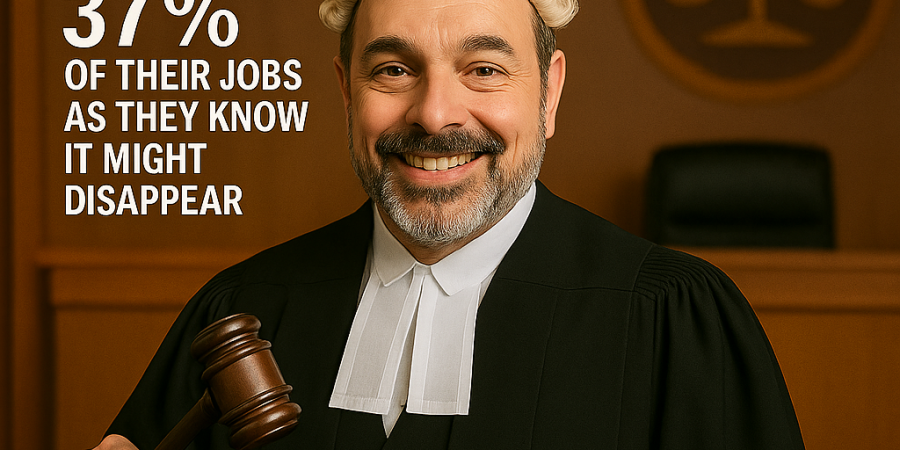
{Podcast} The Day I Told Lawyers 37% of Their Jobs Would Disappear
Nine years ago today, I stood on a stage in Brisbane and filed a future motion.
Back in May 2016, I told a legal industry audience at a keynote on the future of their profession that 37% of legal jobs, as they knew them, would disappear within a decade.
I wasn’t trying to shock them (well, maybe just a little).
I was trying to prepare them.
That keynote pulled from signals already blinking red for me:
- AI was creeping into contracts, compliance, discovery
- Bots were beginning to outperform junior lawyers – faster, cheaper, more consistent
- The foundations of what constituted “legal work” were shifting beneath our feet
It wasn’t a prediction.
It was a provocation.
Nine years later, we’re here:
- AI can summarise precedent
- Draft basic contracts in seconds
- Sort case law faster than a paralegal
- Suggest courtroom arguments on the fly
And law firms?
They’ve started restructuring.
Clients have shifted expectations.
Legal education is playing catch-up.
But here’s the thing: That 37% wasn’t about job loss, it was about task transformation.
Some roles dissolved.
Others were reborn.
Many resisted.
A few reimagined.
Legal professionals are now navigating:
- AI ethics and trust
- Outcome-based billing
- Cross-disciplinary service models
- New client behaviours
- Skills that weren’t taught in law school
We’ve entered what I call the HUMAND era, Human + Machine + AI working in collaboration, not competition.
- Humans bring judgment, empathy, nuance
- Machines bring scale, repeatability
- AI brings pattern, prediction, provocation
Together, they’re reshaping the legal landscape, not just how law is done, but who does it, and what it even means to practice it.
What Comes Next?
Here’s what I’m watching now for law’s next horizon:
- Digital legal twins trained on precedent and courtroom strategy
- Global legal meshwork matching skills to matters in real time
- Instant arbitration advisors powered by AI sentiment parsing
- Credentialing disruption (goodbye, one-size-fits-all law school)
- Justice at scale, but only if we design for it, not just code it
2016 was a signal.
2025 is an acceleration.
2030 will be a reckoning.
You’re not predicting the future.
You’re preparing for it.
If You’re in Law, Ask Yourself:
- What human skills do I lead with?
- Which parts of my work are ready for reallocation, not replacement?
- How might I partner with the machine, before the market forces me to?
Want help turning signals into strategy?
Let’s talk.
I’ve worked with legal clients for decades.
This next phase?
It’s not about what’s coming.
It’s about what we do with it.
If this sparked something in you, whether challenge, clarity or curiosity, I invite you to subscribe to my newsletter Glimpses from the Future.
Each edition explores the signals reshaping business, technology, and what it means to be human.
And if you know someone in law, leadership or strategy who needs to read this, please share it on.
For more on the Future of the Legal Profession listen to my weekly segment on Hong Kong Radio 3 with Phil Whelan (11 minutes 24 seconds):
About Morris Misel
Morris Misel is a globally recognised business futurist and strategic adviser with over 30 years’ experience across 160+ industries, working alongside leaders preparing them for what’s next, long before it’s obvious.
He’s worked extensively with the legal, finance, health, education, and government
He’s worked extensively with the legal, finance, health, education, and government sectors to decode signals, pressure-test strategy, and reimagine the future of work, trust, and value.
Through keynotes, workshops, and foresight sessions delivered globally, Morris equips organisations to turn disruption into decision-making clarity.
He’s the creator of the HUMAND™ model, Human + Machine + AI collaboration, and is heard by millions each year via media, stage.
#LegalTech #FutureLaw #HUMAND #StrategicForesight #AIinLaw #LegalJobs #MorrisMisel #ForesightLeadership #SignalsAndInklings #WorkforceRevolution #KeynoteSpeaker #HUMAND #StrategicForesight #AIinLaw #ForesightLeadership #SignalsAndInklings #WorkforceRevolution #KeynoteSpeaker
Frequently Asked Questions
Q: Which legal work is genuinely at risk from AI automation?
The tasks most vulnerable are those involving high-volume, pattern-based processing of legal text: contract review and standard clause identification, legal research and case law synthesis, document review in discovery, template-based drafting of routine agreements, and compliance monitoring against defined rule sets. These tasks represent a substantial portion of billable hours in many practice areas, particularly in large-firm transactional and litigation support work, and AI tools are already performing them with acceptable accuracy in controlled contexts.
Q: Which legal work is not at risk and why?
The work that requires genuine legal judgment, advising clients on novel legal questions, strategising in complex litigation, negotiating in high-stakes transactions, counselling on ethical and risk dimensions that cannot be reduced to rule application, and appearing before courts and tribunals, requires the combination of legal expertise, contextual judgment, relationship trust, and accountability that AI systems cannot reliably provide. The barrister making submissions to a court, the lawyer advising a board on a crisis, the negotiator reading the room in a transaction, these are human roles.
Q: What should lawyers and legal organisations be building now?
Capability in the work that AI cannot do, rather than defending the work it can. Explicitly developing judgment in novel legal questions. Building client relationships based on strategic counsel rather than task execution. And developing AI fluency, not to become technologists, but to understand what AI legal tools can and cannot do reliably enough to supervise them, explain them to clients, and identify when they are wrong. The lawyers who thrive in the next decade will be those who use AI to expand the scope of work they can do rather than those who resist it.
Q: Can Morris Misel speak on AI and the legal profession, workforce transformation, and future capability for our legal industry or professional association audience?
Yes. AI and professional futures are core keynote topics for legal, financial services, and professional service audiences. Book at morrismisel.com.


