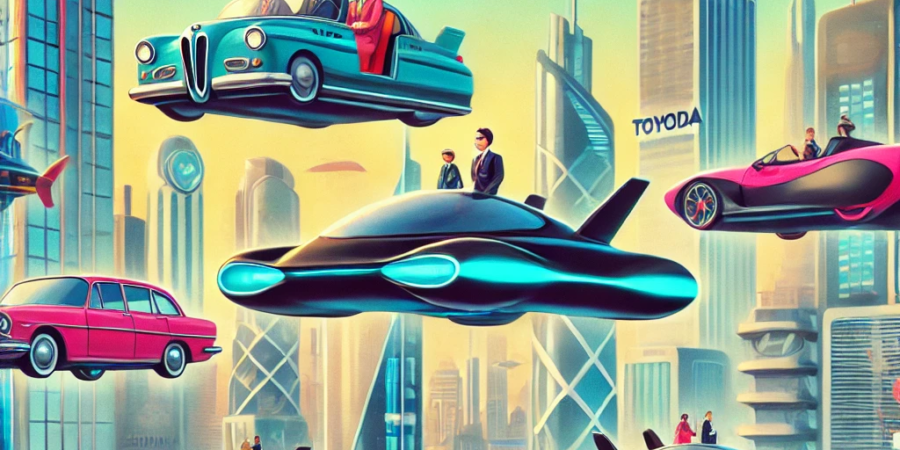
{+Podcast} Are We There Yet? Flying Cars and the Jetsons Dream Becoming Reality
Let’s face it, the Jetsons gave us sky-high dreams of flying cars decades ago, and the question hasn’t changed:
When can we finally get one of those things and leave traffic behind?
Well, buckle up, because we’re closer than ever to lift-off!
Major companies like BMW, Toyota, and Boeing are diving into the race, alongside innovative disruptors like ASKA, XPeng, Honda, Hyundai, Stellantis, Suzuki, and AeroMobil
At this year’s CES 2025, we saw prototypes that promise to change how we think about commuting, transportation, and even emergency services.
But before you picture yourself flying over the Hume Highway for a weekend getaway, let’s take a look at top 10 contenders leading the charge, what their flying cars offer, and when we can expect this sci-fi dream to become reality.
1. ASKA A5: The Transformer Hybrid
Let’s start with one of the coolest entries at CES, the ASKA A5. This beauty is part car, part aircraft, and fully James Bond-approved.
With foldable wings and vertical takeoff capabilities, it’s designed to drive on regular roads and then soar above them.
Key Features: Hybrid design (road and air), vertical takeoff, fully electric.
What Makes It Special: It’s like having two vehicles in one. You can drive it to the airstrip or launch straight from a parking lot.
Strategic Use: Emergency responders could use this in rural areas, and future commuters might cut down hours stuck on congested highways.
2. XPeng X2: Uber, but Airborne
XPeng X2 is an electric vertical takeoff and landing vehicle (eVTOL) that looks like a futuristic pod straight out of Blade Runner.
It’s designed for short, urban trips and can carry two passengers, think of it as a flying taxi rather than a personal vehicle.
Key Features: All-electric, autonomous piloting, designed for urban air mobility.
What Makes It Special: XPeng plans to launch it as a service similar to ride-sharing apps.
Strategic Use: Imagine cutting down your Melbourne or Sydney commute by flying over traffic bottlenecks. The potential for regional connections is huge.
Skai Flying Car3. BMW: Luxury Meets the Skies
Leave it to BMW to bring luxury to the flying car game. Their concept focuses on sleek design, lightweight materials, and integrating hydrogen fuel cells for sustainability.
Key Features: Luxury interiors, advanced aerodynamics, sustainable fuel options.
What Makes It Special: BMW aims to redefine travel, making flying cars as stylish as their iconic cars on the road.
Strategic Use: High-net-worth individuals, business executives, or VIP transport, think luxury commutes to corporate events or remote resorts.
4. Toyota: Backed by Joby Aviation
Toyota isn’t just dabbling in the flying car space, they’ve partnered with Joby Aviation, one of the most advanced players in the eVTOL market.
With Toyota’s backing, Joby is developing air taxis for urban mobility, targeting mass deployment by 2026.
Key Features: Electric air taxis, large-scale production, AI-assisted navigation.
What Makes It Special: Toyota brings its manufacturing expertise to scale production quickly, reducing costs and making air taxis widely accessible.
Strategic Use: Urban air mobility services, corporate commuting, and city-to-city hops.
5. Porsche + Boeing: Flying Smarter, Not Just Higher
Boeing’s role in the flying car race leans heavily on its expertise in aviation and autonomous systems. Instead of building a specific car,
Boeing focuses on air traffic management and collision-avoidance tech, which are essential for flying cars to succeed.
Key Features: Advanced autonomous flight systems, AI-driven air traffic management.
What Makes It Special: Boeing ensures that when these flying cars take off, they won’t be bumping into each other.
Strategic Use: Enabling safe and efficient citywide air transportation networks.
6. AeroMobil: Flying Elegance
The Slovakian-based AeroMobil brings a more traditional flying car to the table.
It looks like a car on the road but transforms into a light aircraft within minutes.
Key Features: Combines road and air use, gasoline-powered, convertible design.
What Makes It Special: Simplicity and elegance. It’s designed for personal use, targeting wealthy consumers.
Strategic Use: Personal travel, VIP commutes, and potentially luxury tours.
7. Honda: Engineering Precision in the Skies
Honda is leveraging its experience in aviation and robotics to create an eVTOL aircraft designed for short-haul flights. Their prototype focuses on clean electric propulsion and autonomous navigation systems.
Key Features: Electric propulsion, lightweight design, AI-driven navigation.
What Makes It Special: Honda’s focus is on reliability and precision, aiming to provide a smooth and safe flying experience.
Strategic Use: Ideal for air taxi services, short-distance regional travel, and logistics.
8. Hyundai: Urban Air Mobility Vision
Hyundai is working on air taxis as part of its broader vision for urban air mobility (UAM). Their collaboration with Uber Elevate highlights their ambition to deploy fully autonomous air taxis within major cities.
Key Features: Electric vertical takeoff, autonomous systems, designed for ride-sharing.
What Makes It Special: Hyundai’s integration of air taxis into a full UAM ecosystem, including ground and air infrastructure.
Strategic Use: Urban air taxi services, corporate travel, and emergency evacuation.
9. Stellantis: Blending Automotive and Aviation Expertise
Stellantis, the parent company behind brands like Jeep and Fiat, is developing a flying car concept that combines their automotive expertise with aviation innovation. Their focus is on affordable air transport solutions.
Key Features: Hybrid propulsion, modular design, scalable production.
What Makes It Special: Stellantis is targeting mid-tier markets by keeping costs manageable through modular design.
Strategic Use: Regional air travel, cargo logistics, and commuter services.
10. Suzuki: Small-Scale, Big Potential
Known for compact cars and motorcycles, Suzuki is taking its minimalist approach to the skies with a small-scale eVTOL prototype. Their focus is on efficiency, affordability, and easy maintenance.
Key Features: Lightweight build, low operating costs, electric propulsion.
What Makes It Special: Suzuki’s design is aimed at smaller, local trips, with a focus on affordability.
Strategic Use: Short-distance commutes, regional transport, and rural connectivity.
When Will We Actually See Flying Cars in Action?
Let’s get real: The tech is nearly ready, but regulation, infrastructure, and affordability are major roadblocks.
Early models like the ASKA A5 are priced at $500,000+, making them toys for the rich or tools for emergency services.
But remember how expensive electric cars were when they first launched? Mass production will eventually lower costs.
We could see air taxis in cities like Melbourne and Sydney by the late 2020s, with personal ownership becoming more common by the 2040s.
Strategic Implications for Businesses
Flying cars aren’t just a novelty, they present opportunities across several industries:
Real Estate: Suburbs further from cities could become viable due to faster commutes.
Healthcare: Emergency services could access rural and remote areas faster.
Tourism: Imagine offering aerial tours over iconic landscapes.
Logistics: High-value cargo could be transported quickly, bypassing ground traffic.
The Ripple Effect of Flying Cars
As I often tell clients and audiences, flying cars represent more than just a futuristic fantasy.
They’re part of a broader evolution in mobility, with ripple effects on cities, work, and even future lifestyle choices.
While we’re not quite living the full Jetsons dream yet, the signs are clear, we’re heading there.
In the meantime, keep dreaming and imagining those possibilities.
When the day comes, I’ll be first in line to take off!
Let’s Get You Ready for the Future
Flying cars are coming, but the question is: Are you ready to seize the opportunities they’ll create?
From strategy sessions to workshops, I help businesses explore and, discover and prepare for future possibilities .
Let’s talk about how your organisation can take off.
What do you think?
Will you be the first to fly to work, or do you see flying cars as more of a niche technology?
Let’s discuss!
For More On Flying Cars and even a little on DeepSeek AI listen in live to Hong Kong 3’s Phil Whelan and me discussing all things Future of Flying Cars (17 minutes 51 seconds)
About Morris Misel
Morris Misel is a global business futurist with 30 +years of experience helping companies see, interpret, and prepare for the future.
He’s delivered over 2,600 keynotes and is heard by millions annually through media appearances and speaking engagements.
His focus?
Helping organisations dream big and act smart as they discover and navigate the next big shifts.
Follow Morris for more insights into the future of mobility and beyond.
Major manufacturers including BMW, Toyota, Boeing, and XPeng displayed functional flying car prototypes at CES 2025, demonstrating serious commercial intent. However, practical adoption remains years away. Regulatory frameworks, infrastructure, safety standards, and cost barriers are substantial. Most credible estimates suggest limited commercial availability for early adopters within five to ten years, with mass market access considerably further out.
Emergency services, logistics, high-value courier delivery, and executive transport represent the most realistic near-term flying car applications. Cities may restructure around vertical landing infrastructure. Tourism, air taxi services, and remote location supply chains could shift significantly. Organisations should focus on solving genuine current transport challenges before assuming flying cars arrive as an immediate solution.
Regulatory approval, airspace management, residential noise concerns, safety certification, charging infrastructure, and maintenance expertise are all unresolved. Current prototypes cost hundreds of thousands of dollars. Battery limitations restrict range and flight time. Pilot training requirements differ fundamentally from driving. Public acceptance of overhead urban air traffic is uncertain. These are systemic barriers requiring years of coordinated effort.
The Jetsons imagined seamless sky highways with affordable personal vehicles for everyday commuters. Current reality is far more constrained: flying cars are targeting niche applications first, not mass transportation. Cities will not become vertical highways in the near term. Early adopters will be specialised services and wealthy individuals. The vision remains aspirational while practical development stays firmly grounded in incremental progress.
Monitor regulatory developments and infrastructure investments in your region. Consider how vertical transportation might reshape supply chains or service delivery models. Build understanding of where flying cars could create genuine operational advantages, particularly in delivery, logistics, and emergency response. Focus on emerging real applications rather than speculative mass adoption scenarios that remain well beyond current timelines.