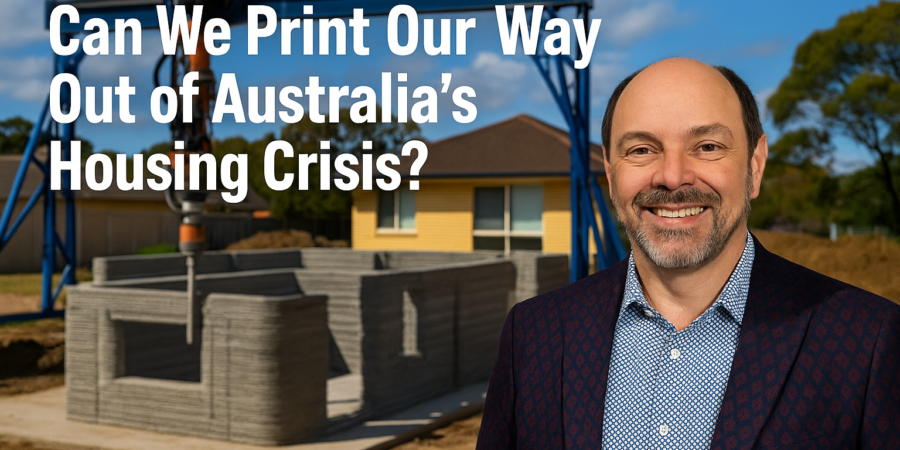
{Podcast} Can We Print Our Way Out of Australia’s Housing Crisis?
Walk into Ballarat today and you’ll find a building site unlike any other. Instead of the steady rhythm of hammers and saws, there’s the hum of a machine extruding concrete in neat, layered ribbons.
Swinburne University engineers have joined with a local builder to deliver the city’s first 3D-printed home.
It is tempting to see this as novelty. But it’s not. It’s a signal.
The provocation isn’t whether we can 3D-print a home. We can. The deeper question is whether Australia could print enough homes to make a serious dent in our housing crisis and what ripple effects that would set loose across construction, finance, labour, design, and community.
What is a 3D-printed house, really?
Strip away the headlines and it’s straightforward. A giant robotic printer, often on rails or arms, extrudes a specially designed concrete or earth mix, layer by layer, guided by a digital file. Within days, walls rise where empty ground stood. The roof, plumbing, wiring, windows, and finishes still require trades. But the backbone of the structure, the walls, partitions, shells is printed.
The appeal is obvious. Build times cut from months to weeks. Costs reduced by 25–30% in some trials. Waste slashed. Designs limited more by imagination than by brick sizes. Potential to put homes in remote or underserviced areas where materials and labour are scarce.
The catch is not whether the printer works. It’s whether regulators, insurers, financiers, and buyers accept a home made by nozzle instead of trowel. That’s the challenge of trust, what I call the Decision Trust Zones.
From hype, to trough, to long tail
This isn’t the first time we’ve talked about printing homes. I’ve been writing on this for over a decade from 3D Printing Coming Soon to a Home Near You to A 3D-Printed World to my April webinar reflections on 3D printing and robots.
The pattern is familiar. Each new breakthrough is greeted with breathless headlines: “The future of housing has arrived.” Then silence, as adoption lags. Critics dismiss it as a gimmick. That’s the classic hype cycle: inflated expectations followed by the trough of disillusionment.
But the real story lies in the long tail. The quiet years when university labs, small builders, and determined engineers keep refining. Away from headlines, the printers keep humming.
Ballarat’s first printed home is not the start of the story. It’s evidence that the story has been unfolding all along.
How many homes could we print?
Australia currently builds around 180,000 new dwellings a year. Against demand, we fall short by roughly 50,000 annually. Over the next decade, that gap adds up to hundreds of thousands of families without secure housing.
Here’s where foresight and modelling matter. Imagine three adoption paths:
-
Conservative: If just 1% of homes were printed next year, that’s ~1,800 dwellings. Push to 5% by 2030, and you’re at 9,000 homes a year, enough to cover nearly a fifth of the shortfall.
-
Moderate: At 2% adoption today and scaling to 15% by 2030, that’s 27,000 printed homes a year. More than half the shortfall closed.
-
Ambitious: If we aimed for 25% of new homes printed by 2030, that’s 45,000 annually, almost the entire shortfall addressed.
These numbers aren’t predictions.
They’re scenarios.
They show what’s possible if ambition, regulation, and culture align.
They also show the limits.
Printing alone won’t fix housing.
But under the right conditions, it could play a decisive role.
For more on 3D Printed Houses listen to my segment on Hong Kong Radio 3, as host Phil Whelan and I chat all things printed homes (17 minutes 40 seconds):
Global signals of possibility
Ballarat isn’t alone. Signals are emerging worldwide:
-
China: WinSun demonstrated a six-storey 3D-printed apartment block as early as 2015. Imperfect, but a proof of concept.
-
Dubai: Entire office buildings printed as part of the city’s 3D Printing Strategy, embedding the technology into national ambition.
-
Texas, USA: Lennar and ICON are building a 100-home community in Georgetown, marketed as the largest 3D-printed neighbourhood on the planet.
-
Mexico: New Story and ICON printed homes for low-income families, proving speed and affordability in vulnerable communities.
-
Netherlands: Project Milestone delivered Europe’s first occupied 3D-printed home in 2021, with multi-storey structures now underway.
-
Germany: Beckum saw the country’s first code-approved printed residence. By 2024, Europe’s largest printed building the “Wavehouse” stood complete.
-
Australia: In Dubbo, a duplex for social housing had its walls printed in under two weeks. In Melbourne’s Wyndham suburb, Luyten’s multi-storey project delivered a four-bedroom home in about five weeks, at 25–30% less cost.
These are not hype. They are signals of scale.
The wider ripple effects
Printing homes is about much more than faster walls. It sends ripples through every part of our lived environment.
-
Labour and HUMAND: The shift is not just fewer bricklayers, but new roles, printer operators, materials designers, AI-driven site planners. My HUMAND framework asking what belongs to Humans, Machines, and AI is at the heart of this transformation.
-
Affordability and equity: If costs fall, mortgages shrink, social housing grows, regional towns attract more residents. But beware the trap: will we create “print suburbs” seen as second class, or integrate printing into mainstream housing?
-
Decision Trust Zones: Councils, insurers, and banks need to redraw their trust boundaries. What happens when the inspector arrives and finds no bricks to tap? Who carries liability if a wall cracks, the builder, the printer, or the algorithm that designed it?
-
Environmental impact: Printing can cut material waste and embodied carbon, especially if local earth mixes or low-carbon composites are used. Imagine homes designed for disassembly and recycling, a circular housing economy.
-
Cultural shifts: Australian housing culture still clings to the brick veneer. Will buyers value a printed wall differently, or will new aesthetics and design freedoms shift our sense of what a home looks like?
-
Political and legal structures: Building codes, zoning laws, and property rights need re-imagining. Governments that move first will shape the future of housing, not chase it.
-
Economic implications: Savings of 25–30% per build are significant. But the bigger question is who captures the value, the developer, the buyer, or the broader community?
Each of these ripples is a choice. None of them are automatic.
Where we go from here
So what must happen?
-
Government: Fast-track new building codes for printed housing. Fund demonstration projects in social housing and regional communities.
-
Industry: Partner with universities like Swinburne, instead of waiting for certainty. Pilot projects now will shape competitive advantage later.
-
Finance and insurance: Develop models for printed housing stock so banks and insurers are not the bottlenecks.
-
Communities: Push for innovation in housing, not just more of the same. Demand that future homes are designed with foresight, not hindsight.
My reflection
When I first wrote about 3D-printed housing more than a decade ago, it felt like a distant possibility. In Real Estate 2030 and Will Real Estate Look Like This in 50 Years?, I pointed to signals of property markets shifting under cultural and technological pressures.
Now, standing in Ballarat, I can point to actual walls rising. This is what foresight looks like in practice: spotting weak signals, watching them mature, and knowing when they tip into reality.
The closing thought
Printing homes will not replace all housing. But it can redefine what it means to build, and by extension, what it means to live. It will reshape jobs, culture, and the very fabric of our communities.
The question is not whether we can print homes. It is whether we choose to make printing part of the solution to our housing crisis and how we manage the ripple effects that follow.
Choose Forward.
I work with leaders in construction, property, and real estate, including JLL, Stockland, Lendlease, Metricon, Built, Caesarstone, Civium, Architectus, and many others, to explore these and many other signals and prepare for the futures the inhabitable futures they may spark.
If your organisation is part of this sector, learn more here about how I help businesses and industries rethink what it means to design, build, and inhabit the future.
Morris Misel is a global futurist, keynote speaker, and strategic advisor across 160+ industries. Heard by millions each year in the media and on stage, he has spent over three decades helping leaders, organisations, and governments prepare for tomorrow’s possibilities.
Morris is the creator of the Immediate Futures™ framework and proprietary foresight tools including HUMAND™, Ripple Effects, and Decision Trust Zones.
Recognised with more than 10 international awards for thought leadership and professional impact, including Thinkers360 Top 10 Global Futurist, Top 50 Voices on the Future of Work, and multiple Excellence in Speaking Awards,
Morris continues to be sought out by CEOs, strategists, and event organisers worldwide for his provocative insights, practical foresight and incredible stage presentations.
Explore more of his work at https://www.MorrisMisel.com.
#MorrisMisel #3DPrintedHomes #HousingCrisis #FutureOfHousing #ConstructionTechnology #HousingInnovation #StrategicForesight #RippleEffects #HUMAND #DecisionTrustZones #HousingAffordability #RealEstateFutures #Leadership #FutureOfCities #Swinburne #Ballarat #KeynoteSpeaker
Frequently Asked Questions
Q: What does 3D-printed construction technology actually signal for housing futures?
It signals that the cost and time constraints on construction are becoming more tractable from a technology perspective, which is meaningful but not sufficient on its own to address housing affordability. The barriers to housing affordability in Australia are primarily land cost and planning system complexity rather than construction cost alone, 3D printing addresses one constraint in a multi-constraint problem. The foresight value of the technology is in what it signals about the trajectory: if construction cost and time continue to fall, the relative weight of the other barriers increases, which changes the policy and planning conversation.
Q: What would it take for additive construction to meaningfully change housing outcomes in Australia?
Regulatory frameworks that accommodate new construction methods at pace, building codes and compliance systems that have historically been designed around traditional construction methods need to adapt. Supply chain development for the materials and equipment at the scale required to make a material difference in housing supply. Integration with planning reform that addresses land cost and zoning constraints, which remain the primary barriers in most Australian cities. And community acceptance of new construction approaches in residential settings, which has historically lagged technical capability.
Q: What is the broader foresight pattern that housing technology illustrates?
That technological solutions to complex social problems often solve the technically tractable parts while leaving the politically and institutionally complex parts unresolved. The housing crisis in Australian cities is primarily a story about land economics, planning systems, and infrastructure investment, not construction technology. Technology that makes construction faster and cheaper is genuinely useful but does not change the land economics or planning dynamics that drive unaffordability. The second-order question is always: what does solving this constraint reveal about the constraints that remain?
Q: Can Morris Misel speak on housing futures, built environment foresight, and the technology-policy interface for our property, government, or urban planning audience?
Yes. Built environment and housing futures are regular keynote topics for property, government, and urban planning audiences. Book at morrismisel.com.