{Podcast} Follow the Money: What AI’s New Billionaires Really Signal About Our Future
TL;DR – Follow the Money, See the Future
AI’s new billionaires aren’t about yachts and net worths. They’re signals. They show us:
- GPUs (the advanced chips powering AI) are the new oil.
- Robotics is replacing human tasks at scale.
- AI Search is dismantling knowledge work.
- Defense AI is weaponising geopolitics.
- Almost all male, almost all under 45, almost all U.S. or China.
- Missing? Education, healthcare, sustainability.
This isn’t a billionaire list. It’s a future map.
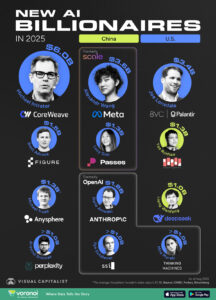
Every chart tells a story. This one the new billionaires minted by AI in 2025 isn’t really about wealth.
It’s a map. A distorted, uncomfortable, revealing map of where society is choosing to invest its energy, and who gets to write the next chapter of work, wealth, and wisdom.
Yes, the headlines are about net worth’s and unicorn valuations.
But look closer. Each billionaire here is a signpost.
A marker of what industries are monetising artificial intelligence fastest.
And, more importantly, what human needs (and fears) are being traded on to build these fortunes.
This is not gossip. It’s foresight.
Who Made the List and Why It Matters
So who are these new AI billionaires? The chart isn’t just a curiosity piece it’s a roll call of the industries society has decided to reward. CoreWeave, riding the GPU arms race. Figure, betting big on humanoid robotics. Perplexity, turning AI search into a billion-dollar knowledge engine. Anthropic and Deepseek, leading the charge on foundation models (the massive AI systems that underpin everything from chatbots to autonomous decision-making) from two different hemispheres. Even Palantir and 8VC, where defence and data intersect, make an appearance.
Now notice the patterns. Almost every name on this chart is male. That isn’t simply bias, it’s a signal about whose values are shaping tomorrow’s AI systems. Age matters too. This isn’t the old guard of grey-haired tech titans. Most of these fortunes sit with founders in their 30s and 40s, a generational shift that suggests the future is being coded not by veterans but by those who grew up native to the internet and global platforms.
And then the geography. Two flags dominate: the United States and China. Europe is invisible. The Global South is absent. If wealth signals influence, then the future of AI is being written in two dialects and the rest of the world is positioned as consumer, not creator.
This isn’t a billionaire list. It’s a worldview map.
Billionaires as Lagging Indicators
By the time someone shows up on a billionaire list, the disruption has already happened.
The tipping point has passed.
What we’re really seeing is the monetisation of a signal that’s been building in plain sight for years.
- GPUs (Graphics Processing Units), the advanced chips powering AI, are the arms dealers of the AI revolution.
- Robotics (Figure) – The embodiment of our obsession with replacing human labour at scale.
- AI search (Perplexity) – The dismantling of knowledge work as we’ve known it.
- Foundation models (Anthropic, Deepseek, 01.AI) – The concentration of language, decision-making, and creativity into a handful of platforms.
- Defense and data (Palantir, 8VC) – The weaponisation of AI geopolitics.
- Creator economy AI (Passes) – The industrialisation of human creativity.
These aren’t “who got rich” stories. They’re future industries maps.
The Geopolitics of Wealth
Notice the clustering. United States. China. A sprinkling of others.
Where’s Europe? Absent.
Where’s the Global South? Silent.
Where’s Australia, Africa, South America? Missing.
This is not an accident. This is geopolitical capital concentration. Two spheres, the U.S. and China are shaping AI’s wealth future. Everyone else risks becoming a consumer, not a creator. An importer of AI systems, not a designer of them.
The ripple effects are profound: regulation without leverage, adoption without influence, anxiety without agency.
HUMAND in Action
Here’s where my HUMAND framework (Human + Machine + AI collaboration) comes in. Look at the billionaire industries again through a HUMAND lens.
- Robotics fortunes rise because machines are being tasked with doing what humans used to do.
- AI search fortunes rise because AI intellect is replacing human knowledge workers.
- GPU fortunes rise because machines and AI need scale far beyond human capability.
- Creator economy AI fortunes rise because human imagination itself is being systematised.
These billionaires are not creating wealth out of thin air. They are extracting it from the tasks humans once performed, and reframing who does what in the triad of humans, machines, and AI.
That is HUMAND in motion and the redistribution of labour, value, and dignity is the unspoken story behind these net worth’s.
Ripple Effects of Concentrated Wealth
When fortunes concentrate this fast, it isn’t just about inequality. It’s about who decides the trajectory of entire industries.
This is what I call the Ripple Effects of AI wealth:
- When CoreWeave surges, every enterprise scrambles for GPU capacity, reshaping cost structures from finance to healthcare.
- When Anthropic or Deepseek scales, the ripple isn’t just better chatbots, it’s the redefinition of decision-making itself.
- When Palantir doubles down on defense AI, ripple effects spread into geopolitics, national security, and civil liberties.
Each billionaire is a pebble dropped into the pond. The waves don’t stop at their industry. They shape how we live, work, learn, love, and fight.
PTFA: Past Trauma, Future Anxiety
Now add another lens. PTFA, Past Trauma, Future Anxiety.
Why does this chart spark unease? Because we’ve seen this movie before. Industrialists amassing wealth as jobs vanished. Tech barons shaping culture without accountability. History teaches us to be wary of power concentrated in too few hands.
Future anxiety bubbles up when we see a dozen new billionaires minted almost overnight from AI:
- What jobs vanish next?
- Who benefits?
- Who gets left out?
- Is this AI for humanity, or AI for the few?
The trauma is past. The anxiety is future. Together, they fuel resistance, regulation, and backlash, the social dynamics that always follow sudden technological wealth.
Decision Trust Zones
This leads us to the heart of it: trust.
If wealth equals influence, then decisions about AI’s direction are being made by a very small group of people in very few places. That is a Decision Trust Zone, where the locus of decision-making power narrows, and society has to decide whether to trust it.
Do we trust billionaires to decide how education AI evolves?
Do we trust them to decide how military AI is deployed?
Do we trust them to decide how human creativity is monetised?
The short answer: we shouldn’t. Not without scrutiny, not without alternatives, not without a deliberate societal voice in the room.
The Absences Tell the Story
Sometimes what isn’t on a chart matters more than what is.
- No billionaires from education AI – Why is teaching and learning not yet monetised at billionaire scale?
- No billionaires from healthcare AI (outside infrastructure) – Where’s the radical redefinition of health equity?
- No billionaires from sustainability AI – Why is saving the planet not yet billionaire-worthy?
Absence is a signal. And it says as much about our priorities, or lack of them, as the presence of GPUs and robots.
As I often remind audiences:
“We can make billionaires out of robots, but not out of teachers. We can monetise war faster than we can monetise wellness.”
What Leaders Should Do Now
If billionaires are lagging indicators, the lesson is simple: don’t wait for your industry’s chart to arrive.
Here’s what boards and leaders should be doing now:
- Audit your dependency on GPUs. If advanced chips are the new oil, what happens to your costs and resilience when the supply chain tightens?
- Rethink knowledge work. AI search isn’t just Google 2.0, it’s the dismantling of research, reporting, and advisory functions. How do you reimagine talent under HUMAND (Human + Machine + AI)?
- Read the geopolitics. If AI wealth is clustering in the U.S. and China, what does that mean for your partnerships, markets, and risks in a two-world AI system?
- Spot the absences. No billionaires yet in education, healthcare, or sustainability. That’s not a void, it’s your opportunity.
- Check your Decision Trust Zones. Don’t hand over critical decisions to invisible algorithms designed in Palo Alto or Shenzhen. Ask: who are we trusting, and why?
Leaders don’t need to chase the billionaires. They need to read the signals those fortunes reveal and prepare.
My Take
So yes, the chart is interesting. But not because it tells us who got rich. Because it shows us where the future is being written in real time.
The billionaires are just the surface. The signal is underneath:
- Wealth clustering in defence, robotics, GPUs, and foundation models.
- Entire continents excluded from the AI wealth map.
- Human tasks being reshuffled into machines and AI at scale.
- Power concentrating into ever-narrower Decision Trust Zones.
If you only look at the chart as gossip, you’ll miss the foresight.
If you follow the money, you’ll see your future.
Call to Action
I spend my life helping boards, leaders, and teams find and read these signals before they blindside them.
Book me to brief your board, before your competitors book me to brief theirs.
Subscribe to my newsletter to get these foresight signals in your inbox first.
Because billionaires aren’t the story.
The story is what their fortunes reveal about your tomorrows.
Choose Forward.
In this week’s HK3 radio segment, I explored these announcements live. Listen here for my conversation with Phil Whelan (17 minutes 56 seconds).
Morris Misel is a futurist and foresight strategist heard by millions each year in the media and onstage.
With more than 30 years working across 160 industries worldwide, he helps leaders and boards decode the signals of tomorrow and prepare for what comes next.
Misel is known for his proprietary frameworks including HUMAND (Human + Machine + AI collaboration), Ripple Effects, PTFA (Past Trauma, Future Anxiety), and Decision Trust Zones.
His work guides organisations from the known to the unknown, translating weak and strong signals into practical strategies that drive resilience, relevance, and results.
You can’t predict tomorrow, but you can prepare for it.
Choose Forward.
#AI #ArtificialIntelligence #FutureSignals #FutureIndustries #FutureOfWork #Foresight #StrategicForesight #AIbillionaires #AIsearch #AItrends #GPUs #Robotics #DefenseTech #AIgeopolitics #CreatorEconomy #FoundationModels #HUMAND #RippleEffects #PTFA #DecisionTrustZones #ChooseForward #Leadership #BoardStrategy #Innovation #FutureLeadership #BusinessStrategy #GlobalTrends #DigitalTransformation #Geopolitics #WealthAndPower #SignalsNotGossip #FollowTheMoney #FutureMap #AI2025 #ScrollStopper
Frequently Asked Questions
Q: What does the concentration of AI wealth signal about how this technological transition is unfolding?
That the economic benefits of AI, at this early stage, are concentrating significantly in the hands of the people and organisations that own the infrastructure and foundational models, compute, data, talent, and intellectual property. This is not surprising; it follows the pattern of previous major technological transitions where the first-mover advantage in infrastructure ownership produced significant and durable wealth concentration. What is different about AI is the speed of the concentration and the degree to which the infrastructure advantage translates into leverage over adjacent sectors (media, knowledge work, creative industries) that are not part of the technology sector themselves.
Q: What are the governance challenges posed by AI wealth and power concentration?
Several are significant. The organisations with the resources to shape AI development (to invest in safety research, to influence regulatory frameworks, to define deployment standards) are the same organisations with the strongest economic incentive to deploy AI as quickly and broadly as possible. This creates a structural conflict between the pace of deployment and the pace of governance development. Additionally, the concentration of AI capability in a small number of organisations creates single points of failure for critical systems, and leverage over democratic processes that previous wealth concentrations did not have because their power was not embedded in communication, information, and decision-support infrastructure.
Q: What does the ripple effect analysis of AI wealth concentration look like for non-technology sectors?
Organisations in every sector are becoming increasingly dependent on AI infrastructure owned by a small number of technology companies. The terms on which that infrastructure is accessed (pricing, data terms, capability availability) are set by the infrastructure owners. Sectors that do not develop genuine AI capability internally are trading one form of dependency for another. The foresight argument for building internal AI capability, for engaging with AI governance, and for supporting regulatory frameworks that prevent infrastructure monopoly is not just ethical. It is a strategic resilience argument.
Q: Can Morris Misel speak on AI governance, power concentration, and the foresight implications of the AI economy for our board, policy, or leadership audience?
Yes. AI governance and economic foresight are core keynote topics for boards, policy, and leadership audiences. Book at morrismisel.com.