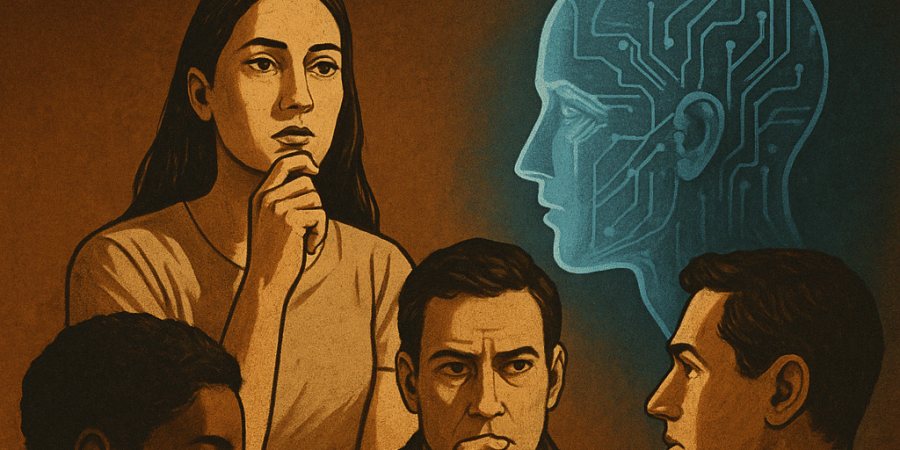
You Make 35,000 Decisions a Day—But How Many Are Still Yours?
They say we make around 35,000 decisions a day.
That’s one every couple of seconds.
You’ve probably made a dozen just reading this sentence: keep reading or not, skim or slow down, agree or question.
Most of them we barely notice.
Do I cross the street now?
Reply to that message?
Keep the lights on or off?
And some, we stew over for days:
Should I leave this job?
Should I say yes to that offer?
What school is right for my kid?
But lately, I’ve been wondering if something deeper is shifting.
Not just in how many decisions we make—but in how many of them are still truly ours.
When was the last time you felt fully in charge of a choice?
No algorithm nudging.
No recommendation.
No automated system stepping in.
We’re entering a new territory.
A world where the edges of decision-making are becoming blurred.
Not just automated, but anticipated.
Not just supported, but shared.
The Six Realms of Choice™
Over decades of work, I’ve watched how people make decisions—on stage, in boardrooms, in moments of crisis, or in quiet, life-altering reflection.
And I’ve come to see that not all decisions carry the same weight, require the same tools, or will survive the arrival of AI in the same way.
Here’s a map.
Not perfect, but practical.
A way to understand the different types of decisions we make—and how some of them are being reshaped, even now.
| Realm | What It Covers | Today | Tomorrow |
|---|---|---|---|
| Reflex | Instinctive reactions: blink, brake, duck. | Human autopilot. | Wearables and edge tech may respond faster, but instinct remains human. |
| Routine | Habits, preferences, micro-decisions. | Music playlists, food orders, inbox sorting. | AI curates based on mood, pattern, behaviour. Often invisible. |
| Pivotal | Major life shifts. | Search, consult, reflect. | AI offers simulations, pros/cons, emotion modelling. Still a human core. |
| Structural | Systems, policies, workflows. | Designed by people, tweaked over time. | AI identifies inefficiencies, biases, future risks in real time. |
| Identity | Personal and professional self-expression. | Intuition, feedback, social context. | Tools surface how different versions of “you” land. You still choose. |
| Legacy | Big arc questions: purpose, contribution, impact. | Human-led, vision-driven. | AI stress-tests scenarios over decades. Values remain human. |
Are These All the Choices We’ll Ever Make?
The short answer: no.
What’s fascinating is how many decisions are now being made around us, about us, or for us—sometimes with our blessing, sometimes without us even noticing.
Let me offer some provocations.
See if any of these sound familiar:
You’re driving to work. Waze reroutes you without asking. It avoids a delay you didn’t know existed. Would you still call it your decision?
Your email app suggests a reply: “Thanks for this. I’ll take a look and get back to you.” You click it without reading. Is that your voice? Or the machine’s?
These aren’t far-off examples.
They’re here.
Quiet.
Constant.
Shaping the rhythm of your day.
We might call these the beginning of a new kind of thinking.
I’ve been toying with four new categories—experimental, not definitive—but they help me wrestle with what’s changing.
Beyond the Realms: Emerging Modes of Choice
Anticipatory Decisions
Waze reroutes you. Amazon surfaces the item you’ll need next week. Spotify hits your mood better than you can describe it.
These aren’t just predictions.
They’re decisions shaped before you even knew a decision needed to be made.
Proxy Thinking
Your systems reorder stock. Your inbox is prioritised. Your bills are paid.
You’ve set the conditions—and then stepped back.
The machine acts.
You delegated, but to code, not a colleague.
Synthetic Futures
A/B testing used to give you two options.
Now AI runs dozens, maybe hundreds.
It doesn’t just help you choose—it helps you invent what to choose from.
Extra-Sentient Decisions
These are harder to explain.
They’re the ones where the machine sees something you can’t.
A planetary pattern.
A risk ripple.
A shift in behaviour across millions of data points.
It recommends action—not based on your logic, but its own.
As AI matures, we won’t just be choosing differently.
We’ll be learning to think in ways that evolution never taught us.
And maybe, just maybe, the next great leap in cognition won’t be about what we decide—but how we redefine what a decision even is.
What does that mean for leadership?
For marketing?
For the way we teach, vote, plan, and live?
That’s the question worth sitting with.
Because the future of decision-making won’t feel like a sci-fi switch being flipped. It will feel like a slow shift.
Like something that used to be hard becoming effortless.
Like something personal becoming slightly less so.
And the choices we don’t notice may end up being the ones that shape us most.
So. What are you still choosing for yourself?
And what’s already being chosen around you?
#AI #decisionmaking #futureofwork #MorrisMisel #leadership #foresight #executivestrategy #digitaltransformation #cognition #automation #keynotespeaker #businessfuturist #marketingstrategy #AIleadership #invisibledecisions #futurethinking #humanmachinecollaboration #strategy


