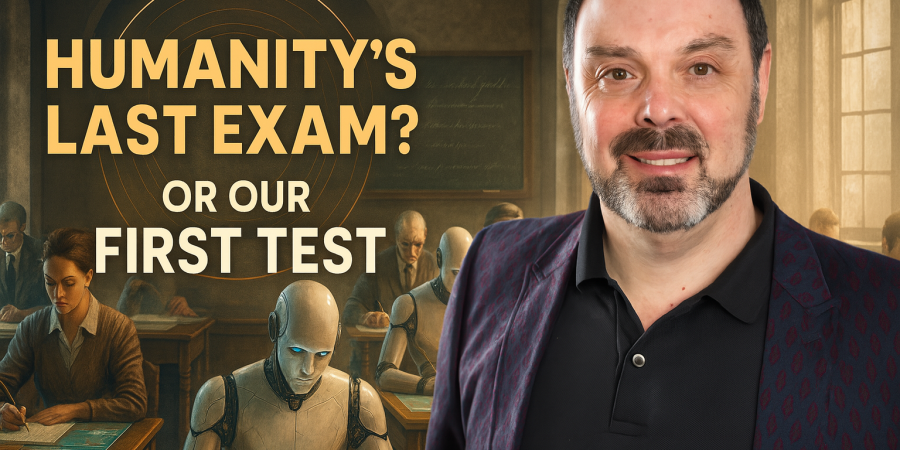
Humanity’s Last Exam? Or Our First Real Test?
1. The Exam Heard Round the World
Imagine this: 2,500 of the most challenging questions ever created.
Not multiple choice.
Not trivia.
We’re talking about high-stakes academic puzzles spanning 57 languages and 140 disciplines.
And we didn’t write them for people.
We wrote them for machines.
A new benchmark quietly dropped into the AI world recently it’s called Humanity’s Last Exam.
It’s the intellectual Olympics of AI: a stress-test for models like GPT-4, Claude, Gemini, and the rest, designed to push them beyond typical benchmarks and into uncharted territory.
And while most people haven’t heard of it, what it signals is massive.
Because we’re not just testing AI.
We’re exposing what comes next for us.
2. This Isn’t About the Machines
Yes, models like GPT-4 scored poorly.
Yes, the benchmark was crafted by 1,000+ experts.
Yes, the questions are terrifying.
Like:
“Translate a funerary Palmyrene inscription with Latin epigraphy.”
“Which sesamoid bone supports the most tendons in hummingbirds?”
But the results aren’t the story.
The existence of this test is.
This benchmark isn’t a celebration.
It’s a symptom.
A marker that AI has matured past our general exams and we now have to make up harder ones just to keep it challenged.
The machines are accelerating.
Faster than most organisations, leaders, or societies are ready for.
And that’s the point: AI is no longer the student. We are.
3. If AI Can Pass Our Exams, What Are We Still Here to Do?
This is where my futurist brain kicks in.
We’ve trained AI to reason, translate, solve, argue.
We’ve taught it to mimic experts.
We’ve given it access to every textbook ever written.
So what’s left?
What can’t it do?
What remains uncopyable, unscannable, unscored?
That’s where the future of human value lives.
Because in every keynote, boardroom, and advisory room I walk into, the real question isn’t “how smart is AI?”
It’s:
What’s still ours?
What do we hold onto?
What do we double down on because it will never be theirs?
4. The End of Intelligence as We Knew It
We’ve misunderstood intelligence for a long time.
We turned it into marks, degrees, exam results, and standardised tests.
We rewarded memory and precision.
We called those who could recall, “smart.”
But AI does that better now. Much better.
So now, we’re staring down the barrel of a new truth:
Knowledge is free. Capability is automated. Memory is outsourced.
We have to redefine intelligence or lose our relevance trying to protect the old definition.
5. The Rise of Wisdom Work
This is where your advantage begins.
When I work with leaders, we map every function, decision, and process into a simple lens:
Is this best done by humans, machines, or both?
That’s the core of my HUMAND™ model and it’s never been more critical.
Because as machines master the exam, we must master the intangibles:
-
Judgement in uncertain contexts
-
Ethical decision-making
-
Creativity without prompts
-
Emotional attunement
-
Purpose-driven navigation
-
Leadership when the map runs out
You can’t benchmark those.
You can’t score them out of 100.
And most importantly you can’t automate them.
Not fully.
Not meaningfully.
6. This Is The Real Test: Can You Lead Where AI Cannot?
In keynotes I say it plainly: We are the test now.
Not a test of facts.
A test of foresight.
A test of moral positioning.
A test of comfort in ambiguity.
Let’s try a few questions from the “Human Exam” that’s brewing in our world:
-
Can you make a decision when there is no obvious answer, only risk?
-
Can you sense when a number is technically right but morally wrong?
-
Can you create value in a moment of confusion or chaos?
-
Can you choose wisely when data says one thing and your gut says another?
-
Can you hold your ground even when the machine disagrees?
This is post-knowledge leadership.
Not knowing more.
Knowing how to lead through the unknowable.
7. The Ripple Effects of an AI That Doesn’t Need Your Credentials
This shift isn’t theoretical. It has ripple effects across everything:
Education:
What are we preparing students for an AI-dominated world of facts, or a human-powered world of questions?
Work:
What jobs survive when knowledge becomes a utility? Only the ones rooted in human context and consequence.
Policy & Governance:
How do we regulate models that can pass our exams but never took our oaths?
Personal Identity:
If you built your sense of worth on being smart, what happens when machines outsmart you?
8. The Shift from Benchmarks to Behaviour
AI is passing our benchmarks.
So we need a new compass.
The future belongs to those who:
-
Lead with clarity, not certainty
-
Choose direction, not perfection
-
Interpret context, not just data
-
Prioritise wisdom, not just knowledge
-
Act human-first, not human-last
This is not soft stuff. It’s survival.
9. My Call to Leaders, Boards, Builders and Thinkers
If your leadership frameworks are still built on the idea that intelligence = knowledge, or that roles = fixed functions… you are preparing your organisation for a world that no longer exists.
You don’t need a new benchmark.
You need a new playbook.
That’s why in every session, we rewire:
-
Decision-making structures for an AI-blended future
-
Organisational capability maps that apply HUMAND thinking
-
Strategy models that assume data will be cheap, but wisdom will be rare
10. This Is Not Humanity’s Last Exam. This Is Our First Real One.
AI passed the test.
Now it’s our turn.
We’re being asked:
-
Can we make decisions AI shouldn’t?
-
Can we imagine futures AI can’t?
-
Can we uphold values AI doesn’t feel?
-
Can we lead people, not just processes?
That’s the work now.
It’s not just about knowing what’s coming.
It’s about knowing what still belongs to us and building from there.
Because the future isn’t about prediction.
It’s about preparation.
And you don’t prepare with answers.
You prepare with better questions.
Ready to Future-Proof Your Leadership Team?
Let’s move beyond the benchmarks.
If your board, your exec team, or your industry is still focused on teaching people how to pass the test while AI rewrites the syllabus we need to talk.
Morris Misel is a global futurist, strategist, presenter and human-first provocateur heard by millions each year in the media and on stage.
He helps decision-makers see the invisible, prepare for the unimaginable, and act before the rest of the world blinks.
#ArtificialIntelligence #StrategicForesight #FutureOfWork #HumanVsAI #LeadershipStrategy #CognitiveAutomation #DecisionMaking #AGI #MorrisMisel #WisdomEconomy #HumanIntelligence #KeynoteSpeaker #ForesightLeadership #DisruptionStrategy #AIandLeadership #PostKnowledgeWorld #HUMAND #FuturePreparedness #AIKeynote