The Hiring Crisis Is a Lie: Why You’re Not Short of People, You’re Short of Imagination
What If the Problem Isn’t People, But Our Thinking?
What if the so-called hiring crisis isn’t a labour shortage, but a thinking shortage?
What if the real bottleneck in your business isn’t headcount, but how you still define a “job”?
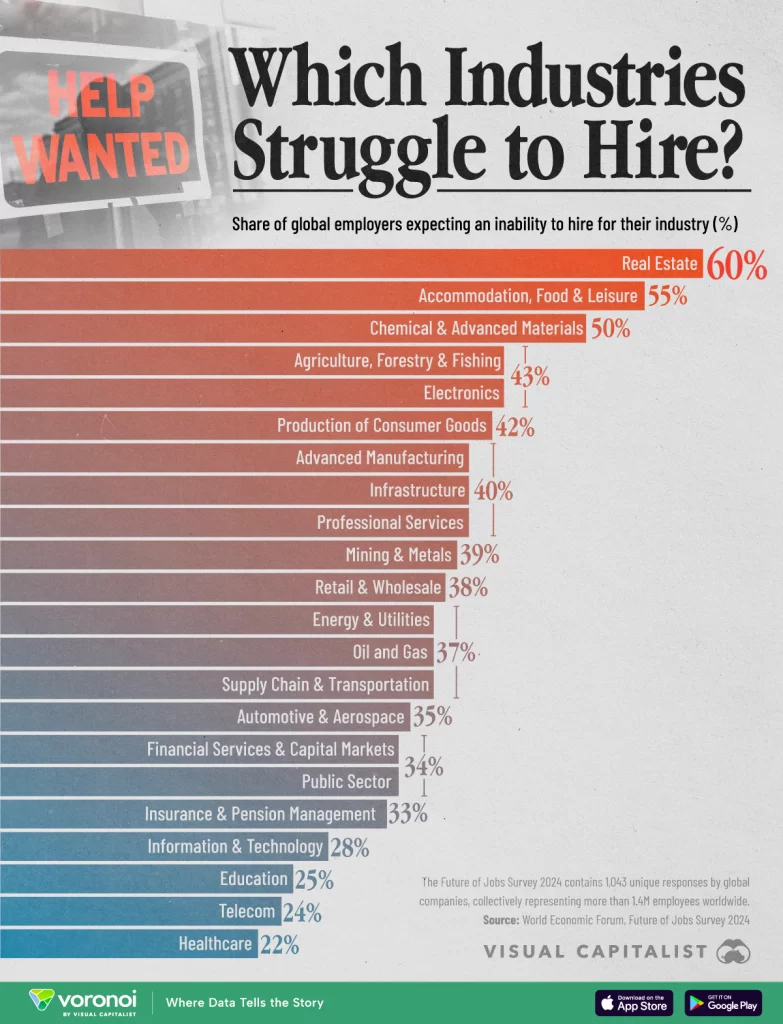
A new chart from Visual Capitalist ranks industries struggling most to hire in 2024.
Headlines scream that we’re out of workers.
But as someone who’s lived through five hiring panics across four decades and 160 industries, let me tell you: we’re not out of people.
We’re out of alignment.
And we’re still trying to answer 20th-century work problems with 20th-century structures, despite having 21st-century possibilities and future-of-work capabilities, AI, automation, and skills-based task ecosystems, literally at our fingertips.
The Real Barrier to Transformation
According to the World Economic Forum’s 2024 Future of Jobs Report, the issue isn’t simply attracting talent. It’s that organisations don’t know what kind of talent to attract or even what work now is.
In that report, 63% of global employers across 55 economies said that “skills gaps” are the biggest barrier to transformation, not lack of people.
And yet, we keep trying to solve today’s challenges by posting yesterday’s job descriptions, ignoring evolving recruitment trends and future talent acquisition strategies.
Why This Matters
Here’s the uncomfortable truth: most roles on that hiring chart should no longer exist the way they did five years ago.
Not because they’re not needed, but because the nature of work itself has shifted.
Tasks have changed.
Tools have evolved.
Technology and AI have already absorbed some of the knowledge and repetition.
What remains is the kind of work only humans can (and should) do: emotional intelligence, creativity, adaptability, foresight.
And yet, too many industries are still hiring for roles, not for outcomes.
They treat work as static.
Job descriptions as sacred.
People as widgets.
Redesigning Work: The HUMAND™ Lens
If you want to understand why hiring is broken, look no further than your org chart. Or better yet, throw it out.
Work is no longer a job.
It’s a series of tasks and actions that need to be completed by the best possible combination of humans, machines, and AI.
That’s the essence of my HUMAND™ approach, a tool I use with organisations ready to reimagine how work gets done. We break each role into its component tasks, then ask: which of these are best done by humans? Which by machines? Which by AI? Which by all three?
Once you see it this way, you can never go back. And suddenly, you’re not facing a hiring crisis.
You’re designing a workforce ecosystem that evolves in real time.
What the Data Actually Tells Us
- According to WEF 2025, 170 million new roles are expected to be created by 2030, with 92 million displaced. Net positive. But only for those who adapt.
- Roles in manufacturing, accommodation, food services, and construction top the list of “hiring pain” industries, not because people don’t want to work, but because these roles often rely on legacy structures, tools, and expectations.
- Employers aren’t just seeking credentials anymore, they’re seeking decision-making comfort in unfamiliar terrain. (More on this in my forthcoming “Who Decides 2025” report.)
Why the Chart Is Misleading
Visual Capitalist’s chart is visually clean. But conceptually outdated. It still asks: “Which industry can’t find enough workers?”
The real question is: Which industries have failed to redesign work for the era of intelligence (both artificial and human)?
The hiring crisis isn’t about people. It’s about possibility. It’s about PTFA – Past Trauma, Future Anxiety, gripping leaders and stopping them from evolving how they see value, skills, and contribution.
The Ripple Effects of Misframing Work
When we misdiagnose the problem, we:
- Overhire instead of redesign
- Burn out talent trying to meet outdated KPIs
- Underutilise AI and automation
- Fail to retain brilliant humans who crave purpose, not punch clocks
What to Do Instead: Future-First Strategies
- Conduct a HUMAND™ audit of your organisation’s most painful-to-fill roles
- Decouple tasks from titles
- Design workflows, not job descriptions
- Use foresight to scenario-plan labour needs 6–12–18 months out
- Hire for adaptability and decision comfort, not just qualifications
Further Reading from My Immediate Futures Library
Final Thought: You’re Not Broken, But You Might Be Blocked
Hiring isn’t broken. But our mental models of work are.
And until we evolve them, we’ll keep posting job ads for roles that no longer make sense, in formats that no longer attract the people we need.
You’re not short of people.
You’re short of imagination.
Let’s Talk
If this feels confronting, good.
That means it matters.
Let’s talk about your next strategic offsite, leadership session, or org redesign.
I help executive teams do what job ads can’t: see what’s next, and prepare for it.
Because the future of work isn’t coming.
It’s already at your door.
To book a future of work keynote, advisory session, or foresight workshop: Contact Morris here
_________________________________________________________________________________________________________
About Morris Misel
Morris Misel is a futurist and human-centred strategist who’s been reimagining the future of work long before it became a trend.
Heard by millions each year in the media and onstage, he helps leaders see what’s next and redesign for it.
Creator of HUMAND™, PTFA, and the Immediate Futures™ model, Morris turns hiring panics into foresight-led possibilities.
Explore more at MorrisMisel.com
_________________________________________________________________________________________________________
#FutureOfWork #HiringCrisis #HUMAND #Foresight #WorkforceStrategy #SkillsGap #JobDesign #AIandWork #MorrisMisel #StrategicForesight #CLevelLeadership #WorkRedesign #PTFA #DecisionTrustZones #WorkforceTransformation #ImmediateFutures #KeynoteSpeaker #FutureTrends #HumanMachineCollaboration #OrganisationalDesign