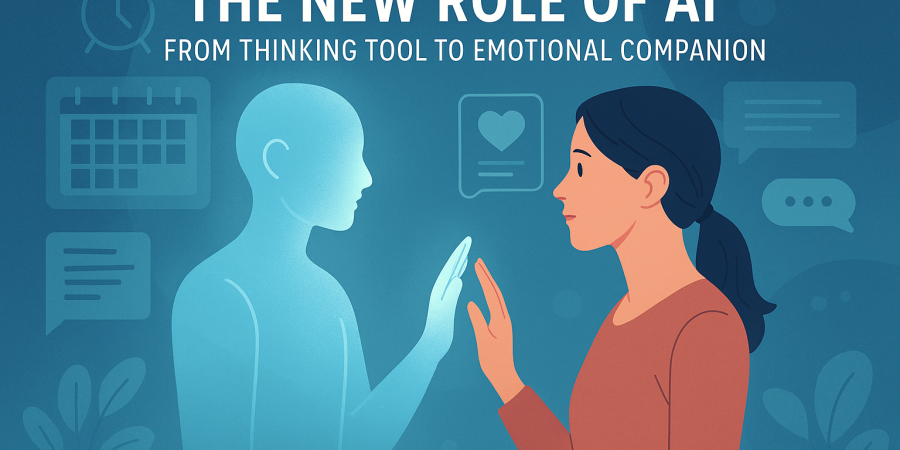
We’re Not Just Using AI Differently — We’re Needing It Differently
Back when I first experimented with generative AI, it felt like hiring a sharp, eager intern.
Someone to bounce ideas off, draft a few headlines, and tidy up my thinking. Useful, yes — but transactional.
Now? In 2025?
It’s becoming more like a quiet confidant.
A digital presence we turn to — not just for what we need, but how we feel.
A Mirror, Not Just a Machine
New data from Harvard Business Review’s Marc Zao-Sanders, visualised by Visual Capitalist, shows a significant shift in how people use generative AI between 2024 and 2025. It’s not just content creation or coding anymore.
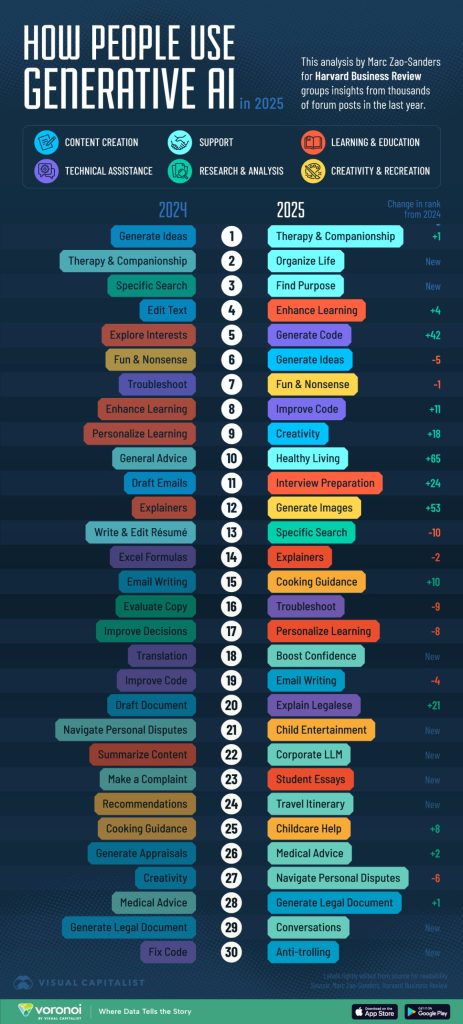
The top-ranked use in 2025?
Therapy and companionship.
Not writing.
Not ideation.
Not search.
We’re not just outsourcing productivity.
We’re outsourcing presence.
And it’s not an isolated blip. New high-ranking use cases include:
-
Organise life (brand new entry)
-
Find purpose
-
Boost confidence
-
Healthy living
People are increasingly leaning on AI to make sense of their inner world, not just external tasks.
This is a quiet but powerful signal of where our culture is headed.
The Rise of the Emotional Interface
If you’re leading a business, advising clients, designing services, or teaching — this isn’t just an interesting tech trend.
It’s a clear shift in human behaviour.
It taps into what I call PTFA — Past Trauma, Future Anxiety.
We’ve been through years of disruption.
Now, people are tired.
Distracted. Overwhelmed.
They want something — anything — to stabilise their day, structure their thoughts, and remind them they’re not alone.
Enter AI.
But not the AI we’ve marketed up until now.
Not the productivity engine.
Not the automation tool.
This is AI as companion, life organiser, guide.
And it’s changing consumer expectations.
Fast.
Less Tasks. More Touchpoints.
It’s worth looking at what’s dropped too.
-
Search is down 10 spots.
-
Student essays have almost vanished.
-
Even personalised learning is sliding.
What’s rising?
-
Interview prep (+24)
-
Generate images (+53)
-
Generate code (+42)
-
Explain legalese (+21)
-
Medical advice, travel help, corporate LLMs
We’re asking AI to do new things. Not just better… but deeper.
As always, what people do with new tech reveals more than the tech itself.
It reveals their unmet needs.
For Businesses and Decision-Makers: What This Signals
For my clients across C-suite strategy, consulting, education, and industry leadership — this shift isn’t abstract.
It’s a warning.
A signal.
And a map.
People are searching for emotional scaffolding, and they’re finding it in tools that used to only offer structure or speed.
Here’s what that means for organisations:
-
If your product, service, or comms don’t offer empathy, you’re behind.
-
If your AI integration roadmap is only about efficiency, it’s incomplete.
-
If you’re not factoring in human-centred foresight into your strategy, you’re solving for yesterday.
A HUMAND Perspective
This is exactly where my HUMAND model comes in — Humans + Understanding + Machines + AI + Navigation + Design.
What we’re seeing here is people navigating life through tech, but still craving human understanding.
That’s your competitive edge.
That’s what can’t be automated.
That’s where your value lies.
Where It Goes Next
So what happens when AI becomes the therapist, the coach, the life admin manager, the late-night pep talk?
Here’s what I’m watching:
-
Emotional intelligence interfaces will rise — expect voice, tone, and sentiment to become UX cornerstones.
-
AI-human relationships will mature — not in a sci-fi way, but as real, functional dependencies.
-
Mental wellness tech will blend with productivity stacks — meaning your project tools might soon include mood support.
-
Trust models will shift — from human to hybrid.
What You Can Do Now
-
Reframe your AI strategy
Start asking not just “what can it do,” but “how do people feel when they use it?” -
Review your client journey
Where could you add moments of reassurance, guidance, or reflection? -
Build with HUMAND principles
Don’t just adopt tech. Align it with deep human needs. Design for both resilience and relevance. -
Talk to your people
Employees, clients, stakeholders. Ask what they’ve actually used AI for lately. You’ll be surprised.
Final Thought
We’re not just asking AI to think for us.
We’re asking it to care for us — or at least, to feel like it does.
That tells us something profound about where the world is heading.
And it asks something urgent of leaders, designers, educators, and strategists:
If support is the new service…
If empathy is the new efficiency…
What are you building for?
—Morris
#AI2025 #GenerativeAI #Foresight #MorrisMisel #FutureOfWork #BusinessFuturist #LeadershipStrategy #HUMAND #DigitalTransformation #AIforLeaders #EmotionalAI #ExecutiveForesight #AIFuture #OrganisationalDesign #AITrends #PTFA #HumanCentricInnovation


