{Podcast} This Robot Doesn’t Sleep And That Changes Everything
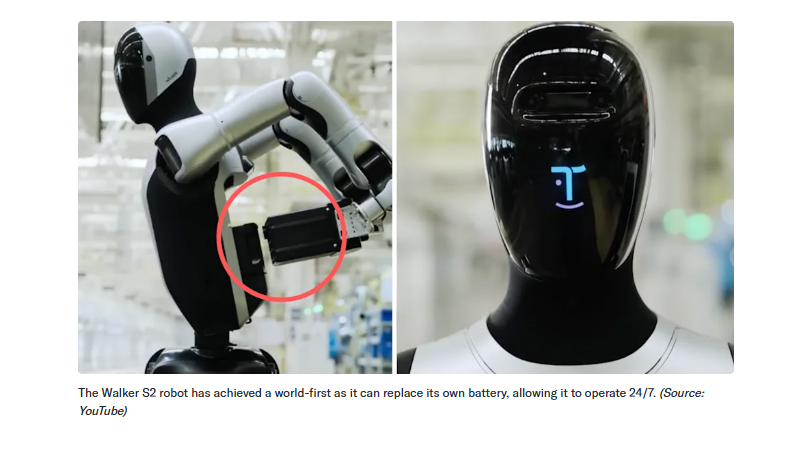
It quietly made history. No smoke. No fireworks. Just a robot that walked itself over to a battery bay, unplugged its own power pack, slid in a fresh one, and went straight back to work.
Three minutes. No downtime. No human.
What we saw in that moment wasn’t just a tech demo it was a glimpse into a different kind of future. One where systems don’t pause, humans aren’t essential for continuity, and entire industries begin reshaping around robotic endurance rather than human limitation.
It wasn’t a Silicon Valley launch. It happened in China.
And it’s a signal Australia and every other nation still defining the future of work cannot afford to ignore.
The Shift We Just Witnessed (Even If You Missed It)
UBTech’s new Walker S2 humanoid robot isn’t just functional it’s strategic. It moves autonomously, performs useful industrial tasks, and now, thanks to its self-swapping dual battery system, it never needs to stop.
That one leap, out of the charger and into the self-swap era, means robots are no longer tethered to human schedules, rosters, or fatigue protocols. That’s not a footnote. That’s a paradigm shift.
Until now, even the most advanced automation still relied on pause points: charging, resting, resetting, recalibrating. But this robot sidesteps that entirely. And what starts in one factory, or warehouse, or airport, doesn’t stay there for long.
“We can’t pretend we didn’t see this coming. We’ve been talking about it for years, but now, it’s here.”
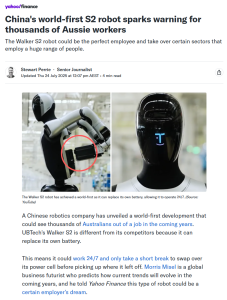
I said that earlier today in Yahoo Finance, where I was quoted on what this breakthrough means for jobs, business, and leadership.
The answer? Everything.
It’s Not Just Robotics, It’s Inhabitable Futures
In my work, we don’t predict the future. We prepare for it.
That means understanding which possibilities are inhabitable, likely, liveable, and strategically actionable and which are just noise. Walker S2 isn’t noise.
It’s a high-signal glimpse of the infrastructure-first future I’ve been mapping across 160+ industries.
Here’s what I see:
- Warehouse and logistics roles will face increased pressure to adopt automation, particularly those built on low-margin, high-repetition tasks
- Supervisory, exception-handling, and orchestration roles will surge in importance, not disappear
- Robots won’t replace humans but jobs will become tasks, and many of those tasks will shift to machine or AI ownership
- Battery-swap stations will become essential infrastructure not just for EVs but for robotics, drones, and modular autonomous fleets
The future is not about tech alone.
It’s about re-architecting the entire system of work and uptime around human–machine collaboration.
That’s where HUMAND™ comes in.
HUMAND™ in Action: What the Walker S2 Actually Means
My HUMAND™ model helps organisations break jobs down into tasks and responsibilities, then ask:
- Is this best done by a Human?
- A Machine?
- An AI?
- Or a strategic blend of all three?
With the Walker S2, the answer is clear:
- Repetitive, high-frequency tasks like patrolling, sorting, or basic picking? Machine.
- Battery maintenance and uptime logistics? Machine + AI.
- System oversight, ethical judgment, contextual decision-making? Human.
We’re not automating humans out of the picture. We’re redesigning the roles they play in a system that never sleeps.
Just like Nio’s EV battery swap stations and Gogoro’s moped network have created a seamless infrastructure model for mobility, UBTech’s Walker S2 is the beginning of a similar transformation for labour and logistics.
This isn’t about one robot. It’s about a new architecture of continuity.
The Numbers Tell the Real Story
Let’s ground this in hard foresight:
- 205,000 professional service robots were deployed globally in 2023, a 30% YoY increase (IFR)
- Asia–Pacific accounted for 162,000 of those units
- Market value in 2025: USD 63 billion
- Projected growth to:
- $212 billion by 2034 (OGAnalysis)
- Or $90 billion by 2032 (Verified Market Research)
- Forecasts anticipate:
- 2 million humanoid service robots within a decade
- 300 million by 2050
This is not fringe anymore. It’s mainstream industrial strategy.
If you’re a logistics firm, a manufacturer, a government body, or an industry association, this is your new operating environment.
For more insights and chat about the Walker 2 Robot, its potential uses and other applications for swappable batteries listen in to Hong Kong Radio 3’s Phil Whelan and I chatting all things Robots in our weekly on air segment (17 minutes 40 seconds):
What Australia (and Others) Must Do Next
If we view Walker S2 as the starting gun, not the finish line, then our response must include:
1. Workforce Redeployment
Train and transition humans into new orchestration, oversight, exception management, and hybrid collaborative roles.
2. Capital Investment in Hybrid Infrastructure
We don’t just need robots. We need swap stations, maintenance hubs, interoperable modules, shared power architecture.
3. National Frameworks for Autonomous Operations
Safety. Oversight. Liability. Ethics. We’re not ready to manage machines that never turn off, and we must be.
4. Hybrid Capability Architecture
Build for interoperability, not just robot units but modular toolkits, remote oversight layers, and adaptive human–machine workflows.
This is what I call building inhabitable futures, ones we can live in, work in, scale in.
This Is a Leadership Moment
The future is not about competing with robots.
It’s about leading with them.
If you lead a business, sector, or team, this is your inflection point:
- Will you wait until others define the rules?
- Or will you set them?
Autonomous infrastructure is coming. The only question is: who gets to shape it?
As I said in Yahoo Finance:
“We must pilot autonomous battery-swappable robots now, and retrain staff into oversight and new workflow orchestration before the shift overtakes us.”
The cost of inaction is irrelevance.
The cost of delay is losing control of your own operating model.
Want to Go Deeper?
If this sparked something, here are a few of my most relevant past pieces for deeper exploration:
Final Thought: Build the Symphony, Not Just the Solo
Battery-swap robots are not a cute trick. They’re the prototype of a much larger shift.
And if we bolt $27/hour roles to infrastructure built for $2 million autonomous systems without redesigning how they co-operate, we’re not building future-ready systems, we’re building friction.
My challenge to boards, leaders, and policymakers?
Don’t just ask what tech is coming. Ask: what does it let us redesign, better?
The world ahead is modular, hybrid, and continuous.
The future won’t stop for a recharge. Neither should we.
📩 Want a full briefing on what this means for your business, industry or board?
I run strategic foresight sessions, leadership keynotes, and confidential advisory to help you navigate what’s next.
Book a discovery call or get in touch at www.MorrisMisel.com.
About Morris Misel
Morris Misel is a globally recognised futurist and strategic foresight advisor.
Heard by millions each year on stage and in media, he helps decision-makers across 160+ industries decode what’s coming and what to do about it.
Creator of HUMAND™ and the Immediate Futures™ Operating Model.
Quoted often across national and global media.
More: www.MorrisMisel.com
Choose Forward.
Because the future isn’t something we predict. It’s something we prepare for, inhabit and lead towards.
#MorrisMisel #StrategicForesight #FutureOfWork #Robotics #Automation #HUMAND #LeadershipStrategy #BatterySwap #AIInfrastructure #InhabitableFutures #WarehouseAutomation #WorkforceEvolution #KeynoteSpeaker #Australia2030 #FuturistThinking #HybridWorkforce
Frequently Asked Questions
Q: What changes strategically when AI and robotic systems can operate 24/7 without degradation?
The constraint of human availability disappears from the tasks those systems perform. Customer service, data processing, logistics coordination, monitoring and compliance, in every domain where AI or robotic systems are reliably deployed, the constraint of human working hours, attention cycles, and recovery needs is removed. This changes the competitive economics of those domains: organisations that have deployed reliable 24/7 AI capability have a structural cost and responsiveness advantage over those that have not, and the advantage compounds as the systems improve.
Q: What are the second-order workforce implications?
The tasks that move to 24/7 AI operation are typically the ones that previously required shift work, extended coverage, and the premium costs associated with unsocial hours. The workers in those roles face displacement, but the displacement pattern is different from previous automation waves: it is not primarily physical labour but knowledge work tasks (monitoring, analysis, first-response customer interaction, routine decision-making) that are moving to continuous AI operation. The workforce transition implications are concentrated in the service sector, which employs a large proportion of the workforce in most developed economies.
Q: What human capabilities become more rather than less valuable in a 24/7 AI environment?
The judgment calls that the AI escalates when it reaches the edge of its reliable operating range, which, for current AI systems, happens regularly in complex, novel, or high-stakes situations. The relationship management that customers and employees value from humans rather than systems. The strategic direction-setting that determines what the AI systems are trying to achieve. And the oversight and governance that ensures the 24/7 systems are operating within intended parameters. These are the human roles that expand as AI takes on continuous operational tasks.
Q: Can Morris Misel speak on AI in operations, workforce transformation, and the 24/7 AI economy for our operations, HR, or leadership audience?
Yes. AI in operations and workforce transformation are core keynote topics. Book at morrismisel.com.