Ripple States: Why Waiting Is the New Risk
There’s something quietly dangerous happening in boardrooms right now.
It’s not the tariff standoff.
Not inflation.
Not even AI, though that’s moving faster than most realise.
It’s the decision to wait.
Across sectors, strategy is being postponed.
Investment shelved.
Conversations paused.
All under the guise of stability returning.
But what we’re in, isn’t stable.
It’s suspended.
We’ve entered what I call a Ripple State, a temporary surface stillness masking deep, directional change.
And the longer we pretend it’s neutral, and we can wait it out, the harder it will be to respond when the real wave hits.
The illusion of pause
The World Economic Forum’s Chief Economists Outlook (May 2025) is clear: this isn’t recovery.
It’s record-level uncertainty.
-
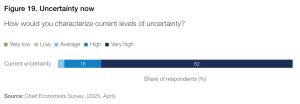
82% of economists rate today’s uncertainty as “very high”
-
87% say businesses will delay strategic decisions this year
-
84% expect firms to reconfigure supply chains or operations
-
Only 27% see strong global economic coordination ahead
What’s described isn’t a moment of clarity.
It’s a fog.
And in fog, delaying doesn’t bring safety.
It just reduces visibility.
Delay isn’t neutral. It’s directional.
Every non-decision still sends a signal to markets, teams, partners.
And in a world this interconnected, those ripples become structural fast.
That’s what makes this moment dangerous: not the disruption itself, but the default to drift.
When AI is being deployed unevenly, when global trade is fracturing, and when geopolitical cohesion is slipping, we’re not in a cycle.
We’re in a shift.
And shifts don’t wait politely for confidence to return.
The problem isn’t just economic. It’s human.
In my forthcoming report Who Decides 2025, I found something the WEF doesn’t say out loud: delay isn’t always strategic, it’s often emotional.
The discomfort of not knowing.
The impulse to outsource complexity.
The fear of being wrong in public.
This isn’t a moral failing. It’s a deeply human response to uncertainty.
But it becomes dangerous when we let that discomfort dictate direction.
The risk isn’t just in getting the future wrong. It’s in outsourcing our discomfort to false certainty.
If you’d like an advance copy of that report, feel free to email me.
Meanwhile, AI is not waiting.
There’s a quiet contradiction in the WEF report:
-
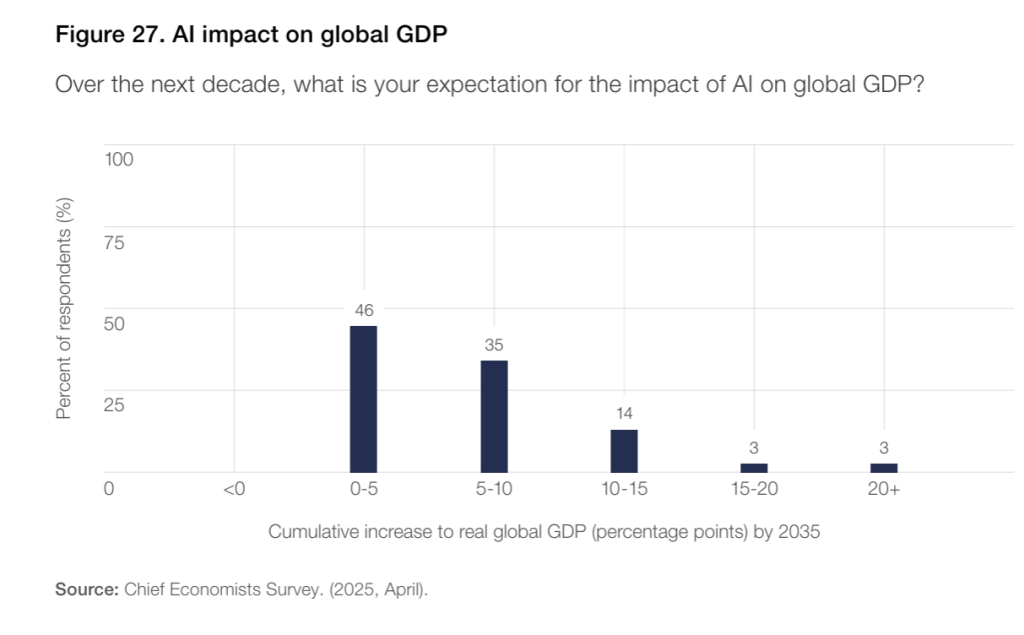
80%+ expect AI to lift GDP by up to 10% over the next decade
-
45% think it’ll be commercially disruptive this year
-
But nearly 50% expect net job losses
-
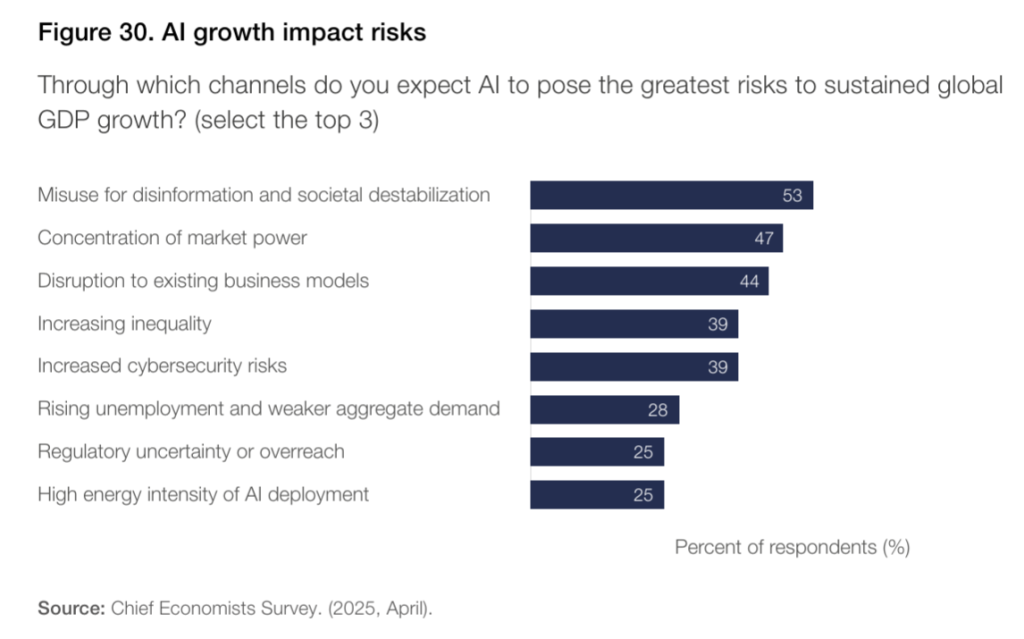
And most cite risks like disinformation, monopolisation, and ethics gaps
It’s a familiar pattern: we sense the upside, acknowledge the risk, but delay the internal action required to navigate either. We treat AI as a forecast, not a foresight moment.
In my work with executive teams, I use the HUMAND model, Human + Machine + AI, to break this inertia.
-
What still needs human wisdom?
-
What can be done faster, cleaner, cheaper by machines?
-
Where can AI assist, not replace?
Foresight is not about choosing one lane.
It’s about knowing when and why to shift between them.
And none of this is happening in a vacuum.
While boards delay, AI models scale.
While policymakers hesitate, defence budgets rise and global trust frays.
While people hold their breath for certainty, innovation, automation, and new customer expectations keep evolving.
The world won’t wait for alignment. And your future customers won’t either.
So what now?
If you lead anything teams, budgets, strategy this moment is not a time to wait and see.
It’s a time to ask:
-
What irreversible decisions can we make now?
-
What ripples are we already sending, intentionally or not?
-
Are we staying human-first in how we shape our AI strategy?
-
Have we confused “delay” with “discipline”?
In my Immediate Futures work, we help leaders map their organisation’s:
-
False delays: What are we postponing that won’t get clearer with time?
-
Hidden readiness: What capabilities are under-leveraged because we haven’t reassessed them post-AI?
-
Decision Trust Zones: Where are our people stuck, not due to lack of data, but lack of clarity or comfort?
These are not abstract.
They’re the reason some firms surge during disruption while others stall waiting for stability that never arrives.
Charting the ripple
Uncertainty at record highs:: 82% rate the climate as very high risk
Strategic paralysis : 87% expect delayed decisions
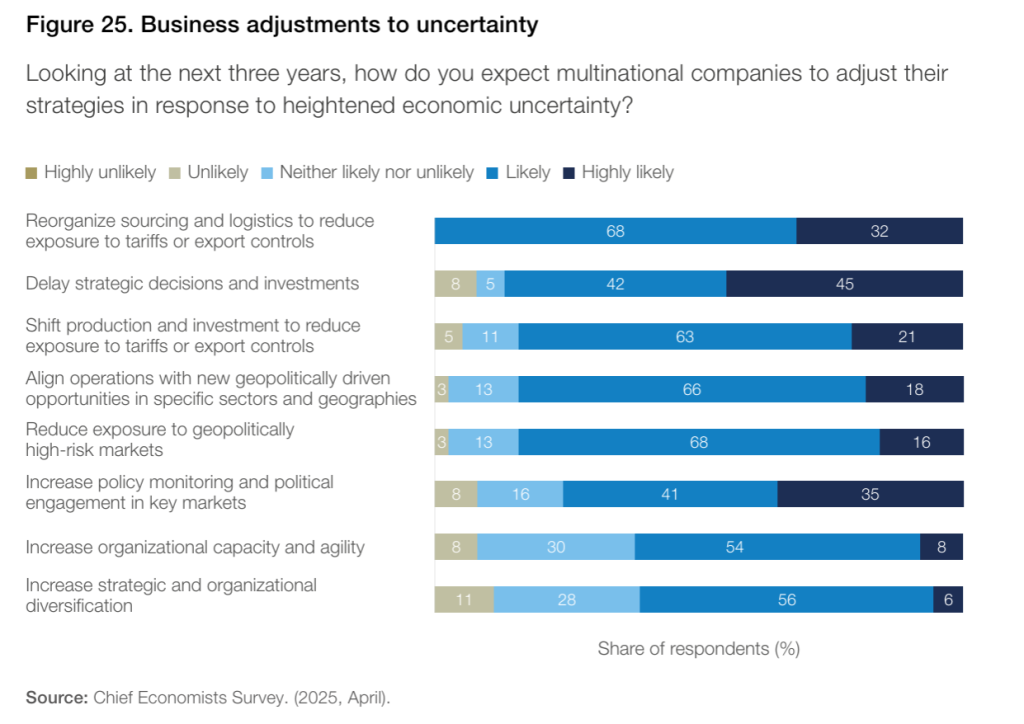
AI’s uneven upside: Growth gains + high risks, co-existing
This isn’t about overreaction.
It’s about clear reaction.
Responding at the right level, with the right tools, for the right horizon.
And that requires something far rarer than speed: strategic nerve.
Strategy isn’t about knowing more. It’s about noticing sooner and moving cleaner.
Work with me
If your organisation is navigating this in-between space and needs fresh strategic sightlines:
Let’s not just ride the ripple.
Let’s decide where it leads.
#MorrisMisel #StrategicForesight #WhoDecides2025 #RippleEffects #LeadershipInUncertainty #ImmediateFutures #AIandBusiness #FutureSignals #ExecutiveStrategy #FutureOfWork #GlobalBusiness #DecisionMaking #KeynoteSpeaker #HUMAND
Frequently Asked Questions
Q: What are Ripple States in the context of strategic foresight?
Ripple States are the intermediate conditions that form between an initial change signal and its full strategic impact, the states of partial transition that are often more disruptive than either the initial signal or the final settled state. Organisations often wait for the Ripple State to resolve before responding, assuming that strategic clarity will emerge as the change progresses. The foresight argument is the opposite: the Ripple State is precisely when early action is most valuable, because the options available narrow and the cost of response increases as the transition approaches completion.
Q: Why is waiting for certainty a higher-risk strategy than acting on signals?
Because the certainty that organisations are waiting for, clear evidence that the change is real and significant, typically arrives after the strategic window for effective response has narrowed substantially. The organisations that responded to digital distribution signals in the early 2000s, to mobile-first signals in the early 2010s, and to AI capability signals in the early 2020s had more options, lower transition costs, and more time to develop capability than those that waited for certainty. In each case, the organisations that waited did so rationally, the signal was genuinely uncertain, and paid a structural price for the rational choice.
Q: How do you decide which signals warrant early action rather than monitoring?
By mapping the asymmetry of outcomes: what is the cost of acting early on a signal that turns out to be weaker than anticipated, versus the cost of waiting on a signal that turns out to be stronger than anticipated? For signals with high potential impact and long capability-building lead times, early action is almost always the better risk position even under significant uncertainty. For signals with low potential impact or short response windows, monitoring is appropriate. The Ripple Effects framework provides the structure for making this asymmetry visible and actionable.
Q: Can Morris Misel speak on the Ripple Effects framework, early signal response, and strategic timing for our leadership team or board?
Yes. Ripple Effects and strategic timing are core keynote and workshop topics. Book at morrismisel.com.