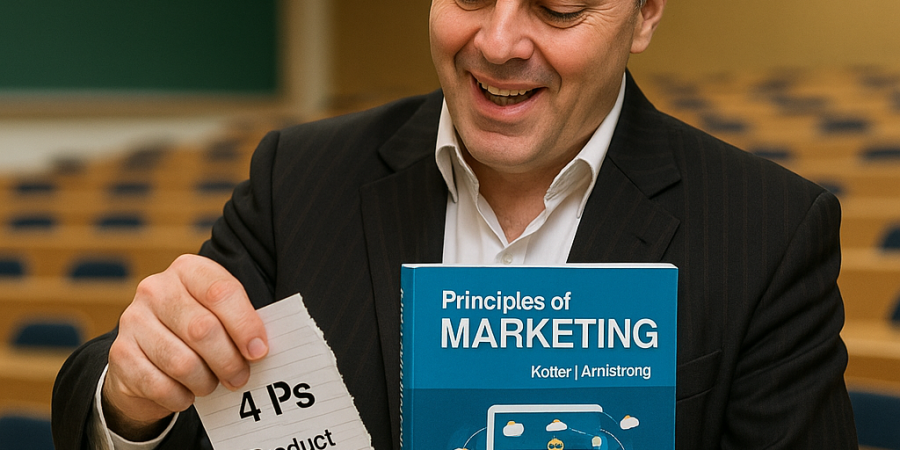
I Taught the Marketing Bible. Then I Started Tearing Out Pages and Writing in the Margins.
What Kotler didn’t teach us about power, people, and the future of business.
I still remember the lecture theatre.
Fluorescent lights buzzing.
Overhead projector humming.
Whiteboard packed with the sacred 4Ps—Product, Price, Place, Promotion.
Behind me, a stack of Kotler textbooks so high they could pass for a pulpit.
In those days, the phrase “the consumer is king” wasn’t just a slogan—it was scripture.
If you taught marketing at a university in the late 20th century, you taught Kotler.
It was the bible.
Memorise it, regurgitate it, pass.
And yet, even then—I didn’t buy it.
And in the background, while I was teaching these theories by day, I was quietly challenging them in my own foresight practice by night.
For over a decade, I stood on the shoulders of these theorists—teaching, testing, dissecting, and debating their work week after week, semester after semester.
This period is not just part of my academic history—it’s the formal bedrock of my 30+ years of foresight work.
Because to argue for the future, you must first know the ground the present stands on.
The Crown Never Fit Right
The idea that the customer ruled the market, that businesses should bend to their every whim, was a comforting lie.
A neat illusion that made everyone feel like they were in control.
Marketers told themselves they knew what the customer wanted.
Customers believed they knew what they wanted too.
But truthfully?
Most of the time, neither side had a clue.
The power dynamic was never equal.
It was always theatre.
And most decisions weren’t made rationally—they were made emotionally, habitually, or under pressure.
So while my students learned Kotler’s classic 7-step New Product Development model, stretching three years from idea to shelf, I was quietly asking them to look at things sideways.
To see the world through the customer’s eyes, not just their wallets.
That made me… unpopular in some corridors.
The Dean’s Office, 1992
I was called in.
Stern faces.
Arms folded.
I’d been using dial-up digital bulletin boards—yes, in 1992—to share lecture notes, assessments, and resources with students. Not in print. Not in folders. But online.
“You’re disseminating university IP beyond its four walls,” they said.
Even though I’d written the material myself, I was asked to pull it down immediately.
So I did.
Then I put it back up somewhere else and told the students, “It’s there if you want it. Just don’t tell anyone how you found it.”
That moment said everything.
Academia wanted marketing to stay inside the lines.
I wanted to redraw them.
Kotler et al Wasn’t Wrong—But the World Moved
There’s no denying Kotler et al gave us structure.
He helped shape an entire discipline.
But his models—like the rational decision-making funnel, or the clean arc from problem recognition to post-purchase behaviour—just don’t hold up in a hyper-connected, impulse-driven, AI-fuelled market.
People don’t move through predictable steps anymore. They scroll. Swipe. Sample. Abandon. Regret. Re-engage.
They’re shaped by algorithms, nudged by influencers, and triggered by context.
The 4Ps? Still useful.
But not sacrosanct.
The consumer?
Still vital.
But not king—or queen—for that matter.
Who Rules the Market Now?
Maybe that’s the wrong question.
It’s not about who sits on the throne—king, queen, or otherwise.
It’s about what shapes the system—the forces, the signals, the flows of trust, timing, relevance, and reach.
And right now, it’s this:
- Context over control
- Convenience over loyalty
- Curiosity over brand fidelity
- Community over hierarchy
- Collaboration over persuasion
The market no longer bends to the will of a sovereign consumer.
It adapts to dynamic relationships, networks, and invisible nudges.
The customer is part of a co-creative loop, not a passive recipient of top-down strategy.
If I Were Teaching Marketing Today…
Here’s what I’d do differently:
- I wouldn’t start with the 4Ps. I’d start with first principles: “What world is this person living in?”
- I’d teach students to map ecosystems, not segments.
- I’d swap linear models for living systems.
- I’d ask: “What happens if your customer doesn’t trust anyone anymore? Not you. Not themselves.”
- I’d introduce PTFA—Past Trauma, Future Anxiety—as a core lens for understanding behaviour.
- I’d challenge them to stop predicting and start preparing.
Because the real skill now isn’t persuasion.
It’s perception.
The Future of Marketing Isn’t in the Models
It’s in the questions we ask, the assumptions we challenge, and the systems we design to adapt—not control.
Marketing, at its best, was never about crowns. It was about connection.
So let’s stop building campaigns for kings or queens and start designing for people in motion—flawed, curious, distracted, evolving.
If this resonated with you, I’d love to hear your own classroom (or boardroom) realisations.
Share it.
Comment.
Let’s rewrite the syllabus together.
And if you’re still teaching Kotler by the book?
No judgement.
Just know the margins are where the magic is.
—Misel
Curious about how this kind of thinking applies to your business, boardroom or briefing?
I work with executives, educators, strategists and teams to unearth unseen signals, pressure-test future possibilities, and design better pathways forward.
Book me for a keynote, workshop or foresight session
Download the latest foresight reports and frameworks
Or just start a conversation—sometimes that’s where the real shift begins
Reach out via morrisfuturist.com or connect with me on LinkedIn @Morris Misel.
Morris Misel is a globally recognised business futurist, strategic adviser, and foresight practitioner with over 30 years of experience helping organisations see what’s next—and make sense of what it means. A former university lecturer in marketing and consumer behaviour, he now advises some of the world’s largest brands, governments, and associations on how to prepare for disruption, opportunity, and everything in between.
Misel is heard by millions each year through media appearances and keynote stages, and he’s the creator of the HUMAND™ model—a framework for navigating the evolving relationship between humans, machines, and AI. His work blends strategic insight, real-world storytelling, and a relentless curiosity about what happens after now.
#brandstrategy #marketingeducation #leadershipthinking #innovationstrategy #customerexperience #marketingleadership #rewritingtherules #storytellinginbusiness #criticalthinking #contextisqueen #ecosystemthinking #newproductdevelopment #unlearnandrelearn #futureofbusiness #changemakers #consciousstrategy #digitalevolution #marketersoflinkedin #visionaryleadership #decoloniseyourtextbook


