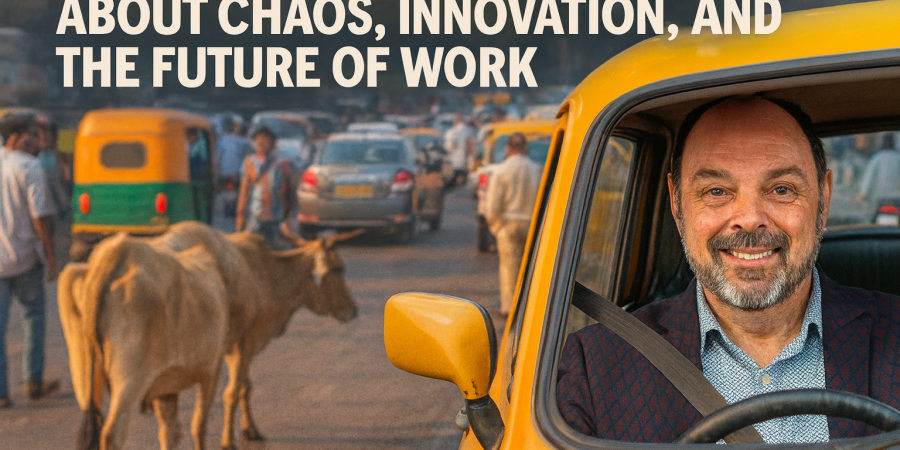
{Podcast} What Indian Traffic Taught Me About Chaos, Innovation, and the Future of Work
In this edition:
-
Innovation doesn’t always come from labs, it comes from the street.
-
Chaos isn’t the opposite of order, it’s a different kind.
-
Why India’s everyday ingenuity is a masterclass in HUMAND™ and inhabitable futures.
-
And what Western leaders need to learn from it, fast.

I didn’t go to India to study the future.
But the future doesn’t care about your itinerary.
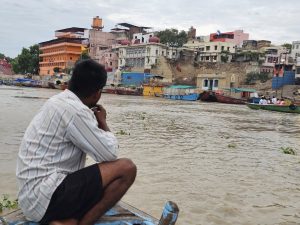
After three weeks, six cities and dozens of conversations, from Delhi to Jaipur, Varanasi to Mumbai, I came back with more than just memories. I came back with reminders. Nudges. Human signals.
Not the kind you map.
The kind you feel.
Because India doesn’t pretend to be one thing. It doesn’t filter or streamline. It coexists, loudly, colourfully, chaotically. And if you’re paying attention, it teaches you what it means to live with contradiction and still move forward.
Innovation in the Middle of the Road
Let’s start with the traffic.
Everyone says the same thing about driving in India: “You need three things, good brakes, good horn, and good luck.”
But that sells it short.
What I saw wasn’t luck. It was improvisational mastery. A beautifully choreographed mess. A social contract of flow.
-
Lanes? Suggestions.
-
Horns? Not angry, informative: “I’m coming through.”
-
Right of way? Negotiated in real time with eye contact and instinct.
It reminded me of something a founder of the $1 billion Waze app once told me when I aske him how we could ensure the future of Innovation, his answer:
“Don’t rush kids into conformity. Let them make a mess. Let them figure out who they are before the system flattens them. That’s how we innovate.”
India’s roads felt like that.
A living metaphor for innovation under pressure.
It’s not clean. But it works.
Coexisting Futures, Side by Side
Everywhere I looked, the future was already happening,multiple versions at once:
-
A 100-year-old spice merchant beside a cashless e-commerce warehouse.
-
A teen with no running water livestreaming dance tutorials.
-
Towering luxury apartments casting shadows on the slums below.
None of it cancelled the other out.
None of it had to.
In foresight, we call this an Inhabitable Future™.
Not just plausible or probable, but actually lived.
India doesn’t simulate these futures. It absorbs them.
It holds them, mess and all.

Small Doesn’t Mean Small-Minded
One of my quietest joys? Watching century-old businesses do one thing, beautifully.
-
A man pressing shirts in a laneway no car could reach.
-
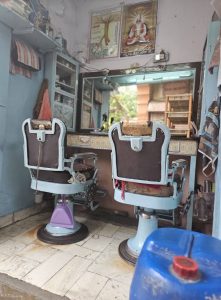
A barber with two chairs and 100 years of generational pride.
-
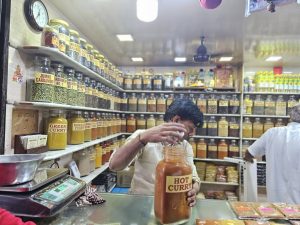
A curry vendor who could blend by scent alone.
No scaling. No VC. No disruption.
Just respect, consistency, and depth.
In a Western context obsessed with growth, these businesses might seem quaint.
But they’re anything but.
They offer something we often overlook in the future of work:
Meaning. Mastery. Legacy.
The Human, The Machine, The Everyday AI
Years ago, I saw a young hotel employee in Kolkata beam with pride after getting the GM’s Porsche serviced. Not only had he washed it, but he’d added a handmade wooden hook inside to save his boss the upgrade fee.
Not German engineering. But beautiful intent.
This is innovation, too.
India’s version of AI isn’t built in a lab.
It’s adaptive ingenuity.
It’s HUMAND™ in action where Humans, Machines, and AI aren’t at war, they’re co-creating.
-
A chai vendor with a rigged solar generator.
-
A street hawker using QR codes.
-
A barber who’s become a TikTok sensation.
It’s not about perfection.
It’s about what’s possible with what you have.
So What Does This Mean for Leaders?
If you’re a policymaker, executive, educator or strategist still seeking linear paths, you’re looking the wrong way.
The future looks like Indian traffic:
-
Dynamic
-
Decentralised
-
Relational
-
Messy, but responsive
-
Full of collisions, yes but also collaboration
This is the world we need to design for.
One where friction doesn’t mean failure.
Where chaos isn’t disorder it’s a different kind of order.
India’s Unlikely Superpower?
It allows contradiction.
It doesn’t demand uniformity.
It doesn’t tidy the mess.
It lets coexistence breathe.
And in a world polarised by politics, algorithms, and rigid ideologies, that might be the single greatest foresight insight of all.
Choose Forward.
Ready to rethink what chaos, culture, and coexistence really mean for your strategy?
If your team is still chasing neat five-year plans in a messy, multi-speed world, this is your wake-up call. Let’s explore how HUMAND™, PTFA™, and coexisting futures can reshape the way you lead, design, and decide.
Book me for your next keynote, strategy session, or leadership offsite.
For more about India’s allure and innovation listen to this week’s Hong Kong Radio 3 segment as Phil Whelan and I chat about my recent trip, learnings and lessons (12 minutes 20 seconds).
🔗 Linked Resources
Morris Misel is a business futurist, human-centric strategist, and trusted advisor to leaders navigating what’s next.
Heard by millions each year on stage and across the media,
Morris is known for decoding weak signals into strong choices, and for guiding organisations through the messiness of real-world futures with clarity, courage, and curiosity.
Learn more at wwwMorrisMisel.com
#Foresight #HUMAND #PTFA #FutureOfWork #LeadershipFutures #CoexistingFutures #StrategicForesight #HumanCentricDesign #IndiaInsights #BusinessStrategy #ComplexityIsTheNewNormal #InnovationUnderPressure #ChooseForward #MorrisMisel
Frequently Asked Questions
Q: What did navigating Indian traffic teach you about adaptive intelligence?
That effective navigation in a genuinely high-complexity, low-rule environment requires a different cognitive mode than navigation in a structured, rule-governed one. Indian traffic, at least in major cities, is not chaotic in the sense of being random; it is complex in the sense of having many agents making independent decisions simultaneously, with negotiation happening in real time at every intersection and merge point. Navigating it well requires peripheral awareness, anticipatory reading of others’ intentions, and continuous micro-negotiation, capabilities that are genuinely different from the rule-following that structured environments reward.
Q: What does this signal about how different environments develop different adaptive capabilities?
That the cognitive toolkit you develop is shaped by the environment you operate in. People who have grown up navigating genuinely complex, rule-light environments, where outcomes depend on reading situations and negotiating in real time rather than following protocols, develop adaptive capabilities that are increasingly valuable in an environment of rapid change and uncertainty. The foresight implication is that organisations and societies that have learned to function effectively amid complexity have developed capabilities that structured, rule-heavy environments have not needed to build.
Q: How does this frame apply to innovation and organisational resilience?
Organisations that have operated in genuinely constrained, uncertain, or complex environments (emerging markets, resource-limited settings, highly competitive sectors) often develop the adaptive problem-solving capabilities that structured, resource-rich organisations lack. The innovation that emerges from constraint is qualitatively different from innovation that emerges from investment. The most adaptive organisations, in my observation, are those that have deliberately built some of the uncomfortable, real-time negotiation capability that complex environments produce, rather than over-engineering their processes to remove all ambiguity.
Q: Can Morris Misel speak on adaptive intelligence, innovation under constraint, and cross-cultural foresight for our leadership, innovation, or global business audience?
Yes. Adaptive intelligence and innovation under constraint are regular keynote topics. Book at morrismisel.com.