What Does a Foresight Strategist Actually Do?
A Conversation on AI, Nostalgia, and Decision-Making
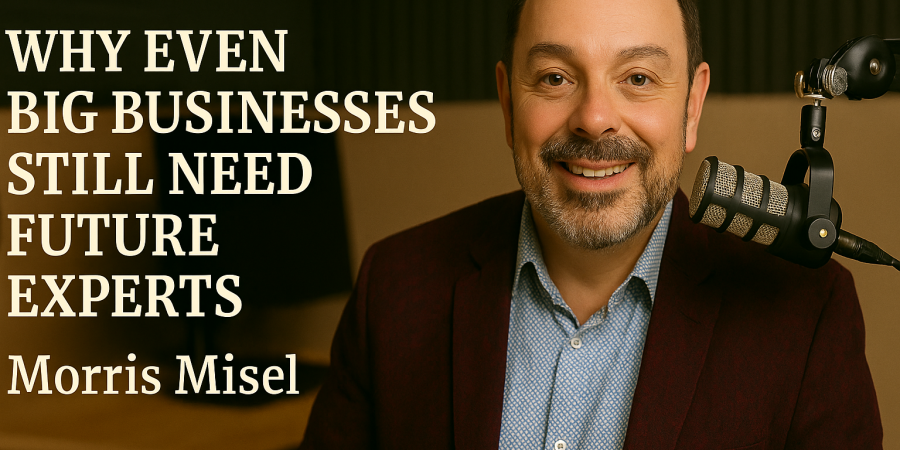
I’ve spent three decades helping businesses anticipate what’s next and two decades on air weekly with Phil Whelan.
But last week on Hong Kong Radio 3 Phil, asked me a deceptively simple question:
“What do you actually do?”
And to be honest, I loved it.
Because right now, when the world feels uncertain, the work of a foresight strategist has never been more necessary, or more misunderstood.
You can listen to the full segment here (17 minutes):
Or read on for some of the most important ripples we explored from AI anxiety and decision fatigue, to the surprising power of nostalgia in shaping our future.
Wait, Big Business Doesn’t Already Know This Stuff?
You’d think the biggest organisations on earth would have futures locked down.
But the truth is, many of them are more overwhelmed than ever.
Not because they’re not smart.
But because they’re swamped.
By noise.
By hype.
By pressure to move fast without clarity.
And so they come to people like me.
Not for predictions, but for preparation.
As I shared on air, my job isn’t to play Mystic Meg.
It’s to guide leaders through what’s likely, impactful, and worth acting on.
And just as importantly what’s not.
Because the greatest risk right now isn’t falling behind the curve. It’s chasing the wrong curve entirely.
AI Won’t Replace All Jobs But It Will Change Every Job
The number one question I get from boards, ministers and CEOs?
“What will AI do and what’s left for humans?”
Let me be clear: wholesale job loss from AI is overblown.
Will it take over some tasks? Yes.
Will it make some roles obsolete? Undoubtedly.
But that’s always been true.
We don’t have stenographers anymore either.
What’s really happening is task evolution not job elimination.
-
A graphic designer won’t be replaced, but how they create will shift
-
A marketer won’t vanish, but the strategy-to-execution balance will
-
An analyst will use AI for acceleration, not redundancy
The conversation needs to evolve from fear of loss to design for difference.
35,000 Decisions a Day But Who’s Really Making Them?
Here’s a stat I dropped during the segment that made Phil pause:
We make roughly 35,000 decisions a day.
Most are automatic (step with your left foot, breathe now).
Some are minor (what to eat, what to wear).
And some are major (where to invest, who to trust, what to change).
But more and more of those decisions are now outsourced often without us noticing.
-
Spotify chooses what we hear next
-
Google Maps tells us where to go
-
Recommender systems shape what we watch, read, even believe
We’re not just in a world of AI assistance.
We’re entering a world of AI influence and that’s far more subtle, and far more powerful.
The question is no longer “Will AI make decisions for us?”
It’s “How many decisions are we willing to hand over, and why?”
The Nostalgia Trap and What It Tells Us About the Future
One of the most fascinating parts of our conversation was about the comeback of cassettes, vinyl, even Polaroids.
Not as gimmicks, but as emotional artefacts.
Brian Eno once said that what we now find groovy 8-bit sound, visual glitches was once considered a flaw. Nostalgia transforms inconvenience into meaning.
It’s a powerful reminder: Not all disruption is digital. Some of it is emotional.
In a world rushing forward, people cling to the tactile, the imperfect, the familiar.
Not because they reject the future. But because they want it to still feel human.
That’s where brands, services, and leaders often get it wrong.
They optimise everything but forget to evoke anything.
Why Even the Giants Are Nervous
Many of the organisations I work with are category leaders.
But success breeds comfort. And comfort can be a dangerous place to sit when the world is shifting.
As Phil put it so perfectly:
“Some of them have just discovered their corporate trousers are around their ankles.”
Exactly. And while that made us both laugh, the reality is sobering.
AI is exposing cracks in business models that haven’t changed since the 1990s.
New competitors aren’t just cheaper they’re often better tuned to new expectations.
And the leadership question that sits behind it all?
“What’s the smart, human thing to do next not just the efficient thing?”
The Immediate Future Is Not Coming. It’s Here.
Right now, we are in what I call another Wild West moment.
Not because it’s chaotic, but because it’s open wide open and still largely unwritten.
We’ve been here before:
-
When the mobile phone arrived
-
When the PC changed offices forever
-
When the internet rewired everything
AI is just the next big wave.
It’s not the end of humanity. But it will change what it means to be human in a working world.
And the businesses, leaders, educators and creatives who lean into that shift with wisdom, imagination, and courage they’ll be the ones writing the next chapter.
Want to hear the full segment?
Tune in to my conversation with Phil Whelan on RTHK3
We chat about:
-
What foresight strategists really do
-
Why job panic is misplaced
-
How AI is changing decision-making
-
And why nostalgia is a force you can’t ignore in future strategy
Want help making sense of what’s next?
I work with boards, leadership teams, and event organisers around the world to translate uncertainty into clarity and prepare for the futures worth inhabiting.
Contact me
Book me for your next keynote or foresight session
Or just explore more ripple-driven insights at morrisfuturist.com
foresight strategist, future of work, ripple effect, decision-making, AI strategy, human futures, nostalgia in business, AI and jobs, leadership foresight, corporate disruption, Morris Misel
Frequently Asked Questions
Q: What is foresight strategy and how is it different from forecasting?
Forecasting attempts to predict specific future states, what will happen, when, and with what probability. Foresight strategy is different in both method and purpose: it explores the range of plausible futures, identifies the signals already present that indicate which futures are becoming more or less likely, and supports organisations in building strategies that are robust across multiple scenarios rather than optimised for a single predicted outcome. The distinction matters because the future is genuinely uncertain in ways that make prediction unreliable, but that uncertainty does not make strategic preparation impossible. It makes foresight more valuable, not less.
Q: What does a foresight strategist actually do in practice with a client?
The work has several components. Signal scanning: identifying the early indicators of change that are already present but not yet fully visible or understood. Scenario development: constructing plausible alternative futures that challenge current assumptions and expand the strategic option space. Implication mapping: translating signals and scenarios into specific strategic questions for the client, what does this mean for your industry, your organisation, your role? And decision support: equipping leaders to make sharper choices under genuine uncertainty rather than pretending certainty exists.
Q: How do you know if a foresight process has been valuable?
Not by whether the predicted futures occurred, foresight is not prediction. By whether the organisation is better prepared for the futures that do arrive. The markers of effective foresight work are: leaders who are less surprised by significant changes and more able to respond quickly; strategies that are resilient across different scenarios rather than brittle to any specific change; and organisations that have developed a genuine capacity for ongoing environmental scanning rather than relying on periodic external input.
Q: How do organisations engage Morris Misel for foresight work?
Through keynotes that brief leadership on the signals most relevant to their sector, workshops that build internal foresight capability, and advisory relationships that provide ongoing strategic intelligence. Book at morrismisel.com.


