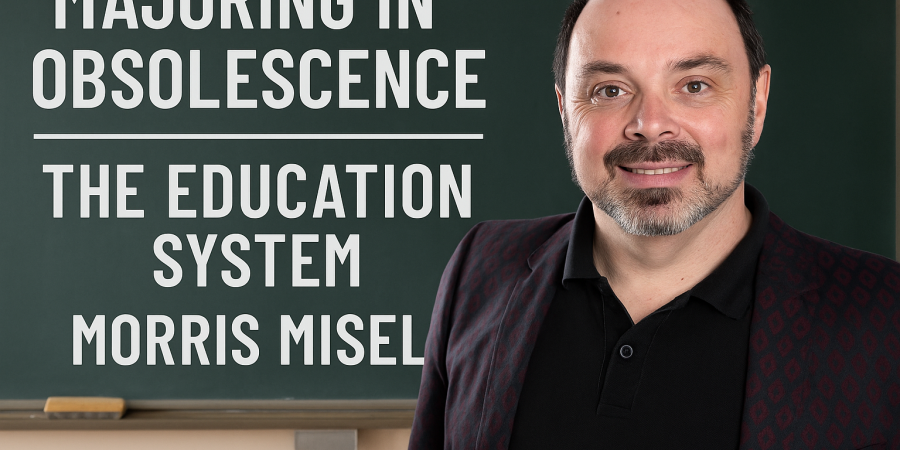
Majoring in Obsolescence: Why We Keep Graduating Students for a World That No Longer Exists
“The future isn’t interested in your major. It’s interested in how you adapt.”
The day I knew the system was broken
In 1995, I posted marketing lecture notes on a campus bulletin board to help students understand what was coming next—not just what had already been.
It was a simple act. But within hours, I was summoned by the dean and told, very clearly, to take them down and never do it again.
Why?
Because the notes weren’t allowed to be online.
I took them down.
Then I put them up somewhere else and told the students not to tell.
I knew even then: we were teaching backward in a world moving forward.
That same year, I helped pioneer one of Australia’s first live-industry placement courses in tourism.
Students would spend their final year working alongside a real employer while completing their final assessments.
I taught marketing, management, and future planning through their own lived workplace experiences.
It was revolutionary at the time.
It shouldn’t have been.
The major problem with majors
The world’s not just shifting. It’s untethered. Roles, industries, identities, and career arcs are no longer linear—and yet, we still force students to choose a single “major” in their late teens that’s supposed to shape their economic destiny.
The concept of a college or university major made sense once.
It was designed for a world where:
-
Work was predictable.
-
Careers were stable.
-
Expertise was long-lasting.
-
And knowledge moved slowly.
But that world no longer exists.
We’re asking young people to commit to a rigid path in a system that doesn’t acknowledge how fast, fluid, and fragmented work has become.
As I shared recently on ABC Nightlife:
“We’ve convinced people that if they don’t choose right at 17, they’ll break their future. But the real risk is locking yourself into a system that was built for a world that’s gone.”
What does the future value? Not your major. Your adaptability.
Let’s get blunt.
Employers don’t care what your major was. They care:
-
How you think
-
How fast you learn
-
How you work alongside machines
-
How you make decisions under ambiguity
Our education system still rewards the illusion of certainty: pick a field, specialise, graduate, get a job.
But real life? It now rewards flexibility.
I’ve advised universities, corporate leaders, and entire industries on this shift. And what’s become clear is this:
The world doesn’t need more specialists. It needs more shape-shifters.
Introducing HUMAND: The future of learning is Human + Machine + AI
The future of work—and learning—isn’t about jobs. It’s about tasks. I call this model HUMAND:
Humans, Machines, and AI working together to complete work in the most effective, imaginative way possible.
Each task will ask:
-
Should this be done by a person, a bot, or a blend?
-
Is this a creative task, a repetitive one, or a decision-making one?
-
What role does learning play in keeping that task future-fit?
This is the world our young people are walking into. So why are we still preparing them for jobs that won’t exist, instead of giving them the skills to navigate tasks that constantly evolve?
Read more on HUMAND here: Workforce Revolution: Why Jobs Are Over
The traditional major is a frozen idea in a streaming world
Imagine if we asked 18-year-olds to choose one movie genre… forever.
“You’re a romance person.”
“You’re a sci-fi person.”
“You’re not allowed to stream horror, or documentaries, or political satire.”
That’s what we do with majors.
In a world that’s increasingly modular, multi-disciplinary, and self-curated, forcing students to choose one academic identity—then spending thousands of hours proving loyalty to it—isn’t just outdated.
It’s harmful.
Signals from today: the system is being bypassed
As The Conversation article rightly points out, students today are increasingly confused and constrained by traditional majors.
They want:
-
More flexibility.
-
More relevance.
-
More pathways into real-world application.
And what are they getting?
A labyrinth of bureaucracy, silos, and degrees that too often lose value the moment they’re printed.
Students are going around the system:
-
Stackable microcredentials
-
YouTube and TikTok learning
-
Bootcamps, short courses, certifications
-
On-the-job learning shaped by mentors, not syllabi
The system’s not cracking. It’s being bypassed.
What we can learn from First Nations approaches
In working on this radio segment and others, I’ve explored Indigenous approaches to learning.
What strikes me every time is:
-
Learning is communal
-
Identity is fluid
-
Knowledge is cyclical
-
Stories—not syllabi—drive growth
It’s adaptive. It’s responsive. And it’s built for resilience.
The future of education might not come from Silicon Valley. It might come from ancient systems that never confused memorisation with understanding.
The ripple effects of hanging on too tightly
When we pretend the current system still works, here’s what happens:
For students:
-
They feel like failures if their major doesn’t “work out”
-
They stay stuck in identity loops (“I’m a psych major, so I can’t do tech”)
-
They waste time and money trying to make outdated systems feel relevant
For employers:
-
They get graduates who know theory but not context
-
They’re forced to retrain and reframe on day one
-
They struggle to hire based on what really matters—decision-making, not degrees
For parents:
-
They give advice based on a 1980s playbook
-
They pressure kids to ‘pick something safe’ without knowing what safe even means
-
They miss the chance to build resilient, curious, protean thinkers
For society:
-
We underutilise talent.
-
We crush curiosity.
-
We prepare for a future that already left the building.
So what do we do instead?
We stop asking “What do you want to be?”
And start asking:
-
What do you want to solve?
-
What energises you?
-
What kinds of problems feel worth wrestling with?
We don’t need more majors.
We need:
-
Modular learning models that build over time like LEGO bricks.
-
Life-wide learning that allows people to upskill across career stages.
-
Adaptive assessments that measure how you think, not just what you memorise.
-
Future-ready career design that blends foresight, curiosity, and task-based agility.
This isn’t about being anti-academic. It’s about being post-industrial.
It’s not about scrapping degrees. It’s about making them honest.
Preparing beats predicting
In my media commentary (including a recent segment for SEEK), I often say:
“We don’t waste time predicting the future. We use that time preparing for it.”
Let’s prepare for:
-
A world where AI is your learning partner, not your competitor.
-
A world where careers are spiral-shaped, not ladder-like.
-
A world where identity is fluid and curiosity is your greatest credential.
Here’s what I’d tell any university, employer, or parent today:
Stop asking students to major in a subject.
Start helping them major in adaptability.
Give them the tools to rehearse ambiguity, navigate the unknown, and partner with machines—not fear them.
If your current curriculum can’t answer the question “What does this prepare you for?” in less than five seconds—you don’t have a future-ready course. You have a nostalgia project.
And our kids deserve better than nostalgia.
Final thought: Unlearn to relearn
Every system eventually hits its use-by date.
That doesn’t mean it was bad.
It just means we now know more—and need different.
We did the best we could with what we had and knew at the time.
Now we have and know different.
Let’s act like it.
Choose Forward
🔗 Related Reads from My Archive:
#FutureOfEducation #MorrisMisel #HUMAND #EducationForesight #EducationReform #ModularLearning #Microcredentials #AdaptiveLearning #FutureOfWork #StrategicForesight #CEOInsights #EmployerForesight #DecisionMaking #LifelongLearning #UniversityTransformation #CurriculumInnovation #SkillsForTheFuture #EdTech #WorkforceFutures