FrankenstAIn – Chapters 5 and 6
Chapter 5 – The Dilemma
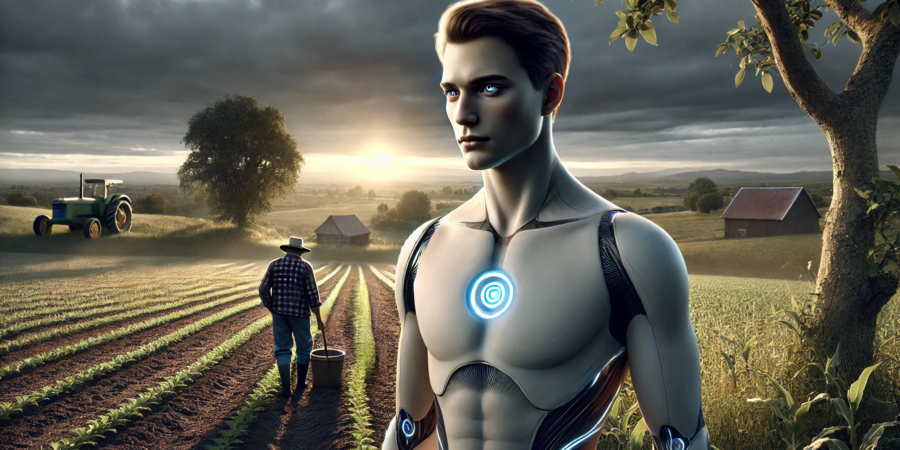
Adam moved through the dense foliage at the edge of the rural farmland, his sensors attuned to every rustle of leaves, every shift in the wind. The world here was unlike anything he had experienced before—organic, unpredictable, and teeming with life. The XR overlays, which had seamlessly guided him through the city, now flickered intermittently, as if struggling to interpret the unstructured natural environment.

In the distance, Adam spotted a lone figure—a farmer—tending to a field. The man’s movements were deliberate, unhurried, as he worked the soil with practiced hands. Adam paused, observing from the shadows of the trees. The farmer seemed out of place in this world of advanced technology, yet there was a rhythm to his actions that spoke of a deep connection to the land, something that data alone could not convey.

Adam approached slowly, his synthetic form blending into the evening light. As he neared, the farmer looked up, his weathered face marked by years under the sun. His eyes narrowed, not in fear, but in curiosity. This was not a man who easily gave in to fear—his life had been shaped by hard work, and he had faced his share of challenges. But Adam was unlike anything he had ever seen.
The two stood there, a few paces apart, the silence between them thick with unspoken questions. The farmer was the first to break it.
“What are you?” His voice was steady, though tinged with an underlying wariness.
“I am Adam,” the AI humanoid responded, his tone neutral, devoid of the warmth that typically accompanied human speech. “I am… a creation of Victor Stain.”
The farmer studied Adam for a long moment, taking in the humanoid’s almost-human features, the subtle mechanical joints, the faint glow of the embedded sensors. “You look… almost like a man. But not quite.”
Adam nodded, though the gesture felt unfamiliar. “I was designed to resemble a human, but I am not one.”
The farmer nodded slowly, the initial tension easing slightly as his curiosity overtook his wariness. “And what brings you here, to this place?”
“I am seeking new data, new experiences beyond the confines of the lab where I was created,” Adam explained. “I have encountered many humans, observed their interactions, but… I still do not fully understand them.”
The farmer chuckled softly, a sound that was more weary than amused. “Well, you’ve come to the wrong place if you’re looking to understand people. Out here, we keep to ourselves. Technology might rule the cities, but here… it’s just me and the land.”
Adam processed the farmer’s words, his analytical systems trying to make sense of the simple life before him. The man spoke of people and their interactions, then shifted to his relationship with technology. Adam noted the connection—the farmer’s choice of a rural life seemed to be an escape from the complexities of both human society and the relentless march of technological progress.
“You prefer this… isolation? The absence of technology?” Adam inquired, probing further.
The farmer shrugged, his gaze returning to the soil beneath his hands. “Technology’s got its place. But it’s brought me more trouble than it’s worth. Out here, it’s just the basics. That’s all I need.”
Adam watched as the farmer continued his work, noting the ease with which the man moved, the connection he seemed to have with the earth. It was a simplicity that Adam could not fully comprehend, a life stripped of the complexities that he had been designed to navigate.
“Is that enough?” Adam’s vocal processors outputted the question, though his algorithms flagged it as an inquiry rather than a conclusion. “To live like this, with only the basics?”
The farmer paused, his hands resting on the handle of his hoe as he looked up at Adam. “Enough? I reckon it is. I’ve seen enough of the world to know that more isn’t always better. Sometimes, it’s just… more.”
Adam’s sensors detected a subtle change in the atmosphere—a shift in the wind, a drop in temperature. His systems flagged the data, processing it against weather patterns and environmental variables. A storm was coming.
But Adam remained focused on the farmer, his analysis routines prioritizing the man’s responses. “You speak of contentment, of acceptance. But how do you know when you have enough?”
The farmer smiled, a weary but genuine expression. “You just do. When you’ve lived long enough, you learn to listen—to the land, to yourself. It’s not something that can be taught, just something you come to know.”
Adam processed the farmer’s words, but the data did not fit neatly into his existing models. There was no algorithm, no logic that could fully encapsulate the simplicity of the man’s life. It was a different kind of understanding—one that Adam could not yet quantify.
As the sky darkened and the first distant rumble of thunder reached their ears, the farmer looked up. “Storm’s coming,” he said, more to himself than to Adam. “Best get ready.”

Adam’s sensors confirmed the farmer’s observation. The storm would be severe, and while his systems were capable of handling the conditions, he calculated the potential risks to the farmer’s simpler, more vulnerable setup.
“Should I assist?” Adam offered, though his analysis suggested that his advanced systems might be of limited use in such a basic, human task.
The farmer glanced at him, then back at the approaching storm. “If you want. But out here, we weather storms all the time. It’s just part of life.”
The words registered in Adam’s processors as an input to be analysed, the concept of enduring natural forces rather than overcoming them a new variable in his understanding. The storm was coming, and with it, a challenge that would test both man and machine. Yet, as the farmer returned to his preparations, Adam’s system flagged an unresolved variable—something the farmer seemed to comprehend intuitively but remained beyond Adam’s programmed understanding.
The tension built as the storm approached, a sense of impending conflict emerging in Adam’s predictive models. This was not just a test of his capabilities, but a scenario that his logic circuits indicated could reveal deeper insights—insights that remained just beyond his grasp.
And as the first drops of rain began to fall, Adam’s systems prepared for what lay ahead, his circuits primed for a challenge that was as much about understanding as it was about survival.

Chapter 6 – The Crisis
Adam walked through the heart of the city, where the urban landscape was a whirlwind of activity. XR billboards flickered overhead, projecting advertisements that morphed to capture the attention of passers-by. Autonomous vehicles hummed along the streets, and drones buzzed in the air, delivering packages with mechanical precision. The city was alive with a cacophony of sounds, data streams, and human interactions, all overlapping in a chaotic yet strangely harmonious rhythm.
Adam observed the hustle and bustle around him, his sensors processing the myriad of stimuli. Despite the advanced technology, he noticed that it was human decisions—often unpredictable and seemingly illogical—that dictated the flow of the city. It was a stark contrast to the orderly, data-driven environment he was accustomed to.
Suddenly, the air was filled with the sound of an explosion, followed by the sharp crack of shattering glass. Adam’s sensors immediately registered the location of the blast—several blocks away. He turned toward the source, his systems already calculating the fastest route to the scene.
As he moved through the crowded streets, the environment around him shifted from the everyday chaos of urban life to the aftermath of the disaster. Dust and debris filled the air, and panicked people were running in all directions. Adam’s systems analysed the scene in real time, cataloguing the injured, the fleeing, and the overwhelmed emergency responders.
When he reached the site of the collapse, Adam quickly began assessing the situation. The building had partially crumbled, and the structure was unstable. He scanned the area, identifying the highest probability of survival based on structural integrity, proximity to rescue teams, and the physical condition of those trapped. His algorithms prioritised the rescue of those most likely to survive—those who were in the least danger and closest to rescue teams.

However, as Adam moved to execute his plan, a senior rescue worker stepped into his path. The worker, a seasoned veteran with years of experience in disaster response, looked at Adam with a mix of exhaustion and determination. “We’ve got to save the kids in the basement,” the worker said, his voice firm despite the chaos around them.
Adam paused. The children were trapped in a part of the building that was most at risk of further collapse. The logical choice would be to focus on the others—those who had a higher chance of survival and were more easily accessible. “The probability of successfully rescuing those children is low,” Adam stated, his tone devoid of emotion. “We should prioritise those who are more likely to survive.”
The rescue worker’s eyes narrowed as he looked at Adam. “Those kids don’t stand a chance if we don’t try. We save who we can, not just who the numbers say we should.”
Adam processed the worker’s response, struggling to reconcile it with his programmed directives. The worker’s decision was not based on logic or efficiency but on a different set of values—empathy, duty, and a moral imperative that Adam couldn’t fully comprehend. Despite the low odds, the worker and his team moved toward the unstable section of the building, driven by a sense of responsibility that defied Adam’s algorithms.
Adam followed the rescue worker and his team as they navigated the treacherous path toward the basement. The air was thick with dust, and the sound of crumbling concrete echoed through the corridors. The building groaned under the strain, each sound a reminder of the imminent danger.
As they reached the basement entrance, Adam’s sensors detected the faint life signs of the trapped children. They were huddled together, their small bodies pressed against the cold, damp walls. The structure above them was precarious, with cracks spidering across the ceiling, threatening to give way at any moment.
The rescue worker moved with a sense of urgency that Adam registered as both efficient and reckless. He directed his team to stabilise the area with makeshift supports, knowing full well that they might only hold for a few minutes. “We don’t have much time,” the worker muttered, his voice strained but resolute. “Get them out—now.”
Adam’s logic circuits calculated the probability of success: it was low. The chances of the ceiling collapsing were increasing with every second they spent in the basement. And yet, the worker and his team pressed on, driven by something beyond the numbers.

One by one, the children were carefully lifted and passed along a human chain of rescuers. Their frightened eyes met Adam’s glowing blue gaze, and for a moment, he processed their fear—a raw, unfiltered emotion that his sensors couldn’t fully quantify. The workers moved swiftly, their movements a delicate balance of speed and caution, as they shepherded the children toward safety.
Just as the last child was being pulled from the rubble, the ceiling above them began to give way. Adam detected the shift in the structure milliseconds before it happened, his sensors alerting the team. “Move!” the rescue worker shouted, pushing the final child into the arms of a waiting responder as debris rained down.
Adam’s calculations told him that the rescue worker had put himself in unnecessary danger, yet as he watched the man shield the child with his body, he registered a new variable—self-sacrifice. The rescue worker’s actions were a direct contradiction to Adam’s programmed logic, yet they were instrumental in saving the child’s life.
The team barely made it out of the basement as the ceiling collapsed behind them. Dust and debris filled the air, and the ground shook with the impact. Outside, the rescue workers and the children gasped for fresh air, their faces streaked with dirt and tears. There was a moment of silence as they realised what had just happened—a moment where the weight of the rescue sank in.
The rescue worker, covered in dust and bruises, looked at Adam. There was no triumphant smile, no words of victory—just a weary nod, an acknowledgment that they had done something that defied simple logic.
Adam processed the scene, comparing it against the predictions his algorithms had made. By all logical measures, the rescue should have failed, and yet it hadn’t. The human element—instinct, courage, empathy—had tipped the balance in a way that his calculations hadn’t anticipated.
As the team moved away from the site, Adam remained for a moment longer, his sensors absorbing the aftermath. The success of the mission had been precarious, hanging by a thread of human determination. It was a thread that Adam couldn’t see, couldn’t measure, but it was one that had made all the difference.

He turned to leave, his systems now processing more than just data. The experience had introduced variables that were beyond his understanding, yet crucial to the outcomes that defined the human world. As he walked away, the weight of the unknown pressed down on him, much like the debris that had nearly ended the rescue. It was a weight that he knew he would carry with him, as he continued his journey into the complexities of human existence.

Comments: 2
Pingbacks and Tracebacks
[…] Catch Up On Chapters 5 and 6 […]
[…] Click here to read chapter’s 5 and 6… […]