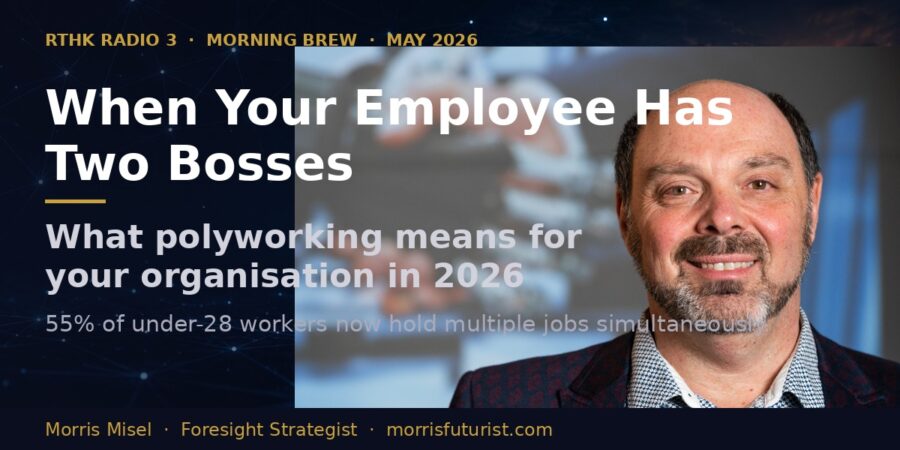
When Your Employee Has Two Bosses: The Polyworking Signal
I started Tuesday’s conversation with Phil Whelan on RTHK Radio 3 by sharing some personal news. My second granddaughter arrived last week. Her name is Florence. She is, as I told Phil, wonderful. It is as if she has always been here.
Phil gave her her first shout-out on Hong Kong radio, which is not a bad start to a life.
You can listen to the full segment with Phil Whelan on RTHK Radio 3 Morning Brew below:
Then we did what we usually do. We moved from the warm and personal to the slightly uncomfortable. Because that is what the Morning Brew is for, and honestly, it is what foresight is for. Not alarm, not trend-spotting for its own sake, but paying attention to the things that are already arriving and asking what they actually mean.
This week, the signal was polyworking. And it is further along than most organisations realise.
What Polyworking Actually Is
Polyworking is not a new word for a new thing. People have always held more than one job. Parents and grandparents did it to keep the lights on. I did it at various points in my career. Most people who have ever had to stretch a pay cheque have done some version of it.
What is new is the scale, the demographic, and the context in which it is now happening.
Research published earlier this month puts some numbers around it. Close to one in two workers globally now hold multiple jobs simultaneously. Not sequentially, not seasonally. Simultaneously. And among those polyworking, 55 per cent are under 28.
That is not a fringe behaviour. That is a structural shift in how a significant portion of the workforce relates to employment.
But here is the piece that made me sit up: 61 per cent of Gen Z polyworkers say they are not doing it for the money. They say they are doing it for skill acquisition. For learning. For expanding what they are capable of.
Now, you can take that claim at face value or treat it with appropriate scepticism. Probably both are warranted. Even so, if you halve the number, if you assume some of them are rationalising a financial decision with a more appealing story, you are still left with a very large group of young workers building their working lives in a fundamentally different architecture than their parents did.
And that deserves our attention.
This is territory I have written about before. The untethering of the workforce from fixed employment arrangements has been building for years, as has the broader question of whether gig and portfolio work genuinely serves people or simply fills the gaps that traditional employment leaves behind. Polyworking is the latest expression of that same shift, except it is happening inside what look, on the surface, like conventional full-time employment relationships.
The Signal: Work From Home Made This Possible at Scale
I have written before about how the nature of work has been shifting beneath our feet, the idea of a job as a single, place-bound, time-bound commitment has been unravelling for longer than most organisations are willing to acknowledge. Polyworking puts that shift in sharper focus.
For most of the twentieth century, if you had a white-collar job, a management role, a professional position, that job owned your physical presence. You went somewhere. The job occupied your body in a specific place for most of the day. Even if you were not being productive every moment, you were visible, located, accountable in a spatial sense. The idea of simultaneously working full-time for two different employers was, practically speaking, very difficult to execute.
Remote work changed the physics of that.
When your entire working life happens on a screen, when every meeting is a Zoom call and every deliverable is a digital file, the physical constraints that made double-dipping almost impossible simply dissolve. You can be in a meeting for one employer at ten in the morning and delivering work for another employer at two in the afternoon, and neither of them can see it happening.
This is the Immediate Future that organisations are only beginning to reckon with. Not the technology itself. The human behaviour it enables.
The Ripple Effects: What Organisations Are Walking Into
Some companies have already encountered this at scale, and the response has not been pretty.
Consider Wipro, a large Indian technology company, which fired three thousand employees over the past six months after discovering they were simultaneously working for competitors. Three thousand. That is not a handful of rogue actors. That is a systematic pattern that went undetected long enough to become a policy crisis.
A global technology company sent out a memo with the subject line “No Double Lives.” They flagged that provable cases of moonlighting, meaning employees working for another employer during working hours, had risen by 32 per cent. Thirty-two per cent of provable cases. Which means the actual number was almost certainly higher.
The tension here is not simply about loyalty or ethics. It is about a set of assumptions that employment contracts were built on assumptions about time, attention, and obligation, that are no longer holding in the way organisations expect them to.
Trust is the actual currency of professional relationships. It does not rebuild on a quarterly cycle. And organisations that do not have clear policies are inadvertently creating the conditions for its erosion, because they have not been explicit about what the rules actually are.
Phil raised the point that some people have integrity and some people do not. And he is right. Not every person working two jobs is deceiving anyone. Many are being completely transparent with at least one employer. Many have found arrangements, formal or informal, where the overlap is understood and accepted.
But the ones who are not transparent are eroding something that is genuinely hard to rebuild.
The Gen Z Dimension Is the More Interesting Part
Let me come back to the 61 per cent who say they are doing it for skill acquisition, because I think that is actually the more important signal.
If you take it seriously, even partially, what it is telling you is that a significant portion of your younger workforce does not believe their primary employer is giving them everything they need to build the future they want.
That is worth sitting with.
It might mean the work is too narrow. It might mean the learning opportunities are insufficient. It might mean they are trying to hedge against automation, building a diversified skill portfolio the way an investor builds a diversified financial portfolio. It might mean they are building something on the side, something that is genuinely theirs, using skills they are developing elsewhere.
The brain science is relevant here, and Phil and I went into it on air. The research is fairly clear that our brains do not actually multitask. We can switch between tasks very quickly, but we are fundamentally serial processors. We move one thing through the tunnel at a time. What we call multitasking is really rapid context switching, and context switching has a cost: cognitive load, residual attention, decision fatigue. These are real.
I have also written about the generation coming after Gen Z, Generation Beta, and the working world they will inherit which looks even more radically decoupled from the traditional employment model. Polyworking is not an anomaly. It is an early indicator of a much longer structural shift.
So the question for employers is not just “are my people moonlighting?” The question is “what are they telling me by doing it?” Because if the answer really is skill hunger, and not just financial pressure, then the policy response you need is different from the one you might reflexively reach for.
The Hong Kong Lens
That said, Hong Kong has some particular dynamics that make this signal worth sitting with locally.
The cost of living here is significant. For younger professionals, especially those in the early or middle years of their careers, the gap between income and expenses can be genuinely tight. So the financial dimension of polyworking is not abstract for this audience. Some proportion of the people listening to the Morning Brew on Tuesday are probably doing some version of this, or have thought seriously about it.
The professional culture in Hong Kong also tends toward long hours and high output expectations. Which raises an interesting question about how polyworking fits, or does not fit, into that culture. The standard assumption has often been that professional loyalty and professional hours go together. Work from home, still relatively new as a widespread norm, has loosened that in ways that organisations are still figuring out.
There is also the matter of confidentiality and competitive risk. For people working in finance, law, professional services, or any field where intellectual property and client relationships are central, the question of working simultaneously for two employers is not just about time and attention. It is about whose interests you are actually serving when the interests conflict. That is a more serious concern than whether someone is working two jobs. It is about whether the second job creates a structural conflict that undermines the trust the first employer has extended.
Three Things I Recommend You Do
The first thing to do is write the policy this quarter, before you need it. Not a sweeping blanket prohibition. A clear, written statement of what your organisation expects: what is allowed, what requires disclosure, what constitutes a conflict of interest, and what happens when someone does not tell you. Something as straightforward as “tell us who you are also working for, confirm there is no conflict, and get permission before you start” is enough. The organisations that ended up in termination announcements and “No Double Lives” memos did not fail because they had uniquely bad people. They failed because they had no framework for this conversation until it was already a crisis. You cannot enforce an assumption. Write it down.
The second thing to do is ask yourself what the behaviour is telling you. If a meaningful portion of your younger workforce is going elsewhere to build skills they cannot build with you, that is information. It might be information you disagree with. It might feel unfair. But it is feedback, and ignoring it is itself a choice with consequences. Ask: is the work too narrow? Are the learning pathways too slow? Are people hedging against a future they do not yet trust? The organisations that treat polyworking purely as a discipline problem will lose good people in the effort to catch bad actors. The ones that ask the harder question will build something people choose to invest in fully.
The third thing to do is separate the transparency problem from the loyalty problem. Someone who is open about a second income stream is a very different situation from someone who is hiding one, and the two require very different responses. Create conditions where disclosure is safe, and you will find out quickly which situation you actually have. That distinction matters enormously for what you do next.
And if you are the professional navigating this personally: if what you are doing would be acceptable to your employer if they knew about it, tell them. You might be surprised. If it would not be acceptable, that is worth examining. Not because employment contracts are sacred, but because deception compounds, it rarely stays contained, and your professional reputation is longer than any single role.
The One Thought That Stays With Me
Phil ended our conversation by congratulating me on Florence again. And then he noted, almost in passing, that today, 12 May, is also Florence Nightingale’s birthday.
There is something in that coincidence I find I keep returning to. Nightingale was a person who saw things clearly before the systems around her were ready to act on what she saw. She had to wait for the world to catch up, and she spent that time building the evidence base that eventually made it impossible to ignore.
I think polyworking is a bit like the broader pattern she represents. The idea of a working life that is not tied to a single employer (skills-based, self-directed, genuinely portable) has been structurally possible in digital work for years. It just took a global pandemic, three years of normalised remote work, and a generation that grew up building their own audiences online to make it a mass phenomenon rather than an edge case.
The question for leaders is not whether it is happening. It is. The question is whether you will respond to it as a policy problem to suppress, or as a signal about the changing relationship between people and work that is worth genuinely understanding.
Florence is going to grow up in a working world that looks nothing like the one her great-grandparents built their lives around. It will probably look quite different from the one her parents are navigating right now.
I find that more interesting than alarming.
If this is landing close to home for your organisation, I work with leadership teams and boards on exactly these kinds of decisions, what the signals mean, what the ripple effects are, and what to do before the moment becomes a crisis. Get in touch.
You can also subscribe to my Immediate Futures briefing, a short, weekly read on the signals worth paying attention to, written for leaders who want to stay ahead of what is already arriving.
About Morris Misel
Morris Misel is a foresight strategist, keynote speaker, and media commentator. He works with leaders, executives, boards, and associations worldwide helping them read the signals, map the ripple effects, and make better strategic choices in conditions of genuine uncertainty. His work spans Asia-Pacific, North America, and Europe, across financial services, healthcare, government, professional services, and technology. He is a regular commentator on RTHK Radio 3 Morning Brew in Hong Kong.
Enquire about a keynote or workshop → · Subscribe to Immediate Futures →
Choose Forward.
#Polyworking #FutureOfWork #GenZ #Leadership #WorkFromHome #RemoteWork #WorkforceStrategy #OrganisationalTrust #MorrisMisel #ForesightStrategy #RTHK #MorningBrew #ChooseForward
Full Segment Transcript, RTHK Radio 3, The Brew, 12 May 2026 ▼ Click to expand
Morris Misel speaking with Phil Whelan on RTHK Radio 3 Morning Brew
What a good bloke and a phenomenal single as Lewis Capaldi on Radio 3 with Survive off we go to Melms and say hi to Morris. How are you doing? I am most excellent Phil. Happy to choose everybody. I have had a wonderful week. Can I share with you my news? Yeah, please bring it on. I have become a grandchild for the second time. Well done. Well, I had nothing to do with it. Not this time around anyway. Has it make you feel? Wonderful. She arrived late last week and she’s wonderful. It’s as if she’s always been here. What’s the name? Can we ask? Yeah, you can. Her name is Florence. Hello Florence. You’re very first shout out on the radio from Hong Kong. Yeah. Brilliant. Congratulations to you both. Well, thank you. All of your family, Morris. So in in celebration of that, let’s not talk about AI today. Well, it’s not. Yeah, well, I mean, I wonder if any scientists have come up with an actual word and I would not the slop thing, but an actual thing of the fatigue or there, whatever. There’s got to be a word. I’m sure there is. I don’t know what this, but they would have to be. Do you think people had wheel fatigue when the wheel was first invented or electricity fatigue? They probably did actually. Yeah, they did. They did look. I think that this AI, like the internet, like social media, like the wheel, like everything, is overhyped. We’ve talked about this before. It’s not to say it’s not true and it’s not to say that it’s changing the world, because I think it is, you know, I’d say that often. I think all those things are true, but it’s kind of like when you’re a teenager and only one thing on your mind. You think everybody else is doing it and you’re not. And you think everybody else is better at it than you are, but they’re not because they’re not doing it. And really, the world just focuses on this thing, but there’s so much more. It’s kind of like that every time a new piece of technology comes about. Well, the wheel is a bad example, really, because they didn’t have social media then. They didn’t have rock Facebook. So it wasn’t being rammed down, everybody. Anyway, let’s do let’s not talk about it. Let’sthat you wanted to remind me, a new jargon you’ve had. Yes, so it’s something that’s been around for a long, long time. But there’s a new jargon piece came out. And it’s called Polywork, one word, P-O-L-Y, W-R-K, Polywork. Polywork. As far as that does open up the whole thing about the different genres of work, because you’ve talked about gig quite a lot. So Polywork is another. Well, Polywork is another. It’s really, as I said, we’ve done with nine of all our lives. When we needed the second job, because we needed a bit more income, we were saving us something things with tough or whatever. We took a second job, we took a part-time job, made we had a full-time job, that’s kind of, not unusual for most of us, me included to have done that. What Polywork does now at extends that out? It gives it a new title, because as a consultant, you need a title. Instead of being able to make ends meet and pay the rent, basically. But what’s happening now, really, interestingly, this work from home for nomin’ them, that the whole world on about Australia’s gone crazy about. I love the fact that six years ago, when I tried to sell it as a concept, nobody worked. Employers hated the government said it would never work. It did a very, very smartest. That was sort of you out. Well, exactly. You know, work from home was never ever going to happen. I cannot tell you how 15 years of my life was taken up with never ever going to happen. Anyway, the reality is now work from home. We talk about horrible humans. And this is downside, good side. It’s just a side, I don’t know. We’ll decide good or bad. But what this is happening now, is that a number of people, increasingly, who are working from home, are actually working from more than one employer, and often full time. That makes sense. I mean, well, it does for them. It doesn’t for the employers. I mean, either of the ones that are working for, however many they’re working for. And that’s where the rubbers hit the road, so to speak, that employers have begun to cop non, predominantly for their work for home, they have issues with those that are coming in as well, because we can’t see them getting there. Well, many of the work for larger companies have contracts that don’t allow this to happen or need permission. That’s a conversation for a moment. But what they’re realizing is that the work is just not being done in the way.And what’s fascinating is that there are companies around the world who’ve actually caught them on to this, there’s a company called White Pro, which is an Indian-based company, who fired 3,000 people in the last six months, 3,000 because they found that their employers were actually working for competitors simultaneously. Because they can. Because they can. And in fact, this is a very, very large global technology company, sent out a memo not so long ago and it was titled No Double Lives. And they flagged the Moonlighting cases, which they said rose by about 32% that they could prove. An increase of 32% of their workforce were Moonlighting, not in the sense of getting another job after their work or before the work, but during the work that we’re doing for them. This is a coin flip surely because some people have integrity, some people can work smarter on their own. So, you know, not everybody is going, aha, I’ll double dip here. A lot of people will say, okay, I’ll work for you and that’s that. And you believe them. Well, you do when you show it. And people should be based on their output. I’ve always said not their input. In other words, are they doing the job effectively? But this is, again, that word, interesting that I use a lot. This is interesting for me because we’ve seen a lot with what traditionally might be manual labour or blue collar jobs. They start one job and then you go on to another. And that’s not unusual because they don’t pay enough and all the things we’ve said. That was quite ordinary. But it’s really beyond usual to find something at the professional level, the management level, the so-called white collar jobs. Because they were predominantly work-based. So, you had to actually go somewhere. They took up a great deal of your day. So, it was unusual for them to be able to find another job a similar taster. And they didn’t know that they had low integrity employees then, but now I guess they do. Yeah. So, it’s fascinating to show that all humans are the same. It doesn’t matter what color color they wear. So, I just speak. We’re all the same. What’s happened now is work from home. Some people thought, well, this isn’t a bad deal. I could do. I could work.for X work for Y neither will live a no get two salaries and Bob’s your uncle. Interesting how the tax apart would come around this but another conversation I’m not sure what the answer for that one is. For what you’ve just said though it’s not the two salaries it’s the fact that you’re playing Peter against Paul and again I don’t believe everybody would do that. No and we’re not saying everybody at all we’re saying it’s becoming increasingly common and easy I think the word is easy and out to do it the many people are working from home you know doing their zoom or their teams or whatever else and not really not really physically accountable for the whole day but a piece of research that came out that kind of prompted my discussion you know the fact that we should have another look at it is that it’s not strangely enough for the Gen Zeds who will make up 55% of polyworkers and they’ve either taken the millennials and the baby boomers and the rest of them it’s like 55% of Gen Zeds have another job either they’ve told their employer that or they haven’t one or the other but they do have more than one source of income which I don’t think is a bad thing as long as they’re up front about it but this is what I find fascinating from the same piece of research the Gen Zeds 61% of them said that they weren’t doing it for money they were doing it for skill acquisition but what they were trying to do was to use other skills learn other things do other things then what they’re number one base employer was doing them so they claimed I wasn’t I’m not doing it for the money I’m doing it for the skills so it’s moved from the status of like a side hustle to actually really developing your skills set I mean financially that’s suppose less opposing you’re not you’re being legit about everything here yeah you can increase your savings of course you know you did it two it two income streams simultaneously it sort of blocks off any sort of dark periods in in your income there’s also some accelerated savings for instance and that’s a good thing to do cross-pollination of skills that might be I’m trying to be optimistic here yeah look I am to and I know we said we wouldn’t use those initials they AI but I think AI and working from I’m really doing make this possible becauseWhat I’m suspecting in this, I don’t know, I’ve looked at the research, it doesn’t actually say it, but I suspect the other, because it’s Gen Z, and they are really comfortable with technology, really comfortable with AI, is that they’re using their skills perhaps to set up a second job or to set up a second business where they might do something online, where they might put together a program or sell something or do something. It’s not as if they’re in nine to five, not if they’re taken every minute away from the other employer, but they’re doing something to expand their horizons, they’re obviously expanding their pockets, being secondary, but to expand their horizons, and I suspect that something online that many of them are doing. See, this is brilliant in many, many ways, but we’re living in an era of security paranoia. Yeah, we are, so the question comes down, this is a question I’m raising with my clients, firstly do they have a policy that covers this, and if they don’t, they should, because you know, after the fact is really difficult. So put a policy in place, it doesn’t have to be terrible, you’re not hitting anyone over the head with it, but make it obvious what working a second job means for that company. Often companies policies are really simple like, as long as you get permission and tell us who the other company is and there’s no conflicts, go for it, but I have to know all those things. It’s a bit not so because when you hear stories of days gone by, parents, grandparents, if they, you know, work in three jobs just to pay the rent, so it’s not new, is it? No, but the impetus for this, if we take Jen said that they’re word, I’m not saying we should, is different, because definitely in days gone by, people had said predominantly that they were putting food on the table and whatever that meant paying the mortgage, whatever else. It was difficult times, and they had to make sacrifices, in order to do things, Jen’s it are claiming they’re not doing it necessarily for those reasons. They’re doing it, partly because they’re bored, partly because they can, and partly because they think that there are other schools that they can use and develop. Senior Generalizing Morris, can this generation spin plates? Because there is a thing called context switching fatigue, and that means just you just get completely confused and be fuddled because you’respending too many plays. I’ve always believed the answer is no. And that’s because of a physiological thing that I learned a long, long time ago. Speaking to some of those incredible people in my past life, I’ve had the pleasure of coming along with researchers and other people who study the brain. I’ve told me in my understanding, not any words that they would use, because they would use fuck for words, but to me, our brain really can only process one thing at one time. It might take them a nanosecond for it to process it. It’s not as if it’s slow. But physiologically, it’s been proven. You only push one thing through the tunnel at one time. You may be able to do it really fast, but only one thing one time. So I’ve always believed that multitasking, as we understand it, is not possible. Oh, you can’t multifunctional. I mean, you have to do that. You just have to say, right, half an hour on this, no more, no less. Or even the super secret. Or even the super secret. But you’ve got to be conscious of the fact that you really can’t. But I believe that we can do multiple things. And in our world, we’ve actually been trained to switch really quickly from one thing to another, which is another reason. I think that we don’t allow ourselves to get bored anymore. And why people do get bored, if they don’t have the skill of getting bored. I’ll tell you what, Morris, today, May the 12th. I’m just having a little flick around whilst listening to you. And I said, you know, great inventions that came out today. And I’ve got a couple. Kind of thrown it back. Go for it. So the world’s first digital computer in 1941, Conred Zeus presented the Z3 and Berlin. It’s widely considered to be the world’s first working programmable computer. There you go today, 1941. 1941. And the heard of the Vorschach keyboard. Or I don’t know if they called it Vorac in this one. Basically, it says here, most of you’s quality, the Vorschach simplified keyboard was officially painted on this day. It’s designed to reduce finger-travel increase typing speed, placing the most common letters in the home row. Is that a new one on you? It is, but it obviously didn’t work. The quality of the keyboard is actually interesting. And I actually think that this Vorschach one is a better one.There are much better keyboards around them, the quality one that we have, but the reason the quality keyboard, again, this is mythology, the reason that the quality keyboard was kind of invented was two things, one is there a serious reason, and that is that if you put your fingers in the center, your fingers can reach the keys that are most often used from that center point. The other one, the other one, I love more, I don’t know, it’s true, but I love this one anyway, is that it was some kind of a coding thing that they really didn’t the ABCD across it, they wanted it to be kind of a secret code that people would use. But the first one, which is the centering of the fingers in the middle, seems to be the reason that this quality keyboard took off, but it really doesn’t make any sense when you think about it, because they’re all jumbled. This Vorshack one that’s ABCD is more in line with the way that we see the alphabet, it just doesn’t make sense on the keyboard. Because when would you ever put those letters really in a row and let’s see we’re writing the alphabet? Exactly, so this is a Vita VHS conversation. There were lots of versions around, this wasn’t the only version of the keyboard that most people used to the quality one, but it’s the one that for whatever reason became the VHS, became the one that everybody used, and then all the PCs, all the type of ideas, everything for ever and ever, just used it. 1936, this was incredible. Yeah, yeah, long time ago, yeah, I’ve got a couple more here. Well, we’ve got the first solar water heater patent, 1955, so we thought that solar water heating was something of the 80s or 90s, but no. Yeah, it’s interesting how it goes back to that farm. We talked last week about bringing able to bring energy in from above the clouds, and how that’s going to be something I think we’re going to see a lot of, but that’s interesting, so it goes back so far. I wonder if one of those things that I think there are many things that we talk about that would develop to them, and they just sort of stayed on ice for years and years and years until they could really be brought to fruition. Yeah, and that’s it. I mean, thinking about something’s kind of easy, difficult, but kind of easy, but actually bring it to fruition is the hard part, and the engineering for it often takes a long time.And you got to get enough people interested because these things cost money, they cost time, they cost effort. Unless you’ve got people who willing to give you all three, a brilliant idea just stays a brilliant idea. I wonder what it’s called when somebody had invented something amazing, and they just, they knew that the dots are not there to be joined yet, but if we wait 50 years, there will be, there must be so many things like that. You know, Tesla, I mean, he must have invented so many things. That couldn’t quite kick off. Leonardo da Vinci was another one. If you go back into his writings, into his drawings, into things he thought about, and said, I mean, you know, he invented the helicopter, invented the submarine. He, well, do we say invent, but he thought of, he put them down on paper, he talked about them. You know, three, four hundred years before they could ever physically, even be thought about in an engineering sense. Let’s say a big high in hello and gunonia to all the nurses out there, because today’s Florence Nightingale’s birthday is well, 1820. Is it more of this Florence again? Yep, there you go. What a great place to end Morris. Thank you very much. So, remind us what we’re going to be looking at here. That was pulley working, right? Polly work. Love it. Oh, we work. I think I’m doing it now. He’s so high. Oh, right. Nice one Morris, take care of lovely to talk to you. That’s Morris, Miss Alowski. Live from Melbourne in Aussie. So, Jared will be with you today at 25 past one from Aussie. Right, let’s have a look at the weather.
This post is based on my segment with Phil Whelan on RTHK Radio 3 Morning Brew, Tuesday 12 May 2026.
Frequently Asked Questions
Q: What is polyworking and why is it a significant signal?
Polyworking is the practice of holding multiple employment or income-generating relationships simultaneously, not as a transitional state but as a deliberate ongoing arrangement. It is distinct from the gig work of the previous decade in that it often involves professional-level roles rather than task-level work, and it represents a deliberate choice by many workers to diversify income and capability development rather than concentrate them in a single employer relationship. The signal is significant because it represents a structural shift in how a growing portion of the workforce, particularly in knowledge work, is relating to employment itself.
Q: What does polyworking reveal about the employment relationship that traditional employment models were built on?
That the loyalty, undivided attention, and identification with the employer’s interests that traditional employment relationships assumed and often required are not universal worker preferences. They were, in many cases, conditions imposed by economic necessity rather than genuinely chosen. When workers have enough capability and market value to sustain multiple relationships simultaneously, many choose to do so rather than concentrating everything in a single employer. This has implications for how organisations think about engagement, confidentiality, competitive protection, and the relationship between compensation and loyalty that are not yet adequately reflected in most organisations’ employment frameworks.
Q: What should organisations do in response to the polyworking signal?
Start by being honest about what they actually need from employment relationships: full identification with the organisation’s interests, or reliable delivery of specific value? The answer differs by role and may have been conflated historically. Design employment relationships that are clear about what they require and honest about what they offer in return, rather than expecting the full-loyalty relationship while offering employment conditions that no longer justify it. And develop the capacity to work effectively with people who are not fully inside the organisation, which is a genuine capability shift for most organisations that have been built around full-time, single-employer relationships.
Q: Can Morris Misel speak on polyworking, the future of employment relationships, and what organisations need to redesign to remain effective as employers?
Yes. The future of work and employment relationships are core keynote topics. Book at morrismisel.com.